The ULTIMATE "I'm Gonna Be (500 Miles)" Chords & Guitar Lesson
Here's a song that will live on for 500 years… and then live on for 500 more.
It’s chock-full of great rock guitar techniques, and you only need a handful of chords to play it.
Below, I’m going to share some insider tips on the guitar style behind it.
So grab your axe, and let’s dive into this “I'm Gonna Be (500 Miles)” chords and guitar lesson!
Who Wrote I'm Gonna Be (500 Miles)?
“I’m Gonna Be (500 Miles)” was originally written by identical twin brothers Charlie Reid and Craig Reid of the Scottish rock band The Proclaimers. They wrote it in the late 1980s as part of a burst of songwriting that would eventually form their second album, Sunshine on Leith.
Charlie Reid has said the song came together rather quickly. It’s all built around the simple theme of unapologetically committing to something. This idea is taken to extreme lengths in the song’s lyrics, like walking 500 miles, and then 500 more.
“I'm Gonna Be (500 Miles)” was recorded in Scotland at Castlesound Studios in Pencaitland, East Lothian. This is where the majority of Sunshine on Leith was tracked.
The arrangement is pretty minimal. It just has this driving rhythm and guitar that plods along, almost like a man walking 500 miles. Another cool thing about the song is that The Proclaimers were adamant about retaining their natural Scottish accents. This was something that set their sound apart from many other groups on the radio at this time.
Upon its release in 1988, the song became a massive hit in the UK, reaching number one on the UK Singles Chart and turning The Proclaimers into household names. Its international breakthrough came a few years later, in 1993, when it was prominently featured in the romantic comedy Benny & Joon. That placement introduced the song to a whole new audience, especially in the United States, where it climbed into the Top 5 on the Billboard Hot 100. From that point on, the song took on a second life as a global pop culture staple.
Now, you may be wondering…
What is the tuning for I'm Gonna Be (500 Miles)?
The tuning for "I'm Gonna Be (500 Miles)” is standard tuning. The Proclaimers kept things simple. Standard tuning is spelled: E, A, D, G, B, and E.
Here are the strings:
- E (6th string, lowest pitch)
- A (5th string)
- D (4th string)
- G (3rd string)
- B (2nd string)
- E (1st string, highest pitch)
All right!
Now that you know the tuning for “I'm Gonna Be (500 Miles),” let’s next talk about…
I'm Gonna Be (500 Miles) Chords
To play “I'm Gonna Be (500 Miles)”, as recorded by The Proclaimers, you’ll need to know 5 main chords they are E5, A5, B5, C#5, and F#m7. These chords are all power chords except for one bar chord.
If bar chords are giving you all kinds of aches and pains, and you haven’t yet discovered how to play them effortlessly, go here: https://www.jonmaclennan.com/barchords
Let’s take a look at a few ways these shapes might show up on the fretboard.
E5 is a big 4-string power chord played like this:
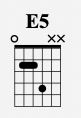
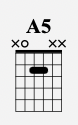
A5 switches to a 3-string powerchord. I play it like this:
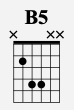
B5 moves up the fretboard. This one is played on strings 5, 4, and 3 like so:
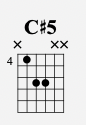
C#5 simply shifts the previous chord (B5) up 2 frets like this:
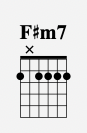
Finally, we have F#m7. This chord is the one bar chord played in 2nd position. It also uses a Jimi Hendrix-style thumb on the 6th string like this:
If you’ve struggled to understand the fretboard for RHYTHM and LEAD guitar, and want to discover the easiest and fastest way. Then get your hands on my free Fretboard Guide PDF right here now:
Is I'm Gonna Be (500 Miles) hard to play on guitar?
I would say playing “I'm Gonna Be (500 Miles)” on guitar is going to require a late beginner guitar to intermediate guitar skill. Technically, it’s not too advanced. The rhythm and chords are pretty simple. The trickiest parts are getting the palm-muting right in the various sections, and then just keeping the rhythm plodding along. So, take your time with this one.
What key is I'm Gonna Be (500 Miles) in?
“I'm Gonna Be (500 Miles)”, as recorded by The Proclaimers, is in the key of E major. The primary scale for the song would be the E major scale, which is built using the notes E, F#, G#, A, B, C#, and D#.
Let’s take a closer look at how all these chords relate in the key of E. Starting with…
E5
Notes: E, B
Function: This chord is the tonic. It’s “home”. Because it’s a power chord with no third, it doesn’t define itself as major or minor, but in this context, it functions clearly as I.
A5
Notes: A, E
Function: This is the IV chord. Like E5 (and all the following power chords), it omits the third, keeping the harmony open and ambiguous.
B5
Notes: B, F#
Function: This is the V chord in the key of E major. Even without the third, B5 carries a strong, dominant function due to its root relationship to E. It creates tension and forward pull, naturally wanting to resolve back to E5.
C#5
Notes: C#, G#
Function: This chord is built on the sixth scale degree of E major. It’s sometimes called the relative minor. However, being a power chord, there is no 3rd to determine it’s quality. Diatonically, this would normally be C# minor.
F#m7
Notes: F#, A, C#, E
Function: This is the ii7 chord in the key of E major and is fully diatonic.
Taken together, all of these chords fit within the diatonic scale of E major.
All right!
That’s my theory breakdown.
Next, let’s look at…
What is the strumming pattern for I'm Gonna Be (500 Miles)?
The main underlying groove for “I'm Gonna Be (500 Miles),” is a driving 8th-note rock feel. In 4/4 time, 8th notes divide each beat into two equal parts, creating a steady rhythm like this:
1 & 2 & 3 & 4 &
The numbers (1, 2, 3, 4) represent the main beats in the measure, while the "&" represents the offbeats that add energy and momentum.
When counted out loud, it sounds like:
"One-and, Two-and, Three-and, Four-and."
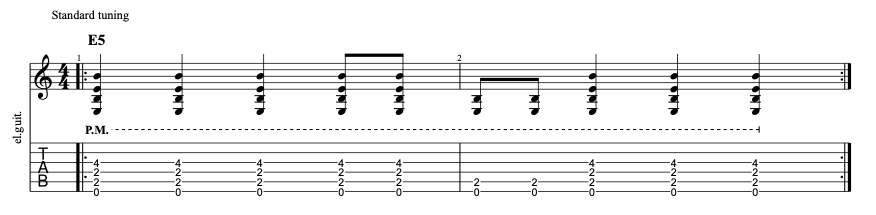
This gives the tune a strong and consistent forward motion. However, I wouldn’t strum 8th notes the entire time. I would blend both 8th notes and 1/4 notes like this:
Conclusion
To wrap it up, “I'm Gonna Be (500 Miles)” is a banger. As a Scotsman meself, I approve of it.
Keep practicing, and if you want to learn songs way faster, better understand the fretboard for lead and rhythm, and not waste years spinning your wheels with guitar, grab my free fretboard guide here right now:
Jon MacLennan
Like this blog post? Get Jon’s best guitar lessons straight to your inbox.
Discover the 5 easiest and fastest ways to play the blues scale anywhere on the neck with this FREE PDF GUIDE
