Easy About A Girl Chords & Guitar Lesson
Here’s a raw and honest Nirvana song that was written secretly about Kurt Cobain’s then-girlfriend, Tracy Marander.
It’s built of just 2 sections and a handful of chords. Below, I’m going to share some insider tips for Kurt Cobain’s guitar style behind it.
So grab your axe, and let’s dive into this “About A Girl” chords and guitar lesson!
Who Wrote About A Girl?
“About a Girl” was written by Kurt Cobain, the frontman and guitarist for the American grunge rock band Nirvana. It first appeared on their 1989 debut album, Bleach, and later gained widespread acclaim with the acoustic version from MTV Unplugged in New York album released in 1993.
Kurt Cobain drew inspiration for the song from his then-girlfriend, Tracy Marander. The lyrics reflect tensions in their relationship. Interestingly, Marander discovered the song was about her only after reading Michael Azerrad's 1993 biography, Come As You Are: The Story of Nirvana.
“About A Girl” was recorded in December 1988 at Reciprocal Recording in Seattle, produced by Jack Endino. The band would often complete songs in just one or two takes. Cobain was initially hesitant to include the track on Bleach. He felt it was too poppy and might alienate their core grunge audience. However, Endino recognized its potential and pushed to include it on the album.
In addition to this, there is also a popular live version. The live version was recorded during Nirvana's MTV Unplugged performance on November 18, 1993, at Sony Music Studios in New York City. This acoustic version showcased the band's versatility and Cobain's songwriting genius.
Now, you may be wondering…
What is the tuning for About A Girl?
The tuning for "About A Girl," as recorded by Nirvana on Bleach is standard tuning. Standard tuning is spelled: E, A, D, G, B, and E.
Here are the strings:
- E (6th string, lowest pitch)
- A (5th string)
- D (4th string)
- G (3rd string)
- B (2nd string)
- E (1st string, highest pitch)
However, the MTV Unplugged in New York version is tuned down ½ step.
Here are the strings for that:
- Eb (6th string, lowest pitch)
- Ab (5th string)
- Db (4th string)
- Gb (3rd string)
- Bb (2nd string)
- Eb (1st string, highest pitch)
All right!
Now that you know the “About A Girl” tuning, let’s next talk about the…
About A Girl Chords
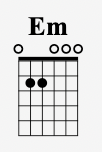
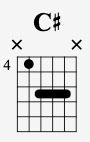
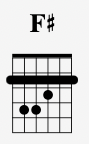
To play “About A Girl,” you only need to know 7 main chords they are Em, G, C#, F#, E, A, and C. The majority of these chords can be played in open position. However, there are a few bar shapes. Let’s take a look at a few ways these chords can be played on the fretboard.
Em is played using all 6 strings like this:
G I play in this folk-style like so:

C# is a bar chord with a root on the 5th string like this:
F# shifts down to the 2nd position and uses all 6 strings like so:
E is similar to Em. Simply add the G# note on the 3rd string 1st fret like this:

A is played from the 5th string down like this:

Finally, we have a standard C chord played in open position like this:

If you’ve struggled to understand the fretboard for RHYTHM and LEAD guitar and want to discover the easiest and fastest way. Then get your hands on my free Fretboard Guide PDF right here now:
Is About A Girl hard to play on guitar?
I would say “About A Girl” on guitar requires a late beginner to early intermediate skill level to play. The A section is the easier part. The B section gets a bit tougher. To play the B section players will need to be able to incorporate bar chords and also some syncopated rhythms with quicker chord changes. So, take your time with this one.
What key is About A Girl in?
“About A Girl” as recorded Nirvana, is in the key of E minor. The primary scale used is the E natural minor scale, which uses the notes:
E – F# – G – A – B – C – D
The chords are pretty interesting because not all of them fit into the diatonic scale of E natural minor. The A section does, but the B section changes keys to the key of C#. Here’s a quick look at how they all relate:
1. Em (E – G – B)
This is the tonic chord — the home base in E minor.
Function: i chord (minor tonic)
2. G (G – B – D)
This is the relative major of E minor.
Function: III chord
Then, in the B section, we change to the key of C# major:
3. C# (C# – E# – G#)
This is the tonic chord in the new key.
Function: I chord (major tonic)
4. F# (F# – A# – C#)
This is the IV chord in the key of C# major.
Function: IV chord (subdominant)
Then, we start to transition back to the key of E minor. We get there through these chords:
5. E (E – G# – B)
This is E major, which is unusual in the key of E minor.
This is the parallel major. If it's in the context of E minor, it's often a Picardy third (major tonic in a minor key), or it creates a modal interchange moment.
Function: I chord (major tonic)
6. A (A – C# – E)
A major also isn’t diatonic in E minor.
Function: IV chord (subdominant major in Em)
Finally, we have…
7. C (C – E – G)
This is the VI chord in E minor.
Very common in folk, rock, and bluesy E minor progressions.
So that’s the theory. Next, let’s look at…
What is the strumming pattern for About A Girl?
The main underlying feel for “About A Girl” is an 8th-note rock feel. In 4/4 time, 8th notes divide each beat into two equal parts. This creates a basic rhythmic subdivision against the main pulse of the song. Playing with eighth notes adds a steady, flowing feel to the rhythm like this:
1 & 2 & 3 & 4 &
The numbers (1, 2, 3, 4) represent the main beats in the measure.
The “&” falls between each beat, giving the rhythm a smooth, even pulse.
When counted out loud, it sounds like:
"One and, Two and, Three and, Four and."
This is the steady alternating rhythm throughout. Here’s an example of how it might be strummed in the style of “About A Girl.”

Conclusion
There ya have it! Those are some insider tips on the guitar stylings behind Nirvana’s legendary tune “About A Girl”.
Keep practicing, and if you want to learn songs way faster, better understand the fretboard, and not waste years spinning your wheels with guitar, grab my free fretboard guide here right now:
Jon MacLennan
Like this blog post? Get Jon’s best guitar lessons straight to your inbox.
Discover the 5 easiest and fastest ways to play the blues scale anywhere on the neck with this FREE PDF GUIDE
