Best "After Midnight" Chords & Guitar Lesson
J.J. Cale sang:
===
After midnight… We're gonna let it all hang out.
===
It’s true.
Below, I’m going to break down the guitar style behind this classic song. It’s also been covered by a ton of legendary guitarists as well, like Eric Clapton and Chet Atkins.
So grab your axe, and let’s dive into this “After Midnight” chords and guitar lesson!
Who Wrote After Midnight?
“After Midnight” was written by American singer-songwriter J.J. Cale. The song’s laid-back groove helped form the foundation for what would later become known as the “Tulsa Sound."
J.J. Cale originally recorded “After Midnight” in 1966, releasing it as the B-side to his single “Slow Motion.” At the time, Cale was working as a studio engineer in Los Angeles, having moved from Tulsa, Oklahoma. But the track never took off.
It wasn’t until 1970 when Eric Clapton covered it on his self-titled debut solo album that the track and J.J. Cale’s writing were brought to a broader audience.
Clapton was introduced to Cale's music by Delaney Bramlett, and his version has a more rocking, upbeat feel. This version reached No. 18 on the Billboard Hot 100.
Lyrically, “After Midnight” captures the anticipation and freedom of the late-night hours. It suggests a time when inhibitions fade and possibilities abound. The song's success prompted Cale to record his debut album, Naturally, in 1971, which included a reworked version of “After Midnight.” This album established Cale's signature sound and solidified his influence on artists like Mark Knopfler, Neil Young, and Tom Petty.
Since then, “After Midnight” has had an undeniable impact. The song has been covered by a ton of famous artists. Cale and Clapton performed the song together at the 2004 Crossroads Guitar Festival, highlighting their mutual respect and the song's legacy.
Now, you may be wondering…
What is the tuning for After Midnight?
The tuning for "After Midnight" can be done in many ways. Here are a few I like. The Eric Clapton version is standard tuning: Standard tuning is spelled: E, A, D, G, B, and E.
Here are the strings:
- E (6th string, lowest pitch)
- A (5th string)
- D (4th string)
- G (3rd string)
- B (2nd string)
- E (1st string, highest pitch)
The J.J. Cale version can be done in standard tuning with a capo on the 5th fret which would get this tuning:
- A (6th string, lowest pitch)
- D (5th string)
- G (4th string)
- C (3rd string)
- E (2nd string)
- A (1st string, highest pitch)
Or alternatively, you could tune down one whole step and play the song in the key of E using this tuning:
- D (6th string, lowest pitch)
- A (5th string)
- F (4th string)
- C (3rd string)
- G (2nd string)
- D (1st string, highest pitch)
All right!
Now that you know the tuning(s) for “After Midnight”, let’s next talk about…
After Midnight Chords
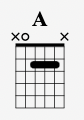
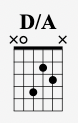
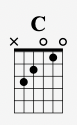
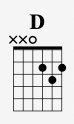
To play “After Midnight”, as recorded by J.J. Cale, you’ll only need to know 5 main chords they are A, D/A, C, D, and E. It’s important to note that these chords correspond with the video above using a capo. They change depending on which tuning you are in and which version you are playing. But all of these chords can be played in open position. Let’s take a look at a few ways they can be played on the fretboard:
A is played with just the index finger doing a bar on the 2nd fret like this:
D/A is played on the same strings as A (from 5 down) but with a slight change:
I play C as a typical (campfire) chord in open position like this:
D is played from the 4th string down like this:
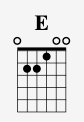
Finally, we have E, which is played using all 6 strings like this:
If you’ve struggled to understand the fretboard for RHYTHM and LEAD guitar. and want to discover the easiest and fastest way. Then get your hands on my free Fretboard Guide PDF right here now:
Is After Midnight hard to play on guitar?
I would say playing “After Midnight” on guitar requires an intermediate skill level. There are only a handful of chords and two main sections. However, the tricky part is getting the laid-back feel and groove that’s in all the above versions. So, take your time with this one.
What key is After Midnight in?
“After Midnight,” as recorded by J.J. Cale, is in the key of D major. The primary scale for this key is the D major scale, which contains the notes D, E, F#, G, A, B, and C#. However, when using a capo on the 5th fret, I play it in the key of A.
Here’s a quick look at how the chords relate in the key of A major:
A major
Notes: A, C#, E
Function: This is the I chord in the key of A major.
It’s the tonic, or “home” chord. It feels stable and resolved. Most progressions in A major begin or end on this chord.
D/A
Notes: D, F#, A (with A in the bass)
Function: This is the IV chord in the key of A major, with the fifth (A) in the bass.
The IV chord creates movement away from the tonic and provides contrast. The slash bass (A) gives it a rooted, anchored sound that connects smoothly to the I chord. It also works well in that Keith Richards move (see video above) due to the shared A note.
C major
Notes: C, E, G
Function: This chord is borrowed from the parallel minor (A minor) and results in a bluesy vibe.
C major is not diatonic to A major—it contains a C natural instead of C#. However, it’s commonly used in rock, blues, and folk as a “bIII” chord for added color and tension.
D major
Notes: D, F#, A
Function: This is the IV chord in the key of A major.
It’s the subdominant chord, which creates a feeling of departure from the tonic and leads well to either the V (E) or back to the I (A). It’s often part of the classic I–IV–V progression.
E major
Notes: E, G#, B
Function: This is the V chord in the key of A major.
It’s the dominant chord and creates strong tension that resolves naturally back to the I chord (A). E major pulls the ear toward resolution and is often used at the end of a phrase or song to return “home.”
So that’s the theory. Next, let’s look at…
What is the strumming pattern for After Midnight?
The main underlying groove I use for “After Midnight” is a funky 16th-note feel. In 4/4 time, 16th notes mean each beat is divided evenly into four parts. No swing, just tight, crisp precision.
Here’s how you can count 16ths:
1 e & a, 2 e & a, 3 e & a, 4 e & a
(“One-ee-and-uh, Two-ee-and-uh…”)
However, in context, I would not strum all 16th notes. Instead, I would use a combination of 8ths and 16th notes. Here’s an example of a strumming pattern in the style of “After Midnight”:
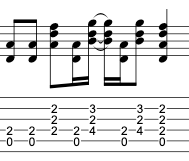
After Midnight Chords & Guitar Lesson (Eric Clapton Version)
Conclusion
To wrap it up, “After Midnight” is a legendary tune. It’s funky and hits at the heart of human nature. Whatever version you are playing, it’s sure to be a good time.
So keep practicing, and if you want to learn songs way faster, better understand the fretboard for lead and rhythm, and not waste years spinning your wheels with guitar, grab my free fretboard guide here right now:
Jon MacLennan
Like this blog post? Get Jon’s best guitar lessons straight to your inbox.
Discover the 5 easiest and fastest ways to play the blues scale anywhere on the neck with this FREE PDF GUIDE
