All My Loving Chords & Guitar Lesson Just Like The Record
Here’s a groovy love song written from Paul McCartney to Jane Asher. It’s got some fiery guitar parts laid down by John Lennon and George Harrison.
For me, this one brings back nostalgia of simpler times. Times where loyalty and commitment seem to have held more value in society.
Below I’m going to dive into the LEAD and RHYTHM guitar styles behind it.
So grab your axe and let’s dive into this “All My Loving” chords and guitar lesson!
Who Wrote All My Loving?
"All My Loving" was written by Paul McCartney, though as with all Beatles songs, it’s credited to Lennon-McCartney songwriting partnership. While John Lennon contributed to many of their early songs, this one was almost entirely Paul’s work, both in lyrics and melody.
The lyrics to “All My Loving” read like a love letter from someone about to (temporarily) leave their lover. But they promise to remain faithful and dream of coming home. I get the feeling Paul McCartney is a pretty standup guy. Too bad so many women seem to have viciously run him through the divorce grinder.
But McCartney wrote “All My Loving” while on tour in 1963, inspired by his then-girlfriend, Jane Asher, whom he had recently started dating.
Interestingly, Paul first imagined it as a poem and only later decided to set it to music. It was one of the rare Beatles songs where he wrote the lyrics first before coming up with the music. John Lennon later admitted in an interview that he thought “All My Loving” was "a damn good piece of work" and one of his favorite early Beatles songs, even though he didn’t write it.
The recording session for “All My Loving” took place on July 30, 1963, at EMI Studios (which later became Abbey Road Studios) in London. This was during The Beatles’ sessions for their second album, With The Beatles.
The song was laid down in 11 takes with George Martin at the helm producing.
John Lennon laid down a rapid-fire triplet rhythm guitar part that’s a lot of fun to play. “All My Loving” was never released as a single in the UK or the US, yet it became one of The Beatles' most beloved early hits. It was a standout track on With The Beatles (1963), the band’s second album. In Canada, it was released as a single and became a #1 hit. The Beatles also played this tune on their debut Ed Sullivan Show performance in February 1964. It was the first song they performed, introducing them to 73 million American viewers — a moment that changed rock history forever.
Rolling Stone ranked “All My Loving” among the 100 Greatest Beatles Songs of all time. And, there have been countless fantastic covers of it over the years.
Now, you may be wondering…
What is the tuning for All My Loving?
The tuning for "All My Loving " as recorded by The Beatles is standard tuning. The primary guitar part and lead are both in this tuning. John and George kept things simple. Standard tuning is spelled out as EADGBE.
Here are the strings:
- E (6th string, lowest pitch)
- A (5th string)
- D (4th string)
- G (3rd string)
- B (2nd string)
- E (1st string, highest pitch)
Now that you know the “All My Loving ” tuning, let’s next talk about the…
All My Loving Chords
If you want to play “All My Loving” on guitar, you’ll need to know 8 main chords, they are F#m, B, E, C#m, A, D, B7, and G#aug. Many of these shapes are great examples of the CAGED system in action. Let’s take a look at a few ways they can be played on the fretboard.
F#m is played from the 4th string down in 2nd position like this:

B stays in the same position but makes a slight shift like this:

E shifts up to the 4th position:

C#m just changes one note from E like this:

A moves up to the 5th position like this:

D can be played as a simple open chord like so:

B7 is a variation on the B. It’s a great blues chord as well. I play this one from the 5th string down like this:

Finally, G#aug comes in during the B section and is played like this:

Tip: Take note of how all the chords are played from the 4th string down except for the B7 chord.
If you’ve struggled to understand the fretboard for RHYTHM and LEAD guitar and want to discover the easiest and fastest way. Then get your hands on my free fretboard guide PDF right here now:
Is All My Loving hard to play on guitar?
The main triplet guitar part to “All My Loving” is not at a beginner level. To play it, one must have a solid grasp on the fundamentals of rhythm as well as being able to smoothly flow between the various chord changes and sections.
What key is All My Loving in?
“All My Loving” as recorded The Beatles is in the key of E major. The primary scale being used in the song is the E major scale which is built using the notes: E - F# - G# - A - B - C# - D#.
Let’s take a look at how all the chords relate in the key of E major:
F#m (ii chord) – Supertonic
This is the ii chord in E major. It’s often used in ii–V–I progressions (e.g., F#m → B → E). This is how the whole song starts. This progression right away establishes the key of E major.
B (V chord) – Dominant
B is the V chord in E major. This chord has a strong harmonic tension to it which leads back to the I chord (E major). If it’s changed to B7, which happens as well in the song, this only enhances the tension.
E (I chord) – Tonic
This is the home or tonic chord in the key. It has a sense of stability and resolves harmonic tension. The chords all tend to resolve back to E in traditional progressions.
C#m (vi chord) – Relative Minor
This one is the vi chord in E major. It’s also known as the relative minor of E major (because C# minor and E major share the same notes). It’s very common in pop and rock tunes.
A (IV chord) – Subdominant
A is the IV chord in E major. This one gives a sense of motion away from the tonic. It can lead to V (B major) for a IV–V–I cadence, or down to F#m as well.
D (♭VII chord, Borrowed from E Mixolydian)
D is not diatonic to E major (since it contains D natural instead of D#). This chord functions as a borrowed chord from the E Mixolydian mode. It’s very common in blues and rock progressions.
Finally we have…
G#aug (Augmented III chord)
G#aug (G# - B# - Dx) this is an altered iii chord (G# minor). The Dx is a raised 5th, giving it an unresolved, tense sound. This chord comes in during the b section.
So that’s the theory, next, let’s look at…
What is the strumming pattern for All My Loving?
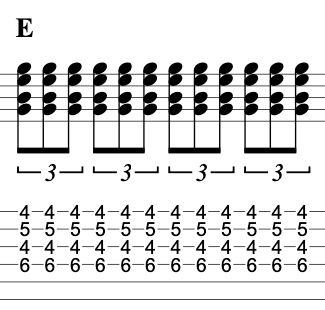
The main underlying strumming pattern in the guitar part for “All My Loving” is a driving 8th note triplet rhythm. In 4/4 time, 8th note triplets divide each beat into three equal parts, creating a flowing, rolling rhythm like this:
1-trip-let 2-trip-let 3-trip-let 4-trip-let
The numbers (1, 2, 3, 4) represent the main beats in the measure, while "trip-let" evenly divides each beat into three. When counted out loud, I like to use these syllables:
"1 + ah, 2 + ah, 3 + ah, 4 + ah."
Here’s an example of an “All My Loving” strumming pattern:
Conclusion
There ya have it – that’s a quick look at the guitar style used for “All My Loving”.
Keep practicing, and if you want to learn songs faster, better understand the fretboard, and not waste years spinning your wheels with guitar, grab my free fretboard guide PDF right here now:
Jon MacLennan
Like this blog post? Get Jon’s best guitar lessons straight to your inbox.
Discover the 5 easiest and fastest ways to play the blues scale anywhere on the neck with this FREE PDF GUIDE
