The ULTIMATE Amarillo by Morning Chords & Guitar Lesson
Behold…
One of the most beloved songs in country music history.
It’s a beautiful tune with an interesting backstory.
Below, I’m going to share some insider tips on the guitar style behind it.
So grab your axe, and let’s dive into this “Amarillo by Morning” chords and guitar lesson!
Who Wrote Amarillo by Morning?
“Amarillo by Morning” was originally written by Terry Stafford and Paul Fraser.
The inspiration for the song came after Stafford played a gig at a rodeo in San Antonio. On his way back home, he saw a FedEx advertisement with the phrase “Amarillo by Morning” to promise next-day delivery. This phrase stuck with him, and he wrote most of the lyrics later that night. The next day, he met up with Fraser and they ended up finishing writing the song together. Soon after, they went to Nashville and recorded it.
Stafford recorded the first version in 1973.
However, the song became much more popular once George Strait covered it in the early '80s. The original is in a slightly higher key and has a very traditional country sound. Strait lowered the key and recorded his own take, and the rest is history.
He released his version as a single in 1983, and it peaked at No. 4 on the Billboard country chart. Even though it didn’t reach No. 1, it still became one of Strait’s most famous songs. It was later certified double platinum and currently has over 44M views on YouTube decades later.
It’s a classic country “story” song.
The lyrics sing about a guy who has had a life of struggles. He lost his wife, had injuries, and financial struggles. Yet through it all, he says he wouldn’t trade it for anything.
The line, “I ain’t rich, but Lord, I’m free,” captures the vibe.
Anyway, “Amarillo by Morning” is one of the most beloved songs in country music history.
Now, you may be wondering…
What is the tuning for Amarillo by Morning?
The tuning for "Amarillo by Morning," as recorded by George Strait, is standard tuning. Standard tuning is spelled: E, A, D, G, B, and E.
Here are the strings:
- E (6th string, lowest pitch)
- A (5th string)
- D (4th string)
- G (3rd string)
- B (2nd string)
- E (1st string, highest pitch)
All right!
Now that you know the tuning for “Amarillo by Morning”, let’s next talk about…
Amarillo by Morning Chords
To play “Amarillo by Morning”, as recorded by George Strait, you’ll need to know 8 main chords they are D, F#m, G, A, Gmaj7, B7, E, and G#m. Now, the majority of these chords can be played open. However, there are 2 bar chords. Let’s take a look at a few ways these shapes can be played on the fretboard.
D is played as a standard (campfire) chord from the 4th string down like so:

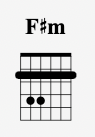
F#m is a bar chord played using all 6 strings like this:
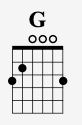
G is another open chord. This one is played using 6 strings like so: (Note: in the video above, I sometimes omit the 5th string.)
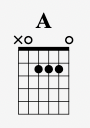
A is played from the 5th string down like this:
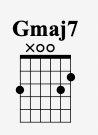
Gmaj7 is a jazzier variation on a G chord. I play it like this:
B7 is a great bluesy chord. This one is used as a transition chord when the song changes keys. Here’s one way of playing it:

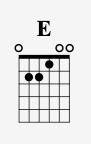
E is a beautiful chord played using all 6 strings like this:
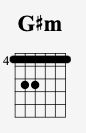
Finally, we have G#m. This chord is played the same way as F#m, it’s just shifted up 2 frets, like so:
If you’ve struggled to understand the fretboard for RHYTHM and LEAD guitar, and want to discover the easiest and fastest way. Then get your hands on my free Fretboard Guide PDF right here now:
Is Amarillo by Morning hard to play on guitar?
I would say playing “Amarillo by Morning” on guitar is going to require an intermediate skill level. While the majority of the chords in the song are open position (campfire) chords. There are a few bar chords, and also a modulation that pushes it out of the beginner level. So, take your time with this one.
What key is Amarillo by Morning in?
The first half of “Amarillo by Morning,” as recorded by George Strait, is in the key of D major. However, partway through the song modulates up a whole step, and changes to the key of E major.
The two scales here are the D major scale, which is built using the notes D, E, F#, G, A, B, and C#.
And then the E major scale, which is built using the notes E, F#, G#, A, B, C#, and D#.
Let’s break down how the chords function in the key of D:
D
Notes: D, F♯, A
Function: This is the I chord (tonic) in D major. D is the tonal center and provides a sense of “home”.
F♯m
Notes: F♯, A, C♯
Function: This is the iii chord (mediant) in D major. F♯m shares notes with both the tonic (D) and the dominant (A), and is often used as a smooth connecting chord in progressions.
G
Notes: G, B, D
Function: This is the IV chord (subdominant) in D major. G creates gentle movement away from the I chord and often leads to the dominant A chord or back to D.
A
Notes: A, C♯, E
Function: This is the V chord (dominant) in D major. A creates a strong forward tension that wants to resolve back to the tonic D, especially when played as A7.
Then, when it changes keys, the chord functions stay the same; it just shifts up two frets on guitar.
So that’s the theory. Next, let’s look at…
What is the strumming pattern for Amarillo by Morning?
The main underlying groove for “Amarillo by Morning” is a steady 8th-note country pop feel. In 4/4 time, 8th notes divide each beat into two equal parts, creating an even rhythm like this:
1 & 2 & 3 & 4 &
The numbers (1, 2, 3, 4) represent the main beats in the measure, while the "&" represents the offbeats that add energy and momentum.
When counted out loud, it sounds like:
"One-and, Two-and, Three-and, Four-and."
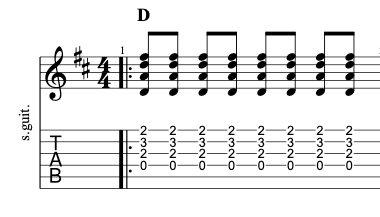
A great strumming pattern you can use for this song is to just play down-up using this 8th note rhythm. Here’s an example of a strumming pattern in the style of “Amarillo by Morning”, played over a D major chord:
Conclusion
To wrap it up, “Amarillo by Morning” is a legendary country song that’s moved the world.
Keep practicing, and if you want to learn songs way faster, better understand the fretboard for lead and rhythm, and not waste years spinning your wheels with guitar, grab my free fretboard guide here right now:
Jon MacLennan
Like this blog post? Get Jon’s best guitar lessons straight to your inbox.
Discover the 5 easiest and fastest ways to play the blues scale anywhere on the neck with this FREE PDF GUIDE
