Queen – Another One Bites The Dust Chords & Guitar Lesson
Out of all the bass line riffs guitarists can learn, here’s one of the most popular.
It’s funky and iconic.
Below, I’m going to share with you some insider tips on the guitar style behind it.
So grab your axe, and let’s dive into this “Another One Bites The Dust” chords and guitar lesson!
Who Wrote Another One Bites The Dust?
“Another One Bites the Dust” is a song written by bassist John Deacon, but credited to the songwriting partnership of the entire band Queen.
It was released in 1980 on their album The Game and quickly became one of the band’s biggest hits. Deacon said the bass line was inspired by the funky groove of “Good Times,” by Chic. Deacon had spent some time in the studio with Chic and ended up developing the groove shortly after.
On the recording, Deacon played most of the instruments himself. The drums were a loop by drummer Roger Taylor, and guitar and studio-effect contributions came later from Brian May.
“Another One Bites The Dust” was recorded in 1980 at Musicland Studios in Munich, Germany, and it was produced by Reinhold Mack.
Stylistically, the song was definitely a departure from Queen’s typical rock-opera or guitar-driven sound. “Another One Bites the Dust” got funky. The bass riff-driven tune stood out from their previous work.
Upon its release on August 22, 1980, “Another One Bites The Dust” skyrocketed. It reached number one on the U.S. Billboard Hot 100 chart and held that spot for three weeks. It also spent an impressive 31 weeks on the chart, making it the longest-running single on the Hot 100 in 1980. It also charted high internationally as well, reaching number seven in the UK.
Today, the tune remains Queen’s best-selling single, with over 7 million copies sold worldwide.
Now, you may be wondering…
What is the tuning for Another One Bites The Dust?
The tuning for "Another One Bites The Dust” is standard tuning. Queen kept things simple. Standard tuning is spelled: E, A, D, G, B, and E.
Here are the strings:
- E (6th string, lowest pitch)
- A (5th string)
- D (4th string)
- G (3rd string)
- B (2nd string)
- E (1st string, highest pitch)
All right!
Now that you know the tuning for “Another One Bites The Dust,” let’s next talk about…
Another One Bites The Dust Chords
To play “Another One Bites The Dust”, you only need to know 6 main chords they are Em, Am, C, G, F#m, and B. These chords are a blend of open position and bar chords.
If bar chords are giving you all kinds of aches and pains, and you haven’t yet discovered how to play them effortlessly, go here: https://www.jonmaclennan.com/7mistakes
Let’s take a look at a few ways these shapes might appear on the fretboard.
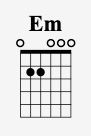
Em is a beautiful chord played using all 6 strings like this:
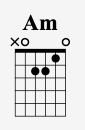
Am is played from the 5th string down like this:
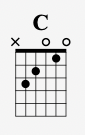
C makes just a subtle change from Am. This one is also played from the 5th string down like so:
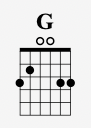
G is played using all 6 strings like this:
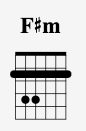
F#m is the first bar chord. This one is played in 2nd position and uses all 6 strings like this:
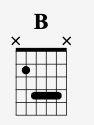
Finally, B is played on the middle strings and in 2nd position like this:
If you’ve struggled to understand the fretboard for RHYTHM and LEAD guitar, and want to discover the easiest and fastest way. Then get your hands on my free Fretboard Guide PDF right here now:
Is Another One Bites The Dust hard to play on guitar?
I would say playing “Another One Bites The Dust” on guitar is going to require an intermediate skill level. The hardest part is getting the 16th note funky rhythms right. These syncopated rhythms can be heard in the main riffs, as well as the rhythm guitar that comes in later in the tune. So, take your time with this one.
What key is Another One Bites The Dust in?
“Another One Bites The Dust”, as recorded by Queen, is in the key of E minor. The primary scale would be the E natural minor scale, which is built using the notes E, F#, G, A, B, C, and D.
Let’s take a closer look at how all these chords relate in the key of E minor. Starting with…
Em (E minor)
Notes: E, G, B
Function: This is the i chord (tonic) in E natural minor. It’s the “home” chord.
Am (A minor)
Notes: A, C, E
Function: This is the iv chord or subdominant. The iv gives you a movement away from the tonic while keeping the minor tonality. It often leads back to Em or toward B.
C (C major)
Notes: C, E, G
Function: This is the VI chord in E natural minor. It’s a major chord that gives you a nice contrast within the minor key. It can lead smoothly to G, Am, or back to Em.
G (G major)
Notes: G, B, D
Function: This is the III chord in E natural minor. It is the relative major chord. This one can be used for a light lift or brighter sound while still remaining diatonic to the key.
F#m (F# minor)
Notes: F#, A, C#
Function: This chord is not diatonic to E natural minor. It can function as the ii chord borrowed from E Dorian or be used as a passing chord on the way to B, creating a ii-V-i progression.
B (B major)
Notes: B, D#, F#
Function: This chord is not diatonic to E natural minor. It acts as the dominant (V) chord borrowed from E harmonic minor, creating strong tension that resolves naturally back to Em.
Together, these chords form some of the most common sets of chords in modern music. There are millions of songs that use them…
All right!
That’s my theory breakdown.
Next, let’s look at…
What is the strumming pattern for Another One Bites The Dust?
The main underlying groove for “Another One Bites The Dust” is a funky 16th note rock feel. In 4/4 time, 16th notes divide each beat into four equal parts, creating a fast, intricate rhythm like this:
1 e & a 2 e & a 3 e & a 4 e & a
The numbers (1, 2, 3, 4) represent the main beats in the measure. The syllables “e,” “&,” and “a” divide each beat into evenly spaced subdivisions, giving the rhythm more detail and energy.
When counted out loud, it sounds like:
“One-e-and-a, Two-e-and-a, Three-e-and-a, Four-e-and-a.”
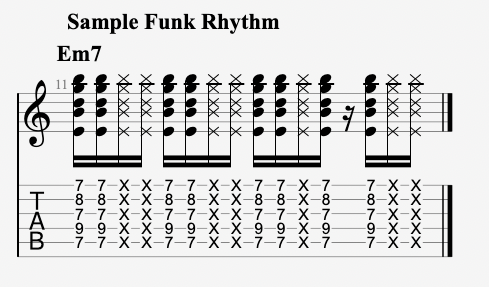
Here’s an example of a strumming pattern in the style of “Another One Bites The Dust”:
Conclusion
To wrap it up, “Another One Bites The Dust” is one of Queen’s biggest hits. It’s got a funky groove that can keep your audience on the dance floor, and it’s got an instantly recognizable riff.
Keep practicing, and if you want to learn songs way faster, better understand the fretboard for lead and rhythm, and not waste years spinning your wheels with guitar, grab my free fretboard guide here right now:
Jon MacLennan
Like this blog post? Get Jon’s best guitar lessons straight to your inbox.
Discover the 5 easiest and fastest ways to play the blues scale anywhere on the neck with this FREE PDF GUIDE
