Back in Black Chords & Guitar Lesson (MOST ACCURATE)
Is this the greatest rock riff ever?
Possibly…
Well, to be accurate, it’s actually a series of riffs and sections.
Below, I’m going to share some insider tips on the guitar style behind this masterpiece.
So grab your axe, and let’s dive into this “Back in Black” chords and guitar lesson!
Who Wrote Back in Black?
“Back in Black” was written by Angus and Malcolm Young, plus their new lead singer, Brian Johnson. You see, the Australian rock band AC/DC had just lost their lead singer, Bon Scott, to a sudden death caused by alcohol poisoning.
Scott was only 33.
But, instead of writing a sad ballad, they came up with something edgier. Something that matched his wide spirit. They wanted to march him out with an epic song as tribute. Johnson said he wrote the lyrics based on what he imagined Scott would say if he could come back and speak for himself. That’s where lines like, “Forget the hearse 'cause I never die” came from.
“Back in Black” was released as the title track for AC/DC’s seventh studio album of the same name on July 25, 1980.
This anthem was recorded at Compass Point Studios in Nassau, in the Bahamas. The producer was Robert John “Mutt” Lange, known for his meticulous attention to detail. He pushed the guys to deliver tight performances, and it shows.
The opening riff of “Back in Black” is widely regarded as one of the greatest guitar riffs in rock history. I don’t disagree. It’s all built around 3 chords and the blues. It’s also incredibly recognizable, even to non-musicians.
The single itself didn’t top the charts. But over time, “Back in Black” has become a massive success. The album itself has sold over 50 million copies worldwide, making it one of the best-selling albums of all time. It’s second only to Michael Jackson’s Thriller.
In 2020, it was ranked #187 in Rolling Stone’s list of The 500 Greatest Songs of All Time.
One other cool story is…
The “Back in Black” album kicks off with this giant bell sound for the song “Hells Bells”. The band found this 2,000-pound bronze bell in a bell factory in Loughborough, England, and recorded it with a mobile studio rig.
Pretty cool, eh?
As a guitarist, I would consider this a must-know tune for all rock guitar players.
Now, you may be wondering…
What is the tuning for Back in Black?
The tuning for "Back in Black," as recorded by AC/DC, is standard tuning. Standard tuning is spelled: E, A, D, G, B, and E.
Here are the strings:
- E (6th string, lowest pitch)
- A (5th string)
- D (4th string)
- G (3rd string)
- B (2nd string)
- E (1st string, highest pitch)
All right!
Now that you know the tuning for “Back in Black”, let’s next talk about…
Back in Black Chords
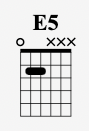
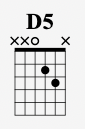
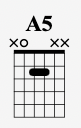
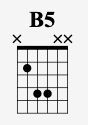
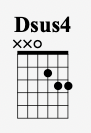
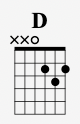
To play “Back in Black”, as recorded by AC/DC, you’ll need to know 7 main chords they are E5, D5, A5, B5, Dsus4, D, and G5. Now, the majority of these chords are power chords. A power chord is simply a two-note chord using the root note and a perfect fifth above. Let’s take a look at a few ways these shapes can be played on the fretboard.
I play E5 as a 3 note power chord in open position like this:
D5 is played on strings 4 through 2 like this:
A5 is played using just 1 finger (the index finger in the fretting hand) like so:
B5 is a movable 3-note power chord shape. This one has a root on the 5th string, and is played like this:
Dsus4 and D are just two subtle variations of the same chord. Notice that it’s just the 1st string that varies between them. This is a common theme in many of AC/DC’s guitar parts:
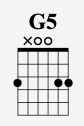
Finally, we have G5. G5 is an open position power chord using 5 strings like this:
If you’ve struggled to understand the fretboard for RHYTHM and LEAD guitar, and want to discover the easiest and fastest way. Then get your hands on my free Fretboard Guide PDF right here now:
Is Back in Black hard to play on guitar?
Yes! I would say playing “Back in Black” on guitar is difficult. It’s going to require an advanced rock guitar skill level. There are many essential rock guitar techniques a player must have down like solid muting skills, fast picking, switching between rhythm and riffs, and also the blues. Then, to top it all off, you’ve got to put on some schoolboy pants and dance around like a madman as you play it flawlessly. So, take your time with this one.
What key is Back in Black in?
“Back in Black,” as recorded by AC/DC, is in the key of E major. The scales for the song are a combination of E mixolydian and the E minor blues scale. This is a common theme in rock music. Let’s break down how the chords relate in the key of E. (Note: I’ve simplified the chords down to just their primary function.)
Here’s a quick look:
E
Notes: E, G♯, B
Function: This is the I chord (tonic) in E major. It’s the tonal center and home base of the key. Often progressions will start and end on this chord.
D
Notes: D, F♯, A
Function: This chord is ♭VII (flat seven) in E major or the sub-tonic. It’s a borrowed chord from the E Mixolydian mode. This chord adds a bluesy or rock flavor that’s very common in classic rock progressions (e.g., E–D–A).
A
Notes: A, C♯, E
Function: This is the IV chord (a.k.a the subdominant) in E major. A creates movement away from the tonic and often sets up a return back home to E.
B
Notes: B, D♯, F♯
Function: This is the V chord (dominant) in E major. B creates a strong tension that wants to resolve back to the tonic E.
G
Notes: G, B, D
Function: This chord is ♭III (flat three) in E major. Again, it’s another borrowed chord. G is not diatonic to the key of E major. Like D major, it shows up in blues and rock progressions all the time. It’s a blues move coming from the E minor blues scale.
So that’s the theory. Next, let’s look at…
What is the strumming pattern for Back in Black?
The main underlying groove for “Back in Black” is a bashing 8th note rock feel. In 4/4 time, 8th notes divide each beat into two equal parts, creating a driving, steady rhythm like this:
1 & 2 & 3 & 4 &
The numbers (1, 2, 3, 4) represent the main beats in the measure, while the "&" represents the offbeats that add energy and momentum.
When counted out loud, it sounds like:
"One-and, Two-and, Three-and, Four-and."
However, in the guitar part, there is a lot of 16th note action. So I would subdivide the rhythm even further to accommodate the various riffs needed to play the song.
Conclusion
Bottom line, “Back in Black” is one of the most legendary rock songs of all time. It ain’t easy. But I’d highly recommend spending some time with it. Your rock guitar playing will thank me later.
Keep practicing, and if you want to learn songs way faster, better understand the fretboard for lead and rhythm, and not waste years spinning your wheels with guitar, grab my free fretboard guide here right now:
Jon MacLennan
Like this blog post? Get Jon’s best guitar lessons straight to your inbox.
Discover the 5 easiest and fastest ways to play the blues scale anywhere on the neck with this FREE PDF GUIDE
