Bad, Bad Leroy Brown Guitar Lesson (w/ BLUESY GROOVE)
Here’s a song about the baddest man in the whole damn town…
His name is Leroy Brown.
Below, I’m going to share some insider tips on the boogie-woogie guitar style behind it.
So grab your axe, and let’s dive into this “Bad, Bad Leroy Brown” chords and guitar lesson!
Who Wrote Bad, Bad Leroy Brown?
“Bad, Bad Leroy Brown” was written and performed by American singer-songwriter Jim Croce. It was released in March 1973 as the lead single from his album Life and Times.
From there, it went on to become his biggest hit.
“Bad, Bad Leroy Brown” reached #1 on the Billboard Hot 100 in July 1973 and remained there for two weeks. It became his only chart-topping hit during his lifetime and was later ranked the #2 song of the entire year by Billboard.
Croce wrote the song based on a real-life tough guy he met during his time in the Army. This bloke was over 6 feet tall. He was from Chicago, carried a gun, and was known as a dangerous man. Leroy sang he’s "meaner than a junkyard dog." However, the script gets flipped when Leroy is outmatched in a bar fight by a jealous husband.
The recording took place in 1972 and was produced by Terry Cashman and Tommy West. Croce was nominated for two Grammys in 1973 (for Pop Male Vocalist and Record of the Year), though he tragically passed away in a plane crash on September 20, 1973, before the awards ceremony.
Beyond Croce’s original, “Bad, Bad Leroy Brown” has inspired some great covers. Even the Chairman of the Board – Frank Sinatra – recorded a version in 1974, which hit No. 83 on the Billboard Hot 100.
Now, you may be wondering…
What is the tuning for Bad, Bad Leroy Brown?
The tuning for "Bad Bad Leroy Brown," as recorded by Jim Croce, is standard tuning. Standard tuning is spelled: E, A, D, G, B, and E.
Here are the strings:
- E (6th string, lowest pitch)
- A (5th string)
- D (4th string)
- G (3rd string)
- B (2nd string)
- E (1st string, highest pitch)
All right!
Now that you know the tuning for “Bad Bad Leroy Brown”, let’s next talk about…
Bad, Bad Leroy Brown Chords
To play “Bad Bad Leroy Brown”, as recorded by Jim Croce, you’ll need to know 5 main chords they are G, D, A7, B7, and C. All of these chords can be played in open position.
Let’s take a look at a few ways these chords can be played on the fretboard.
G is played using all 6 strings like this:
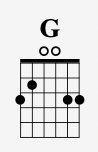
Note: Sometimes I remove the note on the 5th string and just play that string muted. (See video above for demonstration.)
D is played from the 4th string down like so:
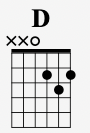
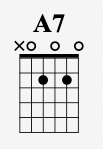
A7 is a bluesy chord I play from the 5th string down like this:
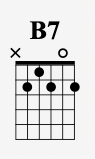
B7 is another great blues chord played from the 5th string down like this:
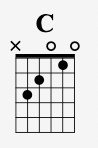
Finally, we have C, which is played in a (campfire) style from the 5th string down like this:
If you’ve struggled to understand the fretboard for RHYTHM and LEAD guitar, and want to discover the easiest and fastest way. Then get your hands on my free Fretboard Guide PDF right here now:
Is Bad, Bad Leroy Brown hard to play on guitar?
I would say playing “Bad, Bad Leroy Brown” on guitar is going to require a late-beginner to intermediate skill level. It only uses 5 chords; however, some of the dominant 7th shapes may be tricky. Also, stretching the blues shuffle pattern (used in the intro), and getting the boogie-woogie feel are going to be more for intermediate players. So, take your time with this one.
What key is Bad Bad Leroy Brown in?
“Bad, Bad Leroy Brown,” as recorded by Jim Croce, is in the key of G major. However, not all the chords fit the diatonic scale. There are a few twists and turns, as well as some funky blues influence.
The main scale being used for the chords and melody is the G major scale, which is built from the notes G, A, B, C, D, E, and F#. Notice that this key has one sharp. The key of G major has one sharp because of the specific pattern of whole steps (W) and half steps (H) in the major scale. For example:
Whole – Whole – Half – Whole – Whole – Whole – Half
(W – W – H – W – W – W – H)
Starting from G and following that pattern:
G → A (whole)
A → B (whole)
B → C (half)
C → D (whole)
D → E (whole)
E → F♯ (whole)
F♯ → G (half)
If we didn’t use F♯, the pattern would break. Using F natural would make E to F a half step, and F to G another half step. This would not gel with the major scale formula. So, F♯ is needed. That’s why the key of G major has one sharp: F♯.
Here’s a quick look at how all these chords relate in the key of G major:
G
Notes: G, B, D
Function: This is the I chord (tonic) in the key of G major — the “home” chord. It provides resolution and a sense of stability. Most songs in G will feel settled when they land here.
D
Notes: D, F♯, A
Function: This is the V chord (dominant) in the key of G major. It builds strong harmonic tension that naturally wants to resolve back to the I chord, G. It’s essential in establishing the key.
A7
Notes: A, C♯, E, G
Function: This is a secondary dominant — specifically the V7 of V (written V7/V). A7 is not diatonic to G major (it has a C♯, which is outside the key), but it’s commonly used. It’s a dominant II chord that pushes the harmony forward.
B7
Notes: B, D♯, F♯, A
Function: This is also a secondary dominant — the V7 of vi (written V7/vi), meaning it might resolve to E minor. However, in this case, it doesn’t. “Bad, Bad Leroy Brown” takes a more bluesy approach and walks up to C.
C
Notes: C, E, G
Function: This is the IV chord (subdominant) in the key of G major. It creates forward motion and can lead to the V chord (D) or back to the I (G).
So that’s the theory. Next, let’s look at…
What is the strumming pattern for Bad, Bad Leroy Brown?
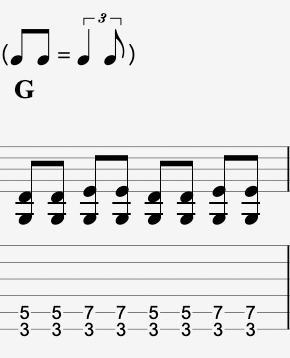
The main underlying groove for “Bad Bad Leroy Brown” is a swinging 8th-note shuffle feel. In 4/4 time, swing 8th notes still divide each beat into two parts, but they’re not equal. Instead of sounding even, the rhythm has a “long-short” feel.
It’s still counted like this:
1 & 2 & 3 & 4 &
But swing, feels more like:
“Daaa-di Daaa-di Daaa-di Daaa-di”
This laid-back groove gives the song that boogie-woogie groove. Here’s an example of a shuffle groove in the style of “Bad, Bad Leroy Brown”:
Conclusion
There ya have it!
Those are some insider guitar tips for this fun, boogie-woogie guitar jam.
Keep practicing, and if you want to get better at this bluesy style and master the fretboard for rhythm and lead, then grab my FREE blues scale PDF guide here right now:
Like this blog post? Get Jon’s best guitar lessons straight to your inbox.
Discover the 5 easiest and fastest ways to play the blues scale anywhere on the neck with this FREE PDF GUIDE
