Heart – Barracuda Chords & Guitar Lesson
Here’s a riff that’s become one of the most recognizable in all of rock and roll history.
It’s got a driving rhythm, and the guitar parts are mighty.
Below, I’m going to share some insider tips on the guitar style behind it.
So grab your axe, and let’s dive into this “Barracuda” chords and guitar lesson!
Who Wrote Barracuda?
“Barracuda” was written by Ann Wilson, Nancy Wilson, Roger Fisher, and Michael Derosier. It was released in 1977 as the lead single from Heart’s second studio album, Little Queen.
It kicks off with an aggressive galloping guitar riff Roger Fisher came up with after being inspired by Led Zeppelin’s “Achilles Last Stand.” Ann Wilson is also a big fan of Robert Plant, and so this riff set the stage for her soaring vocals. The song has some very interesting rhythms and time signature changes. One of the biggest keys to getting the sound is putting a lot of energy into the guitar part.
This opening riff has become one of the most recognizable riffs in rock guitar history. And it’s a ton of fun to play.
“Barracuda” was recorded at Kaye-Smith Studios in Seattle and at Sea-West Studios in Honolulu, with producer Mike Flicker at the helm. He captured the band at their creative peak, and “Barracuda” reached number 11 on the Billboard Hot 100.
This rock anthem has received a lot of praise from critics and fans alike, often cited as one of the greatest hard rock songs of all time. Rolling Stone and VH1 both included it in their lists of top rock songs, and it continues to receive heavy rotation on classic rock radio.
Now, you may be wondering…
What is the tuning for Barracuda?
The tuning for "Barracuda” is standard tuning. Standard tuning is spelled: E, A, D, G, B, and E.
Here are the strings:
- E (6th string, lowest pitch)
- A (5th string)
- D (4th string)
- G (3rd string)
- B (2nd string)
- E (1st string, highest pitch)
All right!
Now that you know the tuning for “Barracuda,” let’s next talk about…
Barracuda Chords
To play “Barracuda”, you only need to know 6 main chord shapes they are E5, F#5, G5, C5, A5, and D5. All of these chords are played as power chords. A power chord is a simple 2 (or sometimes 3) note structure that can be moved around the guitar neck.
Let’s take a look at a few ways these shapes can be played on the fretboard:
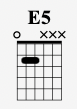
E5 is played with just 1 finger in open position like this:
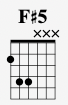
F#5 is played in 2nd position and can use 2 (or sometimes 3) notes like this:
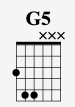
For G5, simply shift F#5 up 1 fret like so:
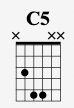
C5 is another great power chord. This one has a root on the 5th string like this:
A5 shifts G5 up 2 frets like this:
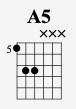
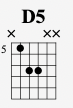
Finally, D5 shifts C5 up 2 frets like this:
If you’ve struggled to understand the fretboard for RHYTHM and LEAD guitar, and want to discover the easiest and fastest way. Then get your hands on my free Fretboard Guide PDF right here now:
Is Barracuda hard to play on guitar?
I would say playing “Barracuda” on guitar is going to require an intermediate to advanced skill level. The trickiest parts are the syncopated rhythms, harmonics, and last lead lines. There are also many guitars on the track, all coming together in a rock n roll fury. So, take your time with this one.
What key is Barracuda in?
“Barracuda”, as recorded by Heart, is in the key of E minor. The primary scale for the song is the E natural minor scale, which is built using the notes E, F#, G, A, B, C, and D.
Let’s break down the main chords and how they function in the key of E minor.
E5
Notes: E, B, E (Root, Perfect Fifth, Octave)
Function: This is the i power chord, the tonic. It is the "home" chord in the key of E minor.
F♯5
Notes: F♯, C♯, F♯ (Root, Perfect Fifth, Octave)
Function: This is the ii power chord, built on the second degree, the supertonic. This chord is used as a quick passing chord on its way up to G.
E5 → F#5 → G5
G5
Notes: G, D, G (Root, Perfect Fifth, Octave)
Function: This is the III power chord, built on the third degree, the mediant. This chord is the relative major of E minor. It functions as a stable chord that can be used to add a contrasting, slightly brighter feel or even a bluesy sound.
C5
Notes: C, G, C (Root, Perfect Fifth, Octave)
Function: This is the VI power chord, built on the sixth degree, the submediant. It functions as a predominant chord and comes in first during the Verse section.
A5
Notes: A, E, A (Root, Perfect Fifth, Octave)
Function: This is the iv power chord, built on the fourth degree, the subdominant. It is a stable chord that provides movement away from the tonic without the tension of the dominant, often setting up the dominant (B5) chord.
D5
Notes: D, A, D (Root, Perfect Fifth, Octave)
Function: This is the vii power chord, built on the seventh degree, the subtonic. It functions as a dominant substitute, creating tension and leading strongly back to the tonic (E5).
All right!
So that’s the theory. Next, let’s look at…
What is the strumming pattern for Barracuda?
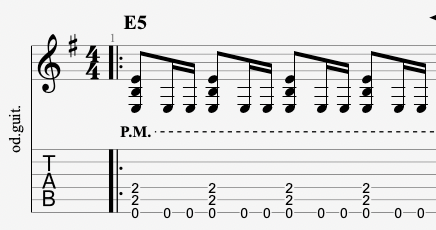
The main underlying feel for “Barracuda” is an 8th note rock feel. In 4/4 time, 8th notes divide each beat into two equal parts, creating a steady, walking rhythm. The counting for 8th notes in a measure looks like this:
1 & 2 & 3 & 4 &
The numbers (1, 2, 3, 4) represent the main beats in the measure. The "&" divides each beat into two evenly spaced subdivisions.
When counted out loud, it sounds like:
"One-and, Two-and, Three-and, Four-and."
Here’s an example of the galloping rhythm that combines 8th notes with 16th notes in the style of “Barracuda”:
Barracuda Scales And Soloing
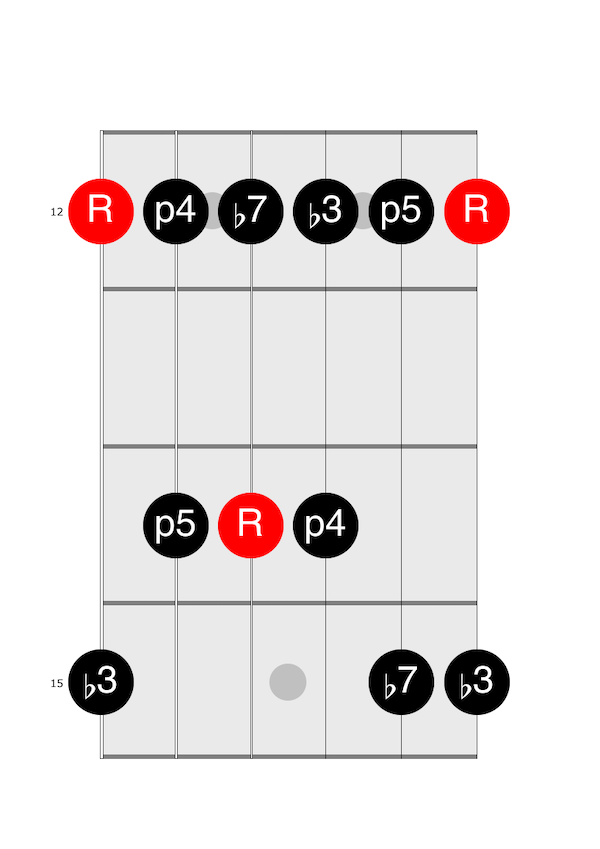
If you would like to solo over this progression and song, the best choice scale for guitar players would be the E minor pentatonic scale. This is a simple five-note scale that’s super common in rock, blues, jazz, and just about every style.
The E minor pentatonic scale uses the notes: E - G - A - B - D
Here’s the scale in intervals as well:
- Root (E)
- Minor 3rd (G)
- Perfect 4th (A)
- Perfect 5th (B)
- Minor 7th (D)
The E minor pentatonic scale can be played in a myriad of different ways on the guitar fretboard. Here’s a common pattern for the scale, starting on the 2nd fret:
Conclusion
Bottom line: “Barracuda” is an epic rock song. From the strong galloping rhythms to the feminine soaring vocals, it's become a legendary part of rock n roll.
So keep practicing, and if you want to learn songs way faster, better understand the fretboard for lead and rhythm, and not waste years spinning your wheels with guitar, grab my free fretboard guide here right now:
Jon MacLennan
Like this blog post? Get Jon’s best guitar lessons straight to your inbox.
Discover the 5 easiest and fastest ways to play the blues scale anywhere on the neck with this FREE PDF GUIDE
