Elvis Presley - Blue Christmas Chords & Guitar Lesson
Behold… One of the best-selling Christmas songs of all time!
It wasn’t written by Elvis, but his version is certainly one of the most famous.
Below, I’m going to share some insider tips on the guitar style behind it.
So grab your axe, and let’s dive into this “Blue Christmas” chords and guitar lesson!
Who Wrote Blue Christmas?
“Blue Christmas” was originally written by Billy Hayes and Jay W. Johnson in 1948. However, Elvis Presley has one of the most famous versions of it.
The song, as it says, is about a “Blue Christmas”. The main character is alone and feeling sad during the holidays because they are missing a loved one. The first recording of “Blue Christmas” was by Doye O'Dell in 1948, and his version has a classic country sound:
It wasn’t until 1957 that Elvis recorded his version at RCA Studios in Nashville, Tennessee. The King’s version was featured on his album, Elvis’ Christmas Album, as song 5.
While there are many jolly Christmas songs, this one captures the melancholic side of the holidays many experience in their lives.
Of course, Elvis gave a soulful delivery and was backed up by the legendary vocal group, the Jordanaires. The Jordanaires were a big part of many of Elvis's biggest hits. They also worked with many other famous artists like Patsy Cline, Eddy Arnold, and Ricky Nelson. In fact, their smooth vocal harmonies and polished sound played a key role behind many popular songs during the '50s and '60s.
Elvis’s version is recognized by the Recording Industry Association of America (RIAA) as one of the most iconic Christmas recordings. It has been inducted into various holiday song halls of fame and continues to be a staple on radio stations during the Christmas season.
Now, you may be wondering…
What is the tuning for Blue Christmas?
The tuning for "Blue Christmas," as recorded by Elvis Presley, is standard tuning. The King kept things simple. Standard tuning is spelled: E, A, D, G, B, and E.
Here are the strings:
- E (6th string, lowest pitch)
- A (5th string)
- D (4th string)
- G (3rd string)
- B (2nd string)
- E (1st string, highest pitch)
All right!
Now that you know the tuning for “Blue Christmas”, let’s next talk about…
Blue Christmas Chords
To play “Blue Christmas”, as recorded by Elvis Presley, you’ll need to know 6 main chords they are E, B7, E7, A, F#7, and A#dim7. The majority of these chords can be played in open position.
Let’s take a look at a few ways these shapes can be played on the fretboard.
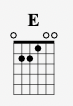
E is played using all 6 strings like so:
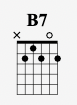
B7 is a great blues chord played from the 5th string down like this:
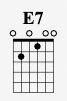
E7 just makes one small change from E. It opens up the 4th string like so:
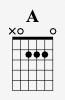
A is played as a standard folk chord from the 5th string down like this:
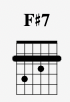
F#7 is the one bar chord. This one is played in the 2nd position using all 6 strings like this:
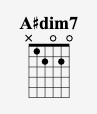
Finally, we have A#dim7. This chord sounds more complicated than it is. Just make one change from the A chord and play from the 5th string down like this:
If you’ve struggled to understand the fretboard for RHYTHM and LEAD guitar, and want to discover the easiest and fastest way. Then get your hands on my free Fretboard Guide PDF right here now:
Is Blue Christmas hard to play on guitar?
I would say playing “Blue Christmas” on guitar is going to require an intermediate skill level. It could be a good beginner song, except for the one bar chord and the swinging strumming pattern. These two start to push the song out of the beginner level. So, take your time with this one.
What key is Blue Christmas in?
“Blue Christmas,” as recorded by Elvis Presley, is in the key of E major. The primary scale used in the song is the E major scale, which is built with the notes E, F#, G#, A, B, C#, and D#.
Let’s break down how the core chords to “Blue Christmas” function in the key of E major:
E (E major)
Notes: E, G♯, B
Function: This is the I chord in E major. This is the tonic and key center. It provides a strong sense of resolution. It sounds like “home”.
B7 (B dominant 7)
Notes: B, D♯, F♯, A
Function: This is the V7 chord in the key of E major (a.k.a the dominant seventh). It creates tension that strongly wants to resolve back to the tonic (E). The dominant 7th adds extra color and drive to the resolution.
E7 (E dominant 7)
Notes: E, G♯, B, D
Function: This is a V7 of A (the IV chord) in E major, making it a secondary dominant (V7/IV). It creates tension that leads the ear toward the A chord, adding movement within the key.
A (A major)
Notes: A, C♯, E
Function: This is the IV chord in E major. A creates movement away from the tonic and often sets up a return to E or leads into the V7 chord (B7).
F#7 (F♯ dominant 7)
Notes: F♯, A♯, C♯, E
Function: This is the V7 of B (V chord), so it’s a secondary dominant (V7/V) in E major. It creates tension that leads naturally to the B chord, adding harmonic interest and forward motion.
A#dim7 (A♯ diminished 7)
Notes: A♯, C♯, E, G
Function: This is a fully diminished chord functioning as a leading-tone chord to B (the V chord) or serving as a passing chord in the key of E major. It creates tension and instability that resolves to more stable chords like B or E.
So that’s the theory. Next, let’s look at…
What is the strumming pattern for Blue Christmas?
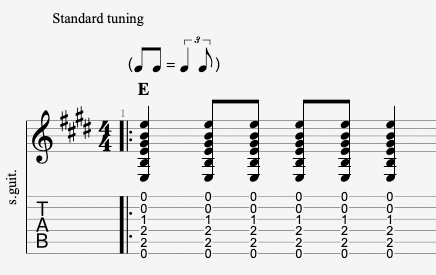
The main underlying groove for “Blue Christmas” is a light 8th-note swing feel. In 4/4 time, 8th note swing divides each beat into two uneven parts, creating a laid-back, swinging rhythm like this:
1 & 2 & 3 & 4 &
The numbers (1, 2, 3, 4) represent the main beats in the measure. The "&" represents the offbeat, which is delayed slightly to create the swing feel, making the first note of each pair longer and the second note shorter.
When counted out loud, it sounds like:
"One...ah, Two...ah, Three...ah, Four...ah."
However, I wouldn’t strum all 8th notes. I would use a combination of 8ths and quarters. Here’s an example of a strumming pattern in the style of “Blue Christmas”:
Conclusion
There ya have it!
“Blue Christmas” is one of the most popular holiday tunes of all time. Whether you are playing along with the recording or doing your own cover for friends and family, it’s sure to help improve your playing.
Keep practicing, and if you want to learn songs way faster, better understand the fretboard for lead and rhythm, and not waste years spinning your wheels with guitar, grab my free fretboard guide here right now:
Jon MacLennan
Like this blog post? Get Jon’s best guitar lessons straight to your inbox.
Discover the 5 easiest and fastest ways to play the blues scale anywhere on the neck with this FREE PDF GUIDE
