The ULTIMATE Burning Love Chords & Guitar Lesson
Elvis Presley sang:
===
Your kisses lift me higher
Like the sweet song of a choir
You light my morning sky
With burning love
===
Here's a rocking tune about love that consumes you. It was a huge hit for Elvis Presley.
Below, I’m going to share some insider tips on the guitar style behind it.
So grab your axe, and let’s dive into this “Burning Love” chords and guitar lesson!
Who Wrote Burning Love?
Despite being recorded famously by Elvis Presley, “Burning Love” was actually written by Dennis Linde in 1971.
The legend has it, he wrote the lyrics and riff in about 20 minutes. This is a pattern I’ve seen with many songs. Sometimes they just fall out of the ether. Linde wrote it while at home playing around with a drum kit. Suddenly, a spark of inspiration turned into one of rock history’s most fiery hits.
The track was first recorded by Arthur Alexander in late 1971. His version has more of a boogie R&B sound.
However, Elvis’s version put the song on the map.
The King recorded his iconic version on March 28, 1972, at RCA Studio C in Hollywood, with production by Felton Jarvis. The session featured some heavy hitters, including James Burton and John Wilkinson on guitars, Emory Gordy on bass, Ronnie Tutt on drums, Glen D. Hardin on piano, Jerry Carrigan on percussion, plus backing vocals by J.D. Sumner & the Stamps.
Upon release on August 1, 1972, Elvis's version soared to #2 on the U.S. Billboard Hot 100 (blocked from #1 only by Chuck Berry’s “My Ding‐a‐Ling”) and topped the Cash Box chart. It reached the Top 10 in the UK, Canada, Australia, and several other countries. “Burning Love” was certified Platinum by the RIAA, and it sold over a million copies.
The song marked Elvis’s last major Top 10 hit, becoming his most successful single since “Suspicious Minds.”
Yet ironically, Elvis said he disliked the tune. He did feel it reflected his true artistic voice. However, since then, “Burning Love” has appeared in films and TV (like Lilo & Stitch and MIB), been covered and remixed by artists across genres, and remains a staple of Elvis tribute shows.
Now, you may be wondering…
What is the tuning for Burning Love?
The tuning for "Burning Love" as recorded by Elvis Presley is standard tuning. Standard tuning is spelled: E, A, D, G, B, and E.
Here are the strings:
- E (6th string, lowest pitch)
- A (5th string)
- D (4th string)
- G (3rd string)
- B (2nd string)
- E (1st string, highest pitch)
All right!
Now that you know the tuning for “Burning Love”, let’s next talk about…
Burning Love Chords
To play “Burning Love”, as recorded by Elvis Presley, you only need to know four main chords they are D, G, A, and Bm. Let’s take a look at a few ways these chords can be played on the fretboard.
D is played in a standard open position, from the 4th string down like this:
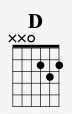
I play G, muting the 5th string like this:
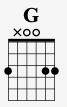
A can be played with one finger as a bar like so:
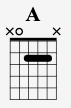
Finally, Bm is the one bar chord. This chord is played in 2nd position and from the 5th string down like this:
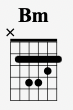
If you’ve struggled to understand the fretboard for RHYTHM and LEAD guitar, and want to discover the easiest and fastest way. Then get your hands on my free Fretboard Guide PDF right here now:
Is Burning Love hard to play on guitar?
I would say playing “Burning Love” on guitar is going to require a late beginner to intermediate skill level. It would be a decent beginner song. However, there is one chord that pushes it out of complete beginner territory, and that is the Bm bar chord. So, take your time with this one. If bar chords are giving you all kinds of aches and pains, and you’ve haven’t yet discovered how to play them effortlessly yet, go here: https://www.jonmaclennan.com/7mistakes
What key is Burning Love in?
“Burning Love,” as recorded by Elvis Presley, is in the key of D major. The primary scale for the song is the D major scale, which is built using the notes D, E, F#, G, A, B, and C#. All the chords being used in the song fit into the diatonic scale of D major. Let’s take a quick look at how the chords relate in the key:
D
Notes: D, F♯, A
Function: This is the I chord (tonic) in the key of D major — the “home base.” It gives you a strong sense of resolution and stability. Most songs in D will feel complete when they land on this chord.
G
Notes: G, B, D
Function: This is the IV chord (subdominant) in D major. It creates forward motion and often sets up a move to the V chord (A) or returns smoothly to the tonic (D). The I–IV–V progression is foundational in pop, rock, folk, and blues.
A
Notes: A, C♯, E
Function: This is the V chord (dominant) in D major. It builds tension that naturally resolves back to the I chord (D). It’s crucial in defining the key and driving the music forward, especially when played as A7, adding even more pull back to D.
Bm
Notes: B, D, F♯
Function: This is the vi chord (relative minor) in D major. It shares two notes with the tonic chord (D and F♯), making it blend beautifully while offering a melancholy or introspective color. The vi chord is commonly used in emotional or reflective sections.
As I said above, these four chords (D, G, A, and Bm) all fit the diatonic key of D major. They are some of the most commonly used chords in songwriting.
So that’s the theory. Next, let’s look at…
What is the strumming pattern for Burning Love?
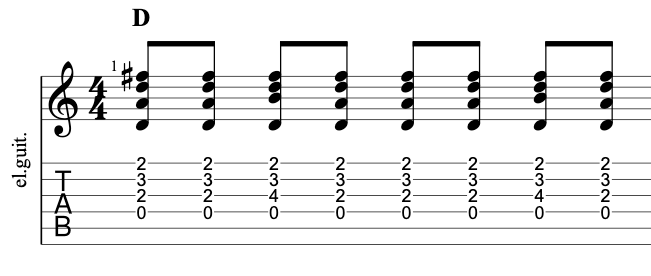
The main underlying groove for “Burning Love” is a steady 8th-note rock feel. In 4/4 time, 8th notes divide each beat into two equal parts, creating a rocking, steady rhythm like this:
1 & 2 & 3 & 4 &
The numbers (1, 2, 3, 4) represent the main beats in the measure, while the "&" represents the offbeats that add energy and momentum.
When counted out loud, it sounds like:
"One-and, Two-and, Three-and, Four-and."
A great way to approach the strumming pattern for “Burning Love” is to infuse it with some classic rhythm & blues guitar ideas. Here’s an example of a strumming pattern in the style of “Burning Love”.
Conclusion
Bottom line, even though Elvis didn’t like it… the crowd did. This song is a perfect example of how rhythm & blues blends perfectly with rock n roll. Especially when you go hear the original Arthur Alexander version, and how it evolved over the years.
Keep practicing, and if you want to learn songs way faster, better understand the fretboard for lead and rhythm, and not waste years spinning your wheels with guitar, grab my free fretboard guide here right now:
Jon MacLennan
Like this blog post? Get Jon’s best guitar lessons straight to your inbox.
Discover the 5 easiest and fastest ways to play the blues scale anywhere on the neck with this FREE PDF GUIDE
