The ULTIMATE Bye Bye Love Chords & Guitar Lesson
Many a man has lost a woman to someone new who makes her feel like she used to.
Here's a landmark song about a poor bloke going through just that.
You only need 4 chords to play it.
Below, I’m going to share some insider tips on the guitar style behind it.
So grab your axe, and let’s dive into this “Bye Bye Love” chords and guitar lesson!
Who Wrote Bye Bye Love?
"Bye Bye Love" was originally written by a husband-and-wife songwriting duo, Felice and Boudleaux Bryant. It initially faced rejection by over 30 artists before the Everly Brothers recorded it, and turned it into a massive hit.
It became a breakthrough song for them that introduced a fresh blend of rockabilly, country, and early rock 'n' roll that would influence generations to come.
"Bye Bye Love" sings about the sorrows of a man who has lost his lover to someone else. The theme of heartbreak and loneliness has resonated with many audiences.
"Bye Bye Love" was recorded at RCA Victor Studios in Nashville, Tennessee. It featured Don and Phil Everly on vocals and acoustic guitars, with Chet Atkins on electric guitar, Floyd "Lightnin'" Chance on double bass, and Buddy Harman on drums.
Upon its release (March 1, 1957), it became a smash hit. The tune shot right up to #2 on the US Billboard Pop charts, #1 on the Cash Box Best Selling Record charts, #1 on the Billboard Country chart, #5 on the Billboard R&B chart, and #6 on the UK Singles Chart.
In 1998, the song was inducted into the Grammy Hall of Fame and was also ranked 210th on Rolling Stone's list of "The 500 Greatest Songs of All Time".
Over the years, "Bye Bye Love" has been covered by a horde of artists, including Simon & Garfunkel, and one of my personal favorites is Ray Charles’ version:
The song's success helped establish the Everly Brothers as pioneers in the music industry, and it remains a timeless classic to this day.
Now, you may be wondering…
What is the tuning for Bye Bye Love?
The tuning for "Bye Bye Love", as recorded by The Everly Brothers, is interesting. There is a strange acoustic guitar punched in at the top that is in an alternate tuning. It’s only for the first riff. Live, they use standard tuning. In this post, I’ll focus on that for ease of learning. Standard tuning is spelled: E, A, D, G, B, and E.
Here are the strings:
- E (6th string, lowest pitch)
- A (5th string)
- D (4th string)
- G (3rd string)
- B (2nd string)
- E (1st string, highest pitch)
All right!
Now that you know the tuning for “Bye Bye Love”, let’s next talk about…
Bye Bye Love Chords
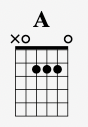
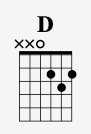
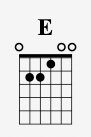
To play “Bye Bye Love”, you’ll need to know 4 main chords they are A, C, D, and E. Let’s take a look at a few ways these chords can be played on the fretboard:
A can be played in open position from the 5th string down like this:
C I play as a bar chord in the 3rd position like so:
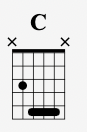
Note: This C chord is only used for the riff.
D is played from the 4th string down like this:
Finally, we have E, which uses all 6 strings like this:
If you’ve struggled to understand the fretboard for RHYTHM and LEAD guitar. and want to discover the easiest and fastest way. Then get your hands on my free Fretboard Guide PDF right here now:
Is Bye Bye Love hard to play on guitar?
I would say playing “Bye Bye Love” on guitar requires a late beginner to intermediate skill level. If you want to play the bar chords and syncopations in the riff at the beginning, that is going to be harder than the basic chords. However, overall, it’s a relatively good song to pick for newer players because, aside from the intro riff, it’s not too difficult. But still take your time with this one.
What key is Bye Bye Love in?
“Bye Bye Love,” as recorded by The Everly Brothers, is in the key of A major. The primary scale for the tune is the A major scale, which uses the notes: A – B – C# – D – E – F# – G#.
There are 3 sharps in this key, and all the chords used in the song fit the diatonic scale except 1. Here’s a quick look at how they all relate:
A
Notes: A, C#, E
Function: I chord — the tonic, home base in A major. Everything resolves here, and it feels stable and resolved.
C
Notes: C, E, G
Function: ♭III chord. This chord is not diatonic to A major. It’s borrowed from the parallel minor key (A minor), and adds a bluesy, rock edge.
D
Notes: D, F#, A
Function: IV chord — the subdominant. Moves away from the tonic, often sets up the dominant (E) or returns to A.
E
Notes: E, G#, B
Function: V chord — the dominant. Leads strongly back to A (I). It's G# (the leading tone) creates a sense of tension that wants to resolve upward to A.
So that’s the theory. Next, let’s look at…
What is the strumming pattern for Bye Bye Love?
The main underlying groove for “Bye Bye Love” is an 8th note feel with a slight swing. In 4/4 time, eighth note swing means you’re still counting two eighth notes per beat — but instead of playing them evenly, the first is held longer and the second is shorter. It gives the rhythm a lilting, triplet-based feel like this:
1 & 2 & 3 & 4 &
(Think: “Long–short, Long–short…”)
You can count it out loud like this:
"One and Two and Three and Four and"
This swing feel is super common in blues and jazz.
Conclusion
Bottom line, “Bye Bye Love” is a classic every guitarist should know.
Keep practicing, and if you want to learn songs way faster, better understand the fretboard, and not waste years spinning your wheels with guitar, grab my free fretboard guide here right now:
Jon MacLennan
Like this blog post? Get Jon’s best guitar lessons straight to your inbox.
Discover the 5 easiest and fastest ways to play the blues scale anywhere on the neck with this FREE PDF GUIDE
