Epic China Grove Chords & Guitar Lesson (The Doobie Brothers)
Want to play an instantly recognizable epic rock guitar riff?
Well, if so, this post could be just what you’re looking for.
You see, this riff is often cited as one of the greatest classic rock guitar licks of all time.
It's been heard on TV shows like The Simpsons and King of the Hill.
So grab your axe, and let’s dive into this “China Grove” chords and guitar lesson!
Who Wrote China Grove?
China Grove was written by Tom Johnston, a founding member, guitarist, and lead vocalist for the American rock band The Doobie Brothers.
It’s one of their most iconic songs, loaded with rock ‘n' roll energy, killer guitar riffs, and a quirky little twist of small-town storytelling.
The driving guitar riff powers the song. Johnston said he came up with the groove during a jam session. The piano part was laid down by Bill Payne, keyboardist of Little Feat, who played on the session. Johnston later said Payne’s opening piano part was so infectious, it helped him come up with the whole vibe and storyline for the song.
“China Grove” sounds like it’s about a real town — and it is, sort of…
There is a town called China Grove in Texas, just outside of San Antonio. But Johnston didn’t originally intend to write about a real place. He actually made up the lyrics as a kind of fun, fictional story about a quirky Southern town full of interesting characters — like the samurai sword-wielding sheriff and the eccentric preacher's daughter.
Johnston: “I thought I had just made it up. Then we were on tour and passed through China Grove, Texas, and I went, ‘Oh man, don’t tell me that’s a real town!’”
So, the town inspired the title, but the characters and story were all Johnston’s imagination.
“China Grove” was recorded at Warner Bros. Studios in North Hollywood, California. The song appeared on the Doobie Brothers’ third studio album, The Captain and Me, released in March 1973.
Ted Templeman the legendary producer was at the helm. He’s known for his work with Van Halen, Montrose, and Little Feat as well.
“China Grove” was first released as a single in July 1973 and reached #15 on the Billboard Hot 100. Over time, it’s become a classic rock staple — featured on countless greatest hits albums and classic rock radio. It’s also been used in movies, TV shows, and video games (like Guitar Hero and Grand Theft Auto V).
Although it didn’t win any big awards at the time, it has a lasting legacy as one of the most recognizable classic rock songs of the '70s.
Now, you may be wondering…
What is the tuning for China Grove?
The tuning for "China Grove," as recorded by The Doobie Brothers, is standard tuning. Standard tuning is spelled: E, A, D, G, B, and E.
Here are the strings:
- E (6th string, lowest pitch)
- A (5th string)
- D (4th string)
- G (3rd string)
- B (2nd string)
- E (1st string, highest pitch)
Now that you know the “China Grove” tuning, let’s next talk about the…
China Grove Chords
To play “China Grove” on guitar, you’ll only need to know 11 main chords they are E, D, C#m, A, Bb, B, C7, G#5, F#m, F#7, and F#7sus4. Let’s take a look at a few ways they can be played on the fretboard.
E is played on the middle strings (strings 5-2) like this:
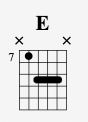
D simply shifts E down two frets like this:
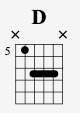
C#m keeps moving down the fretboard, however, here we will change to a minor shape like this:
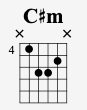
A is played in open position like this:
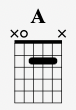
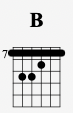
In the prechorus section, there is a walk-up progression that uses Bb, and B in the 6th and 7th positions like this:

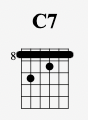
Then it moves up again and changes to a C7 using all 6 strings like this:
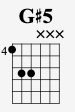
Going into the bridge section, there is a G#5 power chord like so:
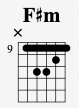
F#m is played in 9th position with a root on the 5th string like this:
Then make a subtle change from there to get a F#7 like this:
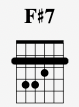
Finally, we have F#7sus4 which is played using all 6 strings as well like this:
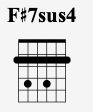
If you’ve struggled to understand the fretboard for RHYTHM and LEAD guitar and want to discover the easiest and fastest way. Then get your hands on my free Fretboard Guide PDF right here now:
Is China Grove hard to play on guitar?
“China Grove” is a fun rockin’ tune that I would say requires a late intermediate to advanced rock guitar skill level to play. There are many chords and rhythms, and also a muting that must be on lock for it to sound right. So, take your time.
What key is China Grove in?
“China Grove” as recorded The Doobie Brothers is in the key of E major. The E major scale uses the notes E - F# - G# - A - B - C# - D#. Most of the chords fit the diatonic scale, however, there are a few exceptions.
I’ve broken it down to the primarily chords for ease of learning. Let’s take a look at how all the chords relate in the key of E major:
1. E major
Notes: E – G# – B
Function: I chord (tonic)
- E is the root of the key.
- G# is the major third.
- B is the perfect fifth.
- This is the home base, the most stable and resolved chord in the key.
2. D major
Notes: D – F# – A
Function: ♭VII (non-diatonic)
- D is a whole step below E (flat seven). This chord is not a part of the E major scale. However, it’s very commonly used in classic rock and blues. It’s a borrowed chord from E mixolydian.
- F# is the 2nd (or 9th) in E major.
- A is the 4th.
3. C# minor
Notes: C# – E – G#
Function: vi chord (relative minor)
- C# is the 6th degree.
- E is the root.
- G# is the 3rd.
- This is the relative minor of E major. Often used in progressions like I–vi–IV–V.
4. A major
Notes: A – C# – E
Function: IV chord (subdominant)
- A is the 4th degree.
- C# is the 6th.
- E is the root.
- This chord leads naturally to V or back to I. It provides a lift or contrast to the tonic.
5. B♭ major
Notes: Bb – D – F
Function: ♭II (very non-diatonic)
- Bb is a half step up from A, outside the E major scale.
- D and F are also not in the key.
- This chord is simply used as a chromatic passing chord.
6. B major
Notes: B – D# – F#
Function: V chord (dominant)
- B is the 5th degree.
- D# is the major 7th of the scale.
- F# is the 2nd.
7. C major
Notes: C – E – G
Function: ♭VI (non-diatonic, modal mixture)
- C is a lowered 6th (outside the scale).
- E and G are in the key.
- Often used in rock, this adds a bluesy/modal quality. E–C–D–E is a well-known riff progression.
8. G#5 (power chord)
Notes: G# – D#
Function: Power chord version of the iii chord, or V/vi
- G# is the 3rd degree.
- D# is the 7th degree.
- This chord lacks a third… so it's ambiguous (neither major nor minor).
9. F# minor
Notes: F# – A – C#
Function: ii chord (pre-dominant)
- F# is the 2nd.
- A is the 4th.
- C# is the 6th.
- Often used in ii–V–I progressions or as a step between E and B.
10. F#7
Notes: F# – A# – C# – E
Function: V/vi (secondary dominant)
- F# is the 2nd.
- A# is the raised 4th (not in E major).
- C# is the 6th.
- E is the root.
- This is the dominant of C#m, and it adds harmonic direction toward the V chord.
So that’s the theory. Next, let’s look at…
What is the strumming pattern for China Grove?
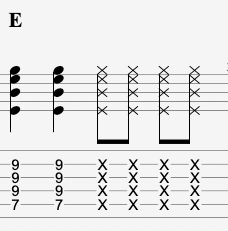
The main underlying rhythm and feel for “China Grove” is a driving 8th-note rock feel. In 4/4 time, 8th notes divide each beat into two equal parts, creating a driving, steady rhythm like this:
1 & 2 & 3 & 4 &
The numbers (1, 2, 3, 4) represent the main beats in the measure, while the "&" represents the offbeats that add energy and momentum.
When counted out loud, it sounds like:
"One-and, Two-and, Three-and, Four-and."
This gives a strong and consistent forward motion to the tune. Here’s an example of a strumming combing 8th notes with some quarter notes in the style of “China Grove”:
Conclusion
Bottom line, “China Grove” is a very recognizable rock guitar riff that’s a blast to play.
Keep practicing, and if you want to learn songs way faster, better understand the fretboard, and not waste years spinning your wheels with guitar, grab my free fretboard guide here right now:
Jon MacLennan
Like this blog post? Get Jon’s best guitar lessons straight to your inbox.
Discover the 5 easiest and fastest ways to play the blues scale anywhere on the neck with this FREE PDF GUIDE
