The ULTIMATE Could You Be Loved Chords & Guitar Lesson
Behold…
A funky Bob Marley tune he wrote while flying through the air in a metal tube.
You only need a couple of chords to play it.
Below, I’m going to share some insider tips on the guitar style behind it.
So grab your axe, and let’s dive into this “Could You Be Loved” chords and guitar lesson!
Who Wrote Could You Be Loved?
“Could You Be Loved?” was written by Bob Marley while in an airplane experimenting with guitar ideas in 1979.
One of the key themes in the song’s lyrics is to not be judgmental. In fact, the background singers during “Could You Be Loved” sing the lyrics to another Marley song called “Judge Not” that goes:
"The road of life is rocky... And you may stumble too. So while you point your fingers, someone else is judging you".
It’s a unique blend of reggae, disco, clavinet, and cuíca rhythms. A cuíca is a Brazilian friction drum that sounds amazing. It's got a shell, a head, and a stick. To play it, the drummer reaches inside the shell with one hand and rubs the stick using a damp cloth. This creates a "laughing" or "squeaking" sound that's a staple of samba and other Afro-Brazilian styles.
“Could You Be Loved” was recorded at Tuff Gong Studio in Kingston, Jamaica, and released on May 16, 1980, as the lead single from the album Uprising.
The single was a global success, reaching the Top 10 across Europe, including #3 in Belgium, #5 in the UK, and the Top 20 in multiple other countries.
Now, you may be wondering…
What is the tuning for Could You Be Loved?
The tuning for "Could You Be Loved" as recorded by Bob Marley & The Wailers is standard tuning. Standard tuning is spelled: E, A, D, G, B, and E.
Here are the strings:
- E (6th string, lowest pitch)
- A (5th string)
- D (4th string)
- G (3rd string)
- B (2nd string)
- E (1st string, highest pitch)
All right!
Now that you know the tuning for “Could You Be Loved”, let’s next talk about…
Could You Be Loved Chords
To play “Could You Be Loved”, as recorded by Bob Marley & The Wailers, you need to know 7 main chords they are Bm, D, G, Em, F#m, A, and A7. Let’s take a look at a few ways these shapes can be played on the fretboard.
Bm is played as a bar chord in 2nd position like this:

D is played in the 5th position and on the middle strings like so:
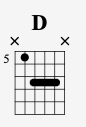
G is played using all 6 strings in 3rd position like this:
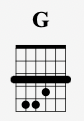
Em shifts up to the 7th position and returns to the middle strings like so:
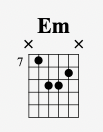
F#m is played using all 6 strings and in 2nd position like this:
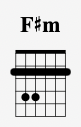
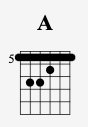
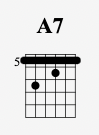
Finally, we have A and A7, which are just two subtle variations on the same main chord, like this:
If you’ve struggled to understand the fretboard for RHYTHM and LEAD guitar, and want to discover the easiest and fastest way. Then get your hands on my free Fretboard Guide PDF right here now:
Is Could You Be Loved hard to play on guitar?
I would say playing “Could You Be Loved” on guitar is going to require an intermediate skill level. The toughest parts are: the percussive picking used in the riff, and the bar chords with a rhythmic emphasis on the upbeat. So, take your time with this one.
What key is Could You Be Loved in?
“Could You Be Loved,” as recorded by Bob Marley & The Wailers, is in the key of B minor. The primary scale is the B natural minor scale, which is built using the notes B, C#, D, E, F#, G, and A. The verse sections are in the key of B minor, but the chorus has a bit of an emphasis on the relative major, D major. But, since the majority of the song is more on a riff and vamp, I would call it the key of B minor.
Here’s a quick look at how the chords relate in the key:
Bm
Notes: B, D, F♯
Function: This is the i chord (tonic minor) in B minor.
It’s the "home" chord, giving a sense of stability and melancholy.
D
Notes: D, F♯, A
Function: This is the III chord in B minor (a.k.a the relative major).
D shares two notes with Bm (D and F♯), offering a smooth, uplifting contrast while still sounding stable and within the key.
G
Notes: G, B, D
Function: This is the VI chord in B minor.
It has a warm, stable feel and often leads back to the tonic. Since it shares two notes with Bm, it can also feel like a gentle detour from the tonic.
Em
Notes: E, G, B
Function: This is the iv chord in B minor.
It gives a darker, more introspective movement than a major IV would. It naturally flows toward the v (F♯m) or back to the i (Bm), as it does in “Could You Be Loved”.
F♯m
Notes: F♯, A, C♯
Function: This is the v chord in B natural minor.
Unlike the V major in harmonic minor (F♯ major), this minor v chord gives the key a more modal, folk-like quality. It doesn’t have the same strong pull to the tonic, but it’s common in natural minor contexts.
A
Notes: A, C♯, E
Function: This is the VII chord in B minor.
It’s a key piece of the Aeolian sound and often appears before resolving back to the tonic (Bm). You’ll hear the VII–i progression in a lot of rock and minor-key pop music.
What is the strumming pattern for Could You Be Loved?
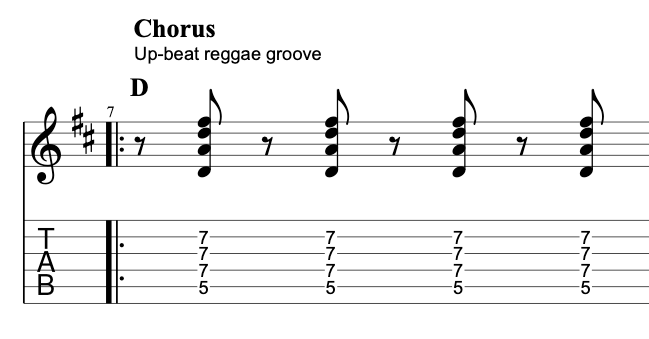
The main feel for “Could You Be Loved” is an upbeat reggae groove. In 4/4 time, 8th notes divide each beat into two equal parts, creating a steady rhythm like this:
1 & 2 & 3 & 4 &
The numbers (1, 2, 3, 4) represent the main beats in the measure, while the "&" represents the offbeats that add energy and momentum.
When counted out loud, it sounds like:
"One-and, Two-and, Three-and, Four-and."
For “Could You Be Loved,” you want to emphasize the “&” or the off-beats. Here’s an example of a strumming pattern in the style of “Could You Be Loved”:
Conclusion
There ya have it!
Those are some insider tips on the guitar style behind “Could You Be Loved”.
Keep practicing, and if you want to learn songs way faster, better understand the fretboard for lead and rhythm, and not waste years spinning your wheels with guitar, grab my free fretboard guide here right now:
Jon MacLennan
Like this blog post? Get Jon’s best guitar lessons straight to your inbox.
Discover the 5 easiest and fastest ways to play the blues scale anywhere on the neck with this FREE PDF GUIDE
