John Denver – “Country Roads” Chords & Guitar Lesson
“Take Me Home, Country Roads” is one of the most famous folk-country anthems in American music history.
But many guitarists play it wrong.
Below, I want to share with you some insider tips on the guitar style behind it.
We’ll look at how to strum it, how to Travis pick it, and even an easy version that uses a capo.
So grab your axe, and let’s dive into this “Country Roads” chords and guitar lesson!
Who wrote Country Roads?
“Take Me Home, Country Roads,” or more commonly known as “Country Roads,” was originally written by Bill Danoff, Taffy Nivert, and John Denver.
The song was not originally intended for John Denver at all. In fact, Bill Danoff and Taffy Nivert were working on the song with Johnny Cash in mind. They thought the country imagery would suit him. But before it went to Cash, Danoff and Nivert performed the unfinished tune for John Denver after one of his concerts in Washington, D.C.
Denver immediately loved it and helped them complete the final lyrics.
In 1971, it made it onto Denver’s album Poems, Prayers & Promises, and grew to be one of his most famous songs.
The recording took place in New York City at RCA Studio A with producer Milton Okun. They kept the arrangement fairly simple. It’s got light fingerpicked acoustic guitar, lead guitar, and a gentle rhythm section.
Denver’s voice is what really sets the tone and also makes a great sing-along.
Another funny fact is that none of the songwriters are actually from West Virginia. Danoff reportedly got the first inspiration for many of the lyrics while driving on country roads in Maryland. The famous line “Blue Ridge Mountains, Shenandoah River” references landmarks associated more with Virginia and Maryland than most of West Virginia. But in the end, they liked the sound of “West Virginia”, and it fit the song perfectly.
Upon its release, “Take Me Home, Country Roads” became a massive hit. It reached number two on the Billboard Hot 100 in 1971 and helped establish John Denver as one of the biggest singer-songwriters of the decade.
Over time, the song transcended its chart success and became deeply tied to the identity of West Virginia itself. In 2014, the state officially named it one of its four state anthems.
It is now routinely sung at sporting events, public gatherings, and ceremonies associated with West Virginia University and the state in general.
Now, you may be wondering…
What is the tuning for Country Roads?
The tuning for "Country Roads” as recorded by John Denver is standard tuning. Denver kept things simple. Standard tuning is spelled: E, A, D, G, B, and E.
Here are the strings:
- E (6th string, lowest pitch)
- A (5th string)
- D (4th string)
- G (3rd string)
- B (2nd string)
- E (1st string, highest pitch)
However, if you want to play an easier guitar version of the song using a capo on the 2nd… this would change the strings to:
- F# (6th string, lowest pitch)
- B (5th string)
- E (4th string)
- A (3rd string)
- C# (2nd string)
- F# (1st string, highest pitch)
All right!
Now that you know the tuning for “Country Roads,” let’s next talk about…
Country Roads Chords
To play “Country Roads”, as recorded by John Denver, you’ll need to know 5 main chords they are A, F#m, E, D, and G. These chords are a mix of open and bar chord shapes.
If bar chords are giving you all kinds of aches and pains, and you haven’t yet discovered how to play them effortlessly, go here: https://www.jonmaclennan.com/barchords
Let’s take a look at a few ways these shapes might show up on the fretboard.
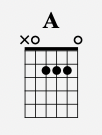
A is played in a typical folk style from the 5th string down like this:
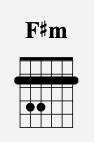
F#m is a bar chord played in 2nd position and uses all 6 strings like so:
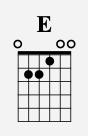
E is another beautiful open-sounding chord. It also uses all 6 strings like this:
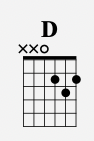
D is played from the 4th string down like so:
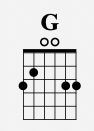
Finally, G is played in an open position using all 6 strings (and 4 fingers in the fretting hand) like this:
If you want to improve your Travis picking for “Country Roads” and not waste years spinning your wheels, grab my free Travis picking cheat sheet PDF guide right here now:
Is Country Roads hard to play on guitar?
I would say playing “Country Roads” on guitar, as recorded by John Denver, is going to require an intermediate skill level. The song itself only uses 5 chords. But the bright country feel, and the fingerpicking are going to be the toughest parts. So, take your time with this one.
What key is Country Roads in?
“Country Roads”, as recorded by John Denver, is in the key of A major. The primary scale for the song would be the A major scale, which is built using the notes A, B, C#, D, E, F#, and G#.
Let’s take a look at how the main chords all function in the key of A major. Starting with…
A
Notes: A, C#, E
Function: This is the I chord, or the “home” chord in the key of A major. Everything else in the song revolves around this one harmonic home base.
F#m
Notes: F#, A, C#
Function: This is the vi chord in A major, a.k.a the relative minor. It shares two notes with the tonic (A and C#), which makes it feel very closely connected to A. It adds a slightly more melancholic color while still staying firmly in the key of A major.
E
Notes: E, G#, B
Function: This is the V chord in A major, the dominant. It creates strong harmonic tension because of the leading tone G#, which wants to resolve up to A. E drives the progression forward and strongly pulls back to the tonic.
D
Notes: D, F#, A
Function: This is the IV chord in A major, sometimes called the subdominant. D moves away from the tonic without strong tension and provides a sense of openness or lift. This progression sets up a nice return often to V (the E chord) or back home to I.
G
Notes: G, B, D
Function: G major is the only non-diatonic chord in the song. It’s a borrowed chord from the Mixolydian mode. It introduces a bluesy, rock-influenced color and creates a sense of unexpected shift before resolving back to diatonic chords like A, D, or E.
Taken together, these chords create a rich palette to choose from in the key of A major.
All right!
That’s my theory breakdown.
Next, let’s look at…
What is the strumming pattern for Country Roads?
The main underlying groove for “Country Roads” is a bright country “2 feel”.
It’s called a “2 feel” because instead of emphasizing all four beats in a bar, the rhythm leans hard on beats 1 and 3, giving the music a spacious, walking-but-not-overcrowded pulse.
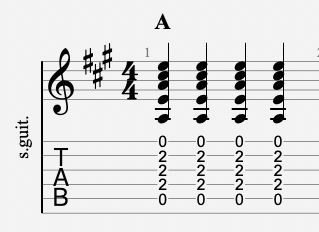
For strumming, I would play on every beat like this:
1 2 3 4
But the emphasis is still on 1 and 3.
When counted out loud, it sounds like:
"One, Two, Three, Four, One, Two, Three, Four."
Here’s an example of how I might play in the style of “Country Roads”:
What is the fingerpicking pattern for Country Roads?
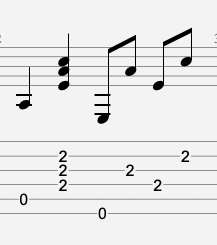
To fingerpick “Country Roads”, I would recommend using a Travis style picking.
John Denver does this live with a thumbpick.
Here’s an example of how I might Travis pick in the style of “Country Roads”:
Conclusion
To wrap it up, “Country Roads” is one of the most famous folk-country anthems in American music history.
Whether you're strumming or Travis picking it, it’s sure to get a great response from your audience.
So keep practicing, and if you want to improve your fingerstyle guitar faster and not waste years spinning your wheels with guitar, grab my free fingerstyle cheat sheet PDF guide right here now:
Jon MacLennan
Like this blog post? Get Jon’s best guitar lessons straight to your inbox.
Discover the 5 easiest and fastest ways to play the blues scale anywhere on the neck with this FREE PDF GUIDE
