The Beatles – “Cry Baby Cry” Chords & Guitar Lesson
Here’s a deep cut from The Beatles' legendary double album, most commonly referred to as the White Album.
With songs like “While My Guitar Gently Weeps” and “Blackbird,” this one often gets swept under the rug.
Below, I’m going to share with you some insider tips on the guitar style behind it.
So grab your axe, and let’s dive into this “Cry Baby Cry” chords and guitar lesson!
Who Wrote Cry Baby Cry?
“Cry Baby Cry” was primarily written by John Lennon, but it is credited under the McCartney/Lennon songwriting partnership. It was recorded by The Beatles for their 1968 double album, commonly known as The White Album.
The song lyrically is quite whimsical, which is very characteristic of Lennon’s writing during this era. The song references kings, queens, duchesses, and imaginary characters in a way that feels playful on the surface but slightly unsettling underneath.
Lennon once said the line “Cry baby cry, make your mother sigh” was inspired by an old playground chant he remembered from childhood. From there, he built a strange, dreamlike world filled with absurd images and disconnected scenes.
“Cry Baby Cry” was recorded at Abbey Road Studios in London during the White Album sessions. The relationship of the band members at this point was starting to get tumultuous. By 1968, The Beatles were increasingly working as individuals rather than a unified band, and the White Album reflects this fragmentation.
Although “Cry Baby Cry” was never released as a single, it has earned a strong reputation among fans and critics as a deep cut from the White Album. It’s frequently praised for its originality and its haunting, off-kilter charm.
Now, you may be wondering…
What is the tuning for Cry Baby Cry?
The tuning for "Cry Baby Cry is standard tuning. Standard tuning is spelled: E, A, D, G, B, and E.
Here are the strings:
- E (6th string, lowest pitch)
- A (5th string)
- D (4th string)
- G (3rd string)
- B (2nd string)
- E (1st string, highest pitch)
All right!
Now that you know the tuning for “Cry Baby Cry,” let’s next talk about…
Cry Baby Cry Chords
To play “Cry Baby Cry”, as recorded by The Beatles, you’ll need to know 9 main chords they are G, Am, F, Em, A, Em(maj7), Em7, Em6, and C7. These chords are a mix of open chords and bar chords. If bar chords are giving you all kinds of aches and pains, and you haven’t yet discovered how to play them effortlessly, go here: https://www.jonmaclennan.com/barchords
Let’s take a look at a few ways these shapes might show up on the fretboard.
G is played in a folk style using all 6 strings like this:

Am is played from the 5th string down like so:

F is a bar chord played in 1st position and uses all 6 strings like this:

Em is a beautiful open-sounding chord. It uses all 6 strings like this:

A is played from the 5th string down like so:

Em(maj7) sounds complicated, but it’s only a slight change from the Em above. I play it like this:

Em7 is just 1 finger like so:

Em6 has a James Bond type of sound to it. I play it like this:

Finally, C7 comes in during the B section and gets a little funky. This chord is played from the 5th string down like this:

If you’ve struggled to understand the fretboard for RHYTHM and LEAD guitar, and want to discover the easiest and fastest way. Then get your hands on my free Fretboard Guide PDF right here now:
Is Cry Baby Cry hard to play on guitar?
I would say playing “Cry Baby Cry” on guitar is going to require an intermediate skill level. The song’s trickiest parts are the 2/4 measures and the bar chords. Getting the counting right and the chords clean are where most of the practice is going to be. So, take your time with this one.
What key is Cry Baby Cry in?
“Cry Baby Cry”, as recorded by The Beatles, is in the key of G major. The primary scale would be the G major scale, which is built using the notes G, A, B, C, D, E, and F#.
Let’s take a closer look at how all these chords relate in the key of G major. Starting with…
G
Notes: G, B, D
Function: This is the I chord, the tonic of G major. It serves as the “home base” of the key. Progressions typically begin or end here.
Am
Notes: A, C, E
Function: This is the ii chord, a minor chord built on the second degree of G major. This is sometimes called the super-tonic and can be used as a stepping stone in a progression.
F
Notes: F, A, C
Function: This chord is not diatonic to G major. The key of G major has an F# instead of F natural. Using F major brings in a bluesy sound and can be thought of as a Mixolydian flavor.
Em
Notes: E, G, B
Function: This is the vi chord, or it is sometimes called the relative minor of G major. It creates a more melancholic sound. It also shares two notes (G and B) with the tonic, making transitions very smooth.
A
Notes: A, C#, E
Function: This is another non-diatonic chord. The C# instead of C natural takes it out of the key of G major. Using this chord brings in a nice color to the progression.
Em(maj7)
Notes: E, G, B, D#
Function: This is a tonic-relative variation of the vi chord with a major seventh. It’s a part of a descending chord progression The Beatles used in many of their songs.
Em7
Notes: E, G, B, D
Function: This is a vi7 chord, a minor seventh built on the relative minor.
Em6
Notes: E, G, B, C#
Function: This is a minor sixth chord built on the relative minor. The C# (not in G major) adds tension and a slightly exotic or jazzy flavor.
C7
Notes: C, E, G, Bb
Function: This is another non-diatonic chord. It’s a bluesy version of a IV chord.
All right!
That’s my theory breakdown.
Next, let’s look at…
What is the strumming pattern for Cry Baby Cry?
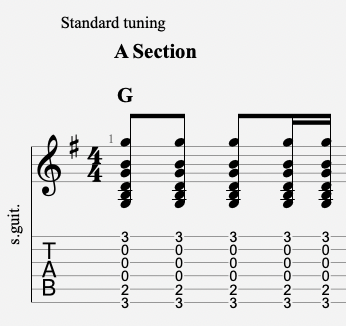
The main feel for “Cry Baby Cry” is an acoustic folk-rock feel. I would count out quarter notes, but underneath that is this subtle 16th rhythm that sneaks in. In 4/4 time, 16th notes divide each beat into four equal parts, creating a quicker, more flowing rhythm. The counting for 16th notes in a measure looks like this:
1 e & a 2 e & a 3 e & a 4 e & a
The numbers (1, 2, 3, 4) represent the main beats in the measure. The "e," "&," and "a" divide each beat into four evenly spaced subdivisions.
When counted out loud, it sounds like:
"One-ee-and-a, Two-ee-and-a, Three-ee-and-a, Four-ee-and-a."
Here’s an example of a strumming pattern in the style of “Cry Baby Cry”:
Conclusion
To wrap it up, “Cry Baby Cry” is a gem. It’s a fun but haunting song from the Beatles' iconic White Album.
Keep practicing, and if you want to learn songs way faster, better understand the fretboard for lead and rhythm, and not waste years spinning your wheels with guitar, grab my free fretboard guide here right now:
Jon MacLennan
Like this blog post? Get Jon’s best guitar lessons straight to your inbox.
Discover the 5 easiest and fastest ways to play the blues scale anywhere on the neck with this FREE PDF GUIDE
