Don't You Forget About Me Chords & Guitar Lesson
Here's a tune that was originally rejected by famous artists like Billy Idol, Bryan Ferry, and even The Fixx.
It wasn’t until Simple Minds recorded it, and it was placed in the film The Breakfast Club, where it really took off.
Below, I’m going to share some insider tips on the guitar style behind it.
So grab your axe, and let’s dive into this “Don't You Forget About Me” chords and guitar lesson!
Who Wrote Don't You Forget About Me?
“Don’t You (Forget About Me)” was written by two songwriters, Keith Forsey and Steve Schiff, specifically for the 1985 film The Breakfast Club.
This tune has become one of the most iconic songs of the 1980s, but its backstory is surprising. It was first offered to several famous artists like Billy Idol, Bryan Ferry, and even The Fixx, to record. But they all declined the offer. It eventually landed with Simple Minds – who also weren't keen on recording someone else’s material.
The band finally agreed to record it after being shown a rough cut of The Breakfast Club.
Simple Minds recorded the song in November 1984.
Upon its release as a single in the U.S. on February 20, 1985, the song instantly struck a chord. It shot up to No. 1 on the Billboard Hot 100 and became Simple Minds’ only U.S. chart-topper
It also reached the UK Top 10 and was featured prominently in The Breakfast Club's opening and closing credits. The track sold over 7 million copies worldwide, making it one of the best-selling singles of its time.
Now, you may be wondering…
What is the tuning for Don't You Forget About Me?
The tuning for "Don't You Forget About Me," as recorded by Simple Minds, is standard tuning. Standard tuning is spelled: E, A, D, G, B, and E.
Here are the strings:
- E (6th string, lowest pitch)
- A (5th string)
- D (4th string)
- G (3rd string)
- B (2nd string)
- E (1st string, highest pitch)
All right!
Now that you know the tuning for “Don't You Forget About Me”, let’s next talk about…
Don't You Forget About Me Chords
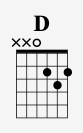
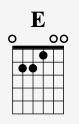
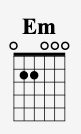
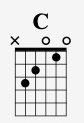
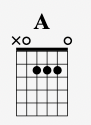
To play “Don't You Forget About Me”, as recorded by Simple Minds, you’ll need to know 5 main chords they are D, E, Em, C, and A. All of these chords can be played as standard open position chords. Let’s take a look at a few ways these chords can be played on the fretboard.
D is played from the 4th string down like so:
E is a great full sounding chord using all 6 strings as well, like this:
Em changes just one note from the previous E chord above. It lowers the G# down to G with the open 3rd string like this:
C is played in a standard (campfire) position like this:
Finally, we have A, which is played from the 5th string down like this:
If you’ve struggled to understand the fretboard for RHYTHM and LEAD guitar, and want to discover the easiest and fastest way. Then get your hands on my free Fretboard Guide PDF right here now:
Is Don't You Forget About Me hard to play on guitar?
I would say playing “Don't You Forget About Me” on guitar is going to require a beginner to late beginner skill level. It only uses 5 chords, and none of them are bar chords. However, there are some syncopated rhythms and also some palm-muting that needs to be in place. So, take your time with this one.
What key is Don't You Forget About Me in?
“Don't You Forget About Me,” as recorded by Simple Minds, is in the key of E major. However, there is a bit of a play between E major and E minor because of some nebulous bluesy thirds that appear in the intro and throughout the song.
Here’s a quick look at how all these chords relate in the key of E major:
E
Notes: E, G♯, B
Function: This is the I chord (tonic) in the key of E major – the “home” chord. It provides the sense of resolution and stability that defines the key.
A
Notes: A, C♯, E
Function: This is the IV chord (subdominant) in the key of E major. It creates forward movement and is commonly used before transitioning to the dominant (V) or back to the tonic (I).
D
Notes: D, F♯, A
Function: This chord does not belong to the key of E major. In the key of E major, D is a sub-tonic of a ♭VII chord. This can be thought of as a borrowed chord from the E Mixolydian mode, or just as a gritty, bluesy chord. The I to the♭VII chord is a common move in rock.
Em
Notes: E, G, B
Function: This is the parallel minor version of the tonic chord (E major vs. E minor). However, Em does not belong to the key of E major diatonically. Its presence implies modal borrowing (from E minor or E Dorian, for example), and this is introduced through the G natural, which clashes with the G♯ of the E major scale. Again, another element of the blues.
C
Notes: C, E, G
Function: C major is also not diatonic to the key of E major. In E major, the vi chord would be C♯ minor. So C is another borrowed chord from the parallel minor (Em). This acts as a ♭VI chord in rock and blues progressions.
So that’s the theory. Next, let’s look at…
What is the strumming pattern for Don't You Forget About Me?
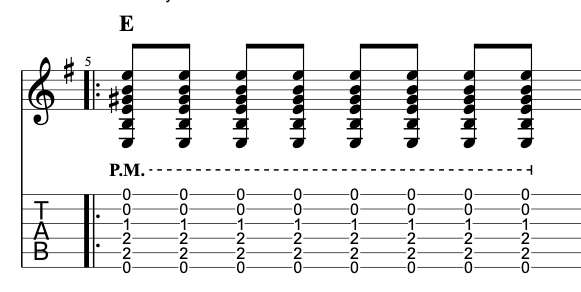
The main underlying groove for “Don't You Forget About Me” is a driving 8th-note rock feel. In 4/4 time, 8th notes divide each beat into two equal parts, creating a driving, steady rhythm like this:
1 & 2 & 3 & 4 &
The numbers (1, 2, 3, 4) represent the main beats in the measure, while the "&" represents the offbeats that add energy and momentum.
When counted out loud, it sounds like:
"One-and, Two-and, Three-and, Four-and."
This gives the song a strong and consistent forward motion. There are many different variations on the strumming, and some of the rhythms are syncopated. But, here’s an example of a “Don't You Forget About Me” strumming pattern using 8th notes and some palm-muting:
Conclusion
There you have it! Those are some insider tips on the guitar style behind this 80s classic.
Keep practicing, and if you want to learn songs way faster, better understand the fretboard for lead and rhythm, and not waste years spinning your wheels with guitar, grab my free fretboard guide here right now:
Jon MacLennan
Like this blog post? Get Jon’s best guitar lessons straight to your inbox.
Discover the 5 easiest and fastest ways to play the blues scale anywhere on the neck with this FREE PDF GUIDE
