The ULTIMATE Down On The Corner Chords & Guitar Lesson
Here’s a fun storytelling song about a street performing band named “Willy and the Poor Boys.
It’s got an awesome upbeat feeling and a great harmonized riff.
Below, I’m going to share with you some insider tips on the guitar style behind it.
So grab your axe, and let’s dive into this “Down on the Corner” chords and guitar lesson!
Who Wrote Down on the Corner?
“Down on the Corner” was written by John Fogerty, the lead singer for the American rock band Creedence Clearwater Revival (CCR). It’s an upbeat roots rock style tune, with a funky groove. The lyrics sing the story of a street corner band that goes by the name of Willy and the Poor Boys. They play music for change. Willy and the Poor Boys consists of four members: Willy on washboard and bass, Stu on rhythm guitar, Doug on drums, and Tom on the trumpet.
They play for tips and to bring joy to the community. But they are broke.
The song captures a romanticized, nostalgic view of simple street life and the power of music to bring people together. The central theme is the joy and authenticity of simple, working-class entertainment and the idea that happiness isn't dependent on wealth.
The story behind the song is purely imaginative, but the name of the fictional band, Willy and the Poor Boys, became the title of the album “Down on the Corner” appears on.
Fogerty got the idea thinking about spontaneous street performers he’d heard, and he used the band members' actual first names (Stu Cook, Doug Clifford, Tom Fogerty) and his own nickname, Willy.
"Down on the Corner" was recorded in 1969 at Wally Heider Studios in San Francisco, California. It was released as a double A-side single along with "Fortunate Son" in September 1969.
Upon its release, “Down on the Corner” became a massive hit. It peaked at Number 3 on the U.S. Billboard Hot 100 chart. Since then, the song has received a ton of airplay and has become one of CCR’s most beloved songs.
Now, you may be wondering…
What is the tuning for Down on the Corner?
The tuning for "Down on the Corner” is standard tuning. Standard tuning is spelled: E, A, D, G, B, and E.
Here are the strings:
- E (6th string, lowest pitch)
- A (5th string)
- D (4th string)
- G (3rd string)
- B (2nd string)
- E (1st string, highest pitch)
Although Fogerty tuned down on many of CCR’s biggest hits. For this one, he kept things simple.
All right!
Now that you know the tuning for “Down on the Corner,” let’s next talk about…
Down on the Corner Chords
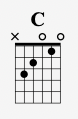
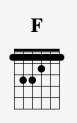
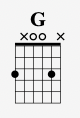
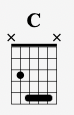
To play “Down on the Corner”, you only need to know 3 chords they are C, F, and G. These chords can be played primarily as open position chords. Or, alternatively, you can play them all as bar chord shapes as well. I would recommend knowing both long-term.
If bar chords are giving you all kinds of aches and pains, and you haven’t yet discovered how to play them effortlessly, go here: https://www.jonmaclennan.com/7mistakes
Let’s take a look at a few ways these shapes might appear on the fretboard.
C can be played in a standard (campfire) position, from the 5th string down, like this:
F is played as a bar chord in 1st position, using all 6 strings like so:
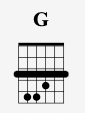
G can be played open position like this:
Now, alternatively, you could play the C as a bar chord in 3rd position like this:
And finally, you can take the F chord above and shift it 2 frets up to get a G like this as well:
If you’ve struggled to understand the fretboard for RHYTHM and LEAD guitar, and want to discover the easiest and fastest way. Then get your hands on my free Fretboard Guide PDF right here now:
Is Down on the Corner hard to play on guitar?
I would say playing “Down on the Corner” on guitar is going to require an intermediate to advanced skill level. There are only 3 chords, so, from a chord progression standpoint, it is very simple. But just because something is simple does not mean it’s easy. Nailing the rhythm/groove is where the bulk of the work is going to be done. You see, the changes are often made on 16th note syncopations. This is a huge part of what gives the song that swampy, funky feel. So, take your time with this one.
What key is Down on the Corner in?
“Down on the Corner”, as recorded by CCR, is in the key of C major. The primary scale for the song is the C major scale, which is built using the notes C, D, E, F, G, A, and B.
Let’s take a closer look at how all these chords relate in the key of C major. Starting with…
C
Notes: C, E, G
Function: This is the I chord, the tonic of the key. It’s the musical “home base”. The I chord is the chord songs often start/end on. Any progression that lands on C feels complete because the chord contains the root (C), major 3rd (E), and perfect 5th (G). These are crucial notes that define the key itself.
F
Notes: F, A, C
Function: This is the IV chord (a.k.a the subdominant). The IV chord proves a nice move away from the tonic without creating strong tension. F feels open and like something new. There are countless songs, moving from C to F. F often circles back to C for resolution or pushes forward to G for more energy.
G
Notes: G, B, D
Function: This is the V chord, the dominant, and it’s the strongest source of tension in the key. The major 3rd (B) creates a leading tone that wants to resolve up to C. That pull makes G the perfect setup chord before returning home to the I chord. G is what gives the classic I–IV–V progression its power, drive, and forward motion.
All right!
That’s my theory breakdown.
Next, let’s look at…
What is the strumming pattern for Down on the Corner?
The main underlying feel for “Down on the Corner” is a swampy 16th-note rock groove.
In 4/4 time, 16th notes divide each beat into four equal parts, creating a quicker, more flowing rhythm. The counting for 16th notes in a measure looks like this:
1 e & a 2 e & a 3 e & a 4 e & a
The numbers (1, 2, 3, 4) represent the main beats in the measure. The "e," "&," and "a" divide each beat into four evenly spaced subdivisions.
When counted out loud, it sounds like:
"One-ee-and-a, Two-ee-and-a, Three-ee-and-a, Four-ee-and-a."
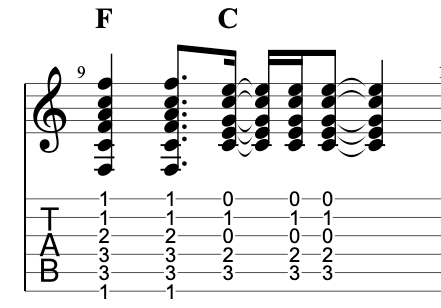
Here’s an example of a strumming pattern in the style of “Down on the Corner”:
Conclusion
Bottom line, “Down on the Corner” is yet another fun and catchy tune written by John Fogerty. He’s a master at creating upbeat pop songs, and with very simple ideas!
Keep practicing, and if you want to learn songs way faster, better understand the fretboard for lead and rhythm, and not waste years spinning your wheels with guitar, grab my free fretboard guide here right now:
Jon MacLennan
Like this blog post? Get Jon’s best guitar lessons straight to your inbox.
Discover the 5 easiest and fastest ways to play the blues scale anywhere on the neck with this FREE PDF GUIDE
