The ULTIMATE Dreams Chords & Guitar Lesson
Here’s a legendary tune from one of the best-selling albums of all time.
It’s also perfect for grabbing a partner and hitting the dance floor for a slow dance.
It’s groovy…
In the pocket…
…and classic.
Below I’m going to share some insider secrets for Lindsey Buckingham’s guitar style on it.
So grab your axe, and let’s dive into this “Dreams” chords and guitar lesson!
Who Wrote Dreams?
"Dreams" was written by Stevie Nicks, lead vocalist and songwriter for the band Fleetwood Mac. It was released as a single in 1977 for the album Rumours, which went on to become one of the best-selling albums of all time.
"Dreams" was inspired by Nicks’ personal experiences and the emotional tension within Fleetwood Mac at the time. You see, the band was going through some drama, with Nicks and Buckingham breaking up and the band's overall tensions running high.
The song is about heartbreak and the realization that love is fleeting. Nicks’ lyrics convey a sense of the relationship on the verge of breaking down. The central theme revolves around letting go of someone, but still being haunted by dreams of the past.
According to Nicks, she wrote "Dreams" in a very relaxed setting. She was staying in a small room at the band's studio, and the song came to her one evening when she was alone. It’s said she came up with the melody first and then crafted the lyrics, letting the emotional weight of the band's internal dynamics inspire the words.
"Dreams" was recorded at The Record Plant in Sausalito, California. This was during the recording sessions for Rumours, which took place throughout 1976 and into early 1977. The album was produced by Ken Caillat and Richard Dashut, who helped capture the band's raw emotional performances.
"Dreams" became Fleetwood Mac's first and only No. 1 single on the Billboard Hot 100 chart in 1977. Rumours, the album it was featured on, went on to sell over 40 million copies worldwide, making it one of the best-selling albums ever.
"Dreams" was included in various "best of" lists and has remained a fan favorite over the years. It was even named one of the 500 Greatest Songs of All Time by Rolling Stone.
Now, you may be wondering…
What is the tuning for Dreams?
The tuning for "Dreams", as recorded by Fleetwood Mac, is standard tuning. Standard tuning is spelled: E, A, D, G, B, and E.
Here are the strings:
- E (6th string, lowest pitch)
- A (5th string)
- D (4th string)
- G (3rd string)
- B (2nd string)
- E (1st string, highest pitch)
All right!
Now that you know the “Dreams” tuning, let’s next talk about…
Dreams Chords
To play “Dreams”, you’ll need to know 3 main chords they are Fsus2, G5, and Am. However, I’ll also show you 2 easier variations (Fmaj7 and G) as alternative options as well. Let’s take a look at a few ways these shapes can be played on the fretboard.
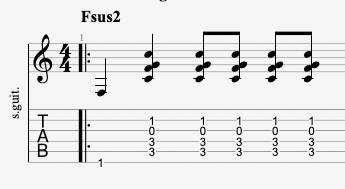
Fsus2 is played on the middle strings, and if you want to add the thumb bass note for an advanced and full sound, you can like this:

G5 simply shifts Fsus2 up 2 frets like this:

So many YouTube instructors and players think this song is only 2 chords, however, there is another chord that pops up in the guitar solo/instrumental section and that is Am. I play it from the 5th string down like this:

As promised, if the chords Fsus2 and G5 are too difficult, try these easier alternatives. First is Fmaj7 played from the 4th string down like so:

Finally, we have G, which can be played in open position like this:

If you’ve struggled to understand the fretboard for RHYTHM and LEAD guitar and want to discover the easiest and fastest way. Then get your hands on my free Fretboard Guide PDF right here now:
Is Dreams hard to play on guitar?
I would say “Dreams” requires a solid intermediate to advanced skill level to play. There are not a lot of chords. However, getting the sections right, knowing when they change (which most people miss), and nailing the solo like Lindsey Buckingham is not easy. So, take your time with this one.
What key is Dreams in?
“Dreams” as recorded by Fleetwood Mac, is in the key of C major/A minor. The primary scale for the tune is the C major scale which uses all natural notes. These notes are: C, D, E, F, G, A, and B.
All of the chords fit the diatonic scale. Here’s a quick look at how they all relate:
Fsus2 (F suspended 2)
Notes in Fsus2: F, G, C
Function: In the key of C major, Fsus2 functions as the IV (subdominant) chord. The suspended 2nd (G) in the chord gives it a slightly open, unresolved feel. It’s typically used as a way to create a sense of suspension before resolving to another chord. The bulk of the song is built around the IV chord. However, the key is still C major/A minor.
G5 (G power chord)
Notes in G5: G, D
Function: G5 is a dominant (V) power chord in the key of C major. Power chords, often just consisting of the root and the 5th, don’t include a 3rd, so they lack major or minor tonality.
Am (A minor)
Notes in Am: A, C, E
Function: Am is the vi (submediant) chord in C major. The vi chord is typically a minor chord, and it often serves as a pre-dominant chord (leading to a V or IV chord), giving the progression a sense of melancholy or tension. This happens during the guitar solo/instrumental section.
So that’s the theory. Next, let’s look at…
What is the strumming pattern for Dreams?
The main underlying groove for “Dreams” is a slow and steady 8th-note rock feel. In 4/4 time, 8th notes divide each beat into two equal parts, creating a driving, steady rhythm like this:
1 & 2 & 3 & 4 &
The numbers (1, 2, 3, 4) represent the main beats in the measure, while the "&" represents the offbeats that add energy and momentum.
When counted out loud, it sounds like:
"One-and, Two-and, Three-and, Four-and."
This gives a strong and consistent forward motion to the tune. Here’s an example of a “Dreams” strumming pattern combining quarter notes and 8th notes like this:
Dreams Guitar Lesson (Lindsey Buckingham Guitar Solo)
Conclusion
To wrap it up, “Dreams” is one of the most iconic slow rock tunes of all time. It’s sure to put your audience into a trance and get a great reaction from the crowd.
Keep practicing, and if you want to learn songs way faster, better understand the fretboard, and not waste years spinning your wheels with guitar, grab my free fretboard guide here right now:
Jon MacLennan
Like this blog post? Get Jon’s best guitar lessons straight to your inbox.
Discover the 5 easiest and fastest ways to play the blues scale anywhere on the neck with this FREE PDF GUIDE
