The ULTIMATE Eight Days A Week Chords & Guitar Lesson
Paul McCartney got the idea for this song when he jumped in a cab and asked the driver, “How've you been?”
The guy’s response was, “Oh, working hard…working eight days a week.”
Below, I want to share some insider tips on the guitar style behind it.
So grab your axe, and let’s dive into this “Eight Days A Week” chords and guitar lesson!
Who Wrote Eight Days A Week?
“Eight Days A Week” was written primarily by Paul McCartney. However, it’s officially credited to the Lennon/McCartney songwriting partnership.
The Beatles recorded “Eight Days A Week” at EMI Studios (now Abbey Road Studios) in London on October 6 and 18, 1964. George Martin was at the helm producing, and the song is noted as one of the first ever pop songs to fade in. This was a technique suggested by recording engineer Norman Smith.
“Eight Days A Week” was released in the UK on the album Beatles for Sale in December 1964. Shortly after, it was issued as a single in the US in February 1965. This is when it became the Beatles' seventh number-one hit on the Billboard Hot 100. The song was also certified Gold by the RIAA on September 16, 1965.
Despite its success, John Lennon later described it as "lousy" and "manufactured." However, the catchy melody and innovative production have stood the test of time. The song's title was later used for Ron Howard's 2016 documentary The Beatles: Eight Days a Week – The Touring Years, which dives into the band's extensive touring history and impact on global pop culture.
Now, you may be wondering…
What is the tuning for Eight Days A Week?
The tuning for "Eight Days A Week" as recorded by The Beatles is standard tuning. John and George kept things simple. Standard tuning is spelled: E, A, D, G, B, and E.
Here are the strings:
- E (6th string, lowest pitch)
- A (5th string)
- D (4th string)
- G (3rd string)
- B (2nd string)
- E (1st string, highest pitch)
All right!
Now that you know the tuning for “Eight Days A Week”, let’s next talk about…
Eight Days A Week Chords
To play “Eight Days A Week”, as recorded by The Beatles, you’ll only need to know 5 main chords they are D, E, G, Bm, and A7. Bm is the one chord I play as a bar chord, the rest are (campfire).
Let’s take a look at a few ways these shapes can be played on the fretboard.
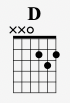
D is played from the 4th string down like this:
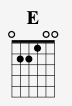
E has a great full sound using all 6 strings like this:
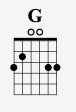
G uses all 6 strings as well, like this:
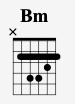
As mentioned, Bm is the one chord I play as a bar chord in 2nd position like this:
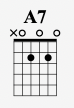
Finally, A7 is played from the 5th string down like this:
If you’ve struggled to understand the fretboard for RHYTHM and LEAD guitar. and want to discover the easiest and fastest way. Then get your hands on my free Fretboard Guide PDF right here now:
Is Eight Days A Week hard to play on guitar?
I would say playing “Eight Days A Week” is a great song for beginners. However, to nail all the parts that’s going to require a late beginner to early intermediate skill level. There are several challenges to navigate, like different strumming patterns, hammer-ons in the riff, and quick changes. So, take your time with this one.
What key is Eight Days A Week in?
“Eight Days A Week,” as recorded by The Beatles, is in the key of D major. The primary scale used in the song is the D major scale, which is built using the notes D, E, F#, G, A, B, and C#.
Here’s a quick look at how the chords relate in the key of D major:
D major
Notes: D, F#, A
Function: This is the I chord in the key of D major.
It’s the tonic, or “home” chord. It feels stable and resolved. Most progressions in D major begin or end on this chord.
E major
Notes: E, G#, B
Function: This chord is not diatonic to D major (it contains G# instead of G natural).
However, this major II chord is a very common move used in millions of songs.
G major
Notes: G, B, D
Function: This is the IV chord in the key of D major. G provides a sense of lift and deviation from the tonic.
B minor (Bm)
Notes: B, D, F#
Function: This is the vi chord in the key of D major.
It’s the relative minor of D and shares two notes (D and F#). It provides a more introspective or emotional color when used in progressions.
A7
Notes: A, C#, E, G
Function: This is the V7 chord in the key of D major.
It creates strong tension that resolves naturally to the tonic (D major). The G natural (b7 of A) adds extra pull and is essential in dominant seventh function.
So that’s the theory. Next, let’s look at…
What is the strumming pattern for Eight Days A Week?
The main underlying groove for “Sweet Dreams” is a driving 8th-note rock feel. In 4/4 time, 8th notes are usually counted as evenly spaced: "1 & 2 & 3 & 4 &" – but in a swing feel, they’re played with a long-short rhythm, like a triplet where the first two notes are tied and the third is played.
So instead of sounding even, they feel like:
“Dah - duh, Dah - duh, Dah - duh, Dah - duh”
You still count them as:
1 & 2 & 3 & 4 &
But the feel is more like:
“One...and, Two...and, Three...and, Four...and”
—with the “&” coming late, like it’s leaning forward into the next beat.
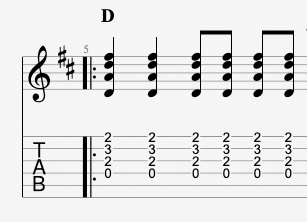
Here’s an example of a strumming pattern in the style of “Eight Days A Week”:
Eight Days A Week Guitar Lesson (Melody)
Another great way to practice this song (aside from the main guitar part) is to try the melody. The melody is the part the singer sings. This will work great for playing your own instrumental version or improving your solos as well.
Eight Days A Week Solo Guitar Performance
Here’s a version I learned from Scotty Anderson, where he plays all the parts at once. It’s not easy to play, but a lot of fun for those who would like a killer solo guitar workout.
Conclusion
Inspired by the plight of the everyday man, mix in a bit of romance, and you’ve got a classic. “Eight Days A Week” is a guitar tune every player should know.
Keep practicing, and if you want to learn songs way faster, better understand the fretboard for lead and rhythm, and not waste years spinning your wheels with guitar, grab my free fretboard guide here right now:
Jon MacLennan
Like this blog post? Get Jon’s best guitar lessons straight to your inbox.
Discover the 5 easiest and fastest ways to play the blues scale anywhere on the neck with this FREE PDF GUIDE
