The Beatles – “Eleanor Rigby” Chords & Guitar Lesson
I’ve always found songs titled women’s names interesting…
“Roxanne”
“Peg”
“Josie”
But here’s one of the darkest, most mysterious of them all.
Below, I’m going to share with you some insider tips on a guitar style behind it.
So grab your axe, and let’s dive into this “Eleanor Rigby” chords and guitar lesson!
Who Wrote Eleanor Rigby?
“Eleanor Rigby” was written primarily by Paul McCartney; however, it’s credited under the typical Lennon/McCartney songwriting partnership. The song marks a clear shift in The Beatles' sound and direction to now including orchestral and classical influences.
This was heavily do to George Martin’s influence. But “Eleanor Rigby” was released on the Beatles’ album Revolver in 1966.
The lyrics sing of a woman named Eleanor Rigby who “picks up the rice in the church where a wedding has been.” The song carries a sense of loneliness and isolation. It portrays the lives of people who live and die almost completely alone. Father McKenzie is another character in the song who writes sermons “that no one will hear” and darns his socks at night.
The song ends with Eleanor’s death and burial, which was attended by no one… except Father McKenzie.
It’s quite an interesting song.
McCartney has said that Eleanor Rigby was a fictional character. However, years later, a real gravestone for an Eleanor Rigby was discovered in the churchyard of St Peter’s Church in Woolton, Liverpool, a place McCartney had visited as a teenager. This coincidence has only added to the song’s lore.
“Eleanor Rigby” was recorded at EMI Studios (now Abbey Road Studios) in London in April and June of 1966. One of its most striking features is the complete absence of guitars, bass, or drums. Instead, the song is driven by a double string quartet, scored by producer George Martin and inspired in part by Bernard Herrmann’s string work for Alfred Hitchcock’s film “Psycho”.
Paul McCartney sings the lead vocal, with John Lennon and George Harrison adding harmonies on the refrain.
Upon its release, “Eleanor Rigby” was unlike anything else on pop radio. In the United States, it reached number 11 on the Billboard Hot 100, which was quite respectable for such an unusual arrangement. Critics immediately recognized it as something special. Over time, it has become one of the most celebrated and haunting songs in the Beatles’ catalog.
Now, you may be wondering…
What is the tuning for Eleanor Rigby?
The tuning for "Eleanor Rigby” is standard tuning. Paul kept things simple. Standard tuning is spelled: E, A, D, G, B, and E.
Here are the strings:
- E (6th string, lowest pitch)
- A (5th string)
- D (4th string)
- G (3rd string)
- B (2nd string)
- E (1st string, highest pitch)
All right!
Now that you know the tuning for “Eleanor Rigby,” let’s next talk about…
Eleanor Rigby Chords
To play “Eleanor Rigby”, as recorded by The Beatles, you only need to know 5 main chords they are C, Em, Em7, Em6, and Em(#5). These chords can all be played in open position, so it’s a great song for beginners.
Let’s take a look at a few ways these shapes might show up on the fretboard.
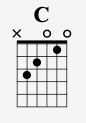
C is played in a standard (campfire) style from the 5th string down like this:
Em is a beautiful-sounding open chord that uses all 6 strings like this:

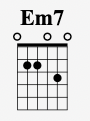
Em7 uses all 6 strings as well, and this one begins a moving line through the chords like this:
Em6 just shifts one note from Em7. The D moves down to the C# on the 2nd string like this:

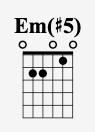
Finally, we have Em(#5). This chord sounds complicated, but it again just makes one more shift from the Em6. I play it like this:
If you’ve struggled to understand the fretboard for RHYTHM and LEAD guitar, and want to discover the easiest and fastest way. Then get your hands on my free Fretboard Guide PDF right here now:
Is Eleanor Rigby hard to play on guitar?
I would say playing “Eleanor Rigby” on guitar is going to require a late beginner skill level. The song only has 5 chords, all of which are open. However, the palm-muting and changing chords smoothly and up to tempo are most likely going to be the hardest parts. So, take your time with this one.
What key is Eleanor Rigby in?
“Eleanor Rigby”, as recorded by The Beatles, is in the key of E minor. The primary scale would be the E minor scale, which is built using the notes E, F#, G, A, B, C, and D.
Let’s take a closer look at how all these chords relate in the key of E minor. Starting with…
Em
Notes: E, G, B
Function: This is the i chord, the tonic in the key of E minor. It’s the home base where everything feels resolved and stable.
Em7
Notes: E, G, B, D
Function: This is still the i chord, but with a minor seventh added. The D note comes directly from the E natural minor scale, so this chord feels completely diatonic. Em7 softens the tonic and makes it sound more open and jazzy. This chord is used as part of a descending line.
Em6
Notes: E, G, B, C#
Function: This is another tonic variation, but the added 6th (C#) comes from E melodic minor rather than E natural minor. That raised 6 gives the chord a more complex sound. It’s closer to a James Bond sound.
Em(#5)
Notes: E, G, C
Function: This is a tonic chord with an altered fifth. The B is raised to C, creating tension inside the chord itself. It adds drama and forward pull while still being rooted in E.
C
Notes: C, E, G
Function: This is the VI chord in the key of E minor. It’s one of the most important supporting chords in minor keys. C major shares two notes with Em (E and G), which makes the move between them feel very smooth.
Together, these chords make up some of the most common sets of chords in popular music.
Millions of songs use them…
All right!
That’s my theory breakdown.
Next, let’s look at…
What is the strumming pattern for Eleanor Rigby?
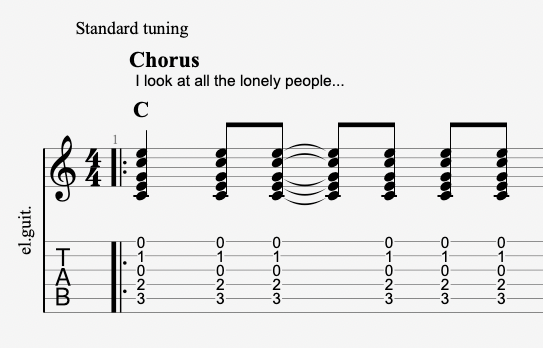
The main underlying groove for “Eleanor Rigby” is an 8th note feel. In 4/4 time, 8th notes divide each beat into two equal parts, creating a driving, steady rhythm like this:
1 & 2 & 3 & 4 &
The numbers (1, 2, 3, 4) represent the main beats in the measure, while the "&" represents the offbeats that add energy and momentum.
When counted out loud, it sounds like:
"One-and, Two-and, Three-and, Four-and."
This gives a strong and consistent forward motion to the tune.
So that’s the overall feel. Here’s an example of a strumming pattern that uses 8th notes in the style of “Eleanor Rigby”:
Conclusion
To wrap it up, “Eleanor Rigby” is one of the most tumultuous and interesting Beatles songs ever. So, was Eleanor a real person or not? Who knows?
But one thing’s for sure…
Keep practicing, and if you want to learn songs way faster, better understand the fretboard for lead and rhythm, and not waste years spinning your wheels with guitar, grab my free fretboard guide here right now:
Jon MacLennan
Like this blog post? Get Jon’s best guitar lessons straight to your inbox.
Discover the 5 easiest and fastest ways to play the blues scale anywhere on the neck with this FREE PDF GUIDE
