The ULTIMATE EVERLONG Chords & Guitar Lesson (Foo Fighters)
Behold…one of the most popular rock songs from the ‘90s.
It’s got incredible energy.
And the songwriting is masterful.
Below, I’m going to share some insider tips on the guitar style behind it.
So grab your axe, and let’s dive into this “Everlong” chords and guitar lesson!
Who Wrote Everlong?
“Everlong” was originally written by Dave Grohl with the Foo Fighters. It was released in 1997 as the second single from their second album, The Colour and the Shape.
Like many great songs, it came out of turmoil. You see, the Foo Fighters had just gone through a lineup change, and Grohl was in the middle of a divorce from his first wife, Jennifer Youngblood. Around this same time, he met Louise Post from the band Veruca Salt. Post became the inspiration for “Everlong”.
Grohl has described the song as being about realizing you’ve met someone who makes you feel completely alive again after heartbreak. This was the intense spark and limerance of a new relationship.
Hence lyrics like: “If everything could ever feel this real forever.”
Grohl wrote the majority of the song while staying at a friend’s house in Virginia over Christmas 1996. He had only his guitar and a small recording setup. It came together quickly once he stumbled upon the opening riff while on acoustic and felt it was something unique. Later, when the band went into Grandmaster Recorders in Hollywood to finish The Colour and the Shape, the track took its final form.
William Goldsmith was still technically still a part of the band at this time, but Grohl actually re-recorded the drums himself. He’s a phenomenal rock drummer and originally played drums for Nirvana. All of this added to the incredible energy the song has.
Upon its release as a single on August 18th, “Everlong” peaked at number 3 on the Billboard Modern Rock Tracks chart. It has steadily grown in popularity since and is now one of the Foo Fighters’ most famous tracks.
“Everlong” has appeared in countless films, shows, and live performances—it even had a viral acoustic version that Grohl performed on The Howard Stern Show in 1998, which brought out the song’s raw emotional power and songwriting genius
Now, you may be wondering…
What is the tuning for Everlong?
The tuning for "Everlong,” as recorded by the Foo Fighters, is drop D tuning. Drop D tuning is spelled: D, A, D, G, B, and E.
Here are the strings:
- D (6th string, lowest pitch)
- A (5th string)
- D (4th string)
- G (3rd string)
- B (2nd string)
- E (1st string, highest pitch)
So, you just change that one string from standard tuning and you’re good to go.
All right!
Now that you know the tuning for “Everlong,” let’s next talk about…
Everlong Chords
To play “Everlong”, you’ll need to know 7 main chords they are Dmaj7, Bsus2, Gsus2, B5, G5, D5, and A5. Keep in mind that for these chord shapes to work, you must be in a drop D tuning.
Let’s take a look at a few ways these shapes can be played on the fretboard.
Dmaj7 is a beautiful-sounding chord played in 9th position with the 6th string open like this:

Bsus2 makes just a subtle change from the Dmaj7. Here we’ll simply bar the index finger like this:

Gsus2 is played by shifting the previous chord down to the 5th fret like this:

B5 is played in 9th position like this:

G5 is a one-finger power chord played in the 5th position like so:

D5 is played in open position using all the strings but the 1st, like this:

Finally, we have A5, which is another one-finger power chord played like this:

If you’ve struggled to understand the fretboard for RHYTHM and LEAD guitar, and want to discover the easiest and fastest way. Then get your hands on my free Fretboard Guide PDF right here now:
Is Everlong hard to play on guitar?
I would say playing “Everlong” on guitar is going to require at least an intermediate skill level. The most difficult parts are the rhythmic sycopations, the riffs, and the speed. It must be played with a relentlessly driving, high-energy rhythm to get the sound. So, take your time with this one.
What key is Everlong in?
“Everlong”, as recorded by the Foo Fighters, is in the key of D major. The primary scale for the song is the D major scale, which is built using the notes D, E, F#, G, A, B, and C#.
All of the chords fit into the diatonic scale of D major. Let’s take a look at how they function in the key of D major next. Starting with…
Dmaj7
Notes: D, F#, A, C#
Function: This is the I chord in the key of D major. It’s the tonic—the home base. The major 7th (C#) adds a jazzy color to it. But the way Grohl plays the chord is more rock.
Bsus2
Notes: B, C#, F#
Function: B is the sixth degree in the key of D major, so this chord functions as a vi chord variation. Instead of being B minor, the sus2 omits the minor third (D) and replaces it with a second (C#), creating a more open, ambiguous sound.
Gsus2
Notes: G, A, D
Function: G is the IV chord in D major. Normally, it would be G major (G, B, D), but the sus2 replaces the B with an A similar to what we did on the previous chord. This gives the sound a suspended, unresolved sound.
B5
Notes: B, F#
Function: This is a power chord built on the sixth degree of D major. Because it lacks a third, it doesn’t define itself as major or minor.
G5
Notes: G, D
Function: This is the IV chord in power chord form. Like all “5” chords, this removes the third and keeps things harmonically neutral.
D5
Notes: D, A Function: This is a tonic power chord. It’s the root of the key stripped down to rock basics.
A5
Notes: A, E
Function: This is the V chord in power chord form.
All right!
That’s my theory breakdown.
Next, let’s look at…
What is the strumming pattern for Everlong?
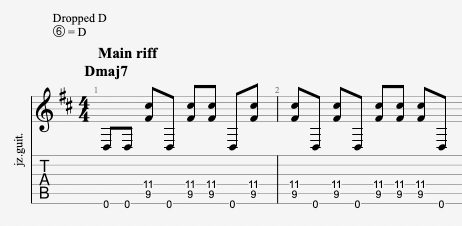
The main underlying feel for “Everlong” is a relentless 8th-note rock feel. In 4/4 time, 8th notes divide each beat into two equal parts, creating a steady, walking rhythm. The counting for 8th notes in a measure looks like this:
1 & 2 & 3 & 4 &
The numbers (1, 2, 3, 4) represent the main beats in the measure. The "&" divides each beat into two evenly spaced subdivisions.
When counted out loud, it sounds like:
"One-and, Two-and, Three-and, Four-and."
Here’s an example of a simple rock strumming pattern on the Dmaj7 chord in the style of “Everlong”:
Conclusion
Bottom line, “Everlong” is a classic piece of ‘90s rock history. The guitar part is very recognizable, and the song works great on both electric and acoustic.
Keep practicing, and if you want to learn songs way faster, better understand the fretboard for lead and rhythm, and not waste years spinning your wheels with guitar, grab my free fretboard guide here right now:
Jon MacLennan
Like this blog post? Get Jon’s best guitar lessons straight to your inbox.
Discover the 5 easiest and fastest ways to play the blues scale anywhere on the neck with this FREE PDF GUIDE
