The ULTIMATE “Fly Me To The Moon” Chords & Guitar Lesson
There are countless lessons online for this song, but unfortunately, most are garbage.
Below, I’m going to share with you what I believe to be the MOST accurate approach, and some insider tips on the guitar style behind it.
So grab your axe, and let’s dive into this “Fly Me To The Moon” chords and guitar lesson!
Who Wrote Fly Me To The Moon?
“Fly Me to the Moon” was originally written by American composer and pianist Bart Howard in 1954. At first, it was titled “In Other Words”, but then he changed the name, and it has gone on to become a standard of the Great American Songbook. The first recording of it was done by Kaye Ballard (as a ballad) in 1954:
However, the song didn’t really break through until Frank Sinatra got his hands on it. His version, arranged by Quincy Jones and performed with the Count Basie Orchestra in 1964, became the gold standard of the song.
Sinatra took a different approach. They transformed it into an upbeat swinging groove, giving it a timeless and sophisticated charm.
Another interesting note is that “Fly Me to the Moon” became associated with NASA and the Apollo program, particularly Apollo 10 and Apollo 11. Astronauts played the song on their space missions, linking it to humanity’s literal journey to the moon!
Now, you may be wondering…
What is the tuning for Fly Me To The Moon?
The tuning for "Fly Me To The Moon” is standard tuning. Most old-school jazz players didn’t use alternate tunings. Standard tuning is spelled: E, A, D, G, B, and E.
Here are the strings:
- E (6th string, lowest pitch)
- A (5th string)
- D (4th string)
- G (3rd string)
- B (2nd string)
- E (1st string, highest pitch)
All right!
Now that you know the tuning for “Fly Me To The Moon,” let’s next talk about…
Fly Me To The Moon Chords
To play “Fly Me To The Moon”, as recorded by Frank Sinatra, you’ll need to know 12 main chords they are Am7, Dm7, G7, Cmaj7, Fmaj7, Bm7b5, E7, A7, F7, Fm7, Bb7, and G7#9. Notice how none of these chords are simple triads? Tunes from the Great American Songbook had more sophisticated chords than modern pop music.
If bar chords are giving you all kinds of aches and pains, and you haven’t yet discovered how to play them effortlessly, go here: https://www.jonmaclennan.com/barchords
For this lesson, I prefer to use what I call “Freddie Green” style chord shapes. Let’s take a look at a few ways these shapes might show up on the fretboard.
Am7 uses the strings 6, 4, and 3 like this:

Dm7 uses 3 strings right in a row like so:

G7 goes back to strings 6, 4, and 3 like this:

Cmaj7 has a root on the 5th string like this:

Fmaj7 simply relocates the Cmaj7 shape just higher up the neck, like so:

Bm7b5 looks like Am7 above, just shifted up two frets:

E7 goes back to 3 strings right in a row like this:

A7 is a great bluesy shape (similar to G7 above):

F7 shifts the root of the chord to the 5th string like this:

Fm7 doesn’t come in until the very end of the song during the tag. I play it like this:

Bb7 goes back to strings 6, 4, and 3 like this:

And finally, G7#9 down low on the fretboard can be played like this:

If you’ve struggled to understand the fretboard for RHYTHM and LEAD guitar, and want to discover the easiest and fastest way. Then get your hands on my free Fretboard Guide PDF right here now:
Is Fly Me To The Moon hard to play on guitar?
I would say playing “Fly Me To The Moon” on guitar is going to require an intermediate to advanced skill level. The song has 12 main chords, and they are all more sophisticated harmony. So instead of chords like Am and Dm, you see things like Bm7b5 and G7#9. This can be more challenging. So, take your time with this one.
What key is Fly Me To The Moon in?
“Fly Me To The Moon”, as recorded by Frank Sinatra, is in the key of C major. The primary scale would be the C major scale, which is built using the notes C, D, E, F, G, A, and B.
Let’s take a closer look at how all these chords relate in the key of C major. Starting with…
Am7
Notes: A, C, E, G
Function: This is the vi7 chord, a minor seventh built on the sixth degree of C major. It’s a more melancholic chord in the key, and is sometimes called the relative minor.
Dm7
Notes: D, F, A, C
Function: This is the ii7 chord, built on the second degree of C major. The most common way this chord is used is as a pre-dominant chord. It usually goes to the dominant (G7), and then eventually home to the tonic (C).
G7
Notes: G, B, D, F
Function: This is the V7 chord, the dominant seventh in C major. It can create tension. The F (minor seventh) adds a bluesy pull, and the B (leading tone) strongly pulls toward C, making the V–I resolution satisfying.
Cmaj7
Notes: C, E, G, B
Function: This is the Imaj7 chord, the tonic major seventh chord. It’s the “home” chord, but with a little more sophistication than just a triad like C.
Fmaj7
Notes: F, A, C, E
Function: This is the IVmaj7 chord, built on the fourth degree. It gives you a feeling of moving away from the tonic, but still stays in the key.
Bm7b5
Notes: B, D, F, A
Function: This is the viiø7 chord, also called half-diminished. It naturally occurs in C major as a leading-tone chord.
E7
Notes: E, G#, B, D
Function: This chord is not in the key of C major naturally. The G# note is what takes it out of the diatonic scale. It often functions as a secondary dominant, specifically V7/vi, leading to A minor or Am7.
A7
Notes: A, C#, E, G
Function: This is also a non-diatonic chord. A7 can act as a secondary dominant (V7/ii) in C major. It typically leads to Dm or Dm7.
F7
Notes: F, A, C, Eb
Function: This is another non-diatonic chord, often borrowed from C minor (the parallel minor). It can function as a bluesy subdominant or as a chromatic passing chord.
Fm7
Notes: F, Ab, C, Eb
Function: This is borrowed from the parallel minor key, acting as a iv7 in C minor. This chord comes in as a beautiful surprise right before the ending.
Bb7
Notes: Bb, D, F, Ab
Function: This is also non-diatonic in C major but it’s a part of a ii-V progression coming from the previous chord. Again, another beautiful surprise we hear at the very end of the tune.
G7#9
Notes: G, B, D, F, A# (enharmonic of Bb)
Function: This is the V7 altered chord, it’s the Jimi Hendrix chord, and creates a lot of pull to move back toward the tonic. It’s how the song ends.
Together, these chords make up some of the most common sets of chords in popular music.
Millions of songs use them…
All right!
That’s my theory breakdown.
Next, let’s look at…
What is the strumming pattern for Fly Me To The Moon?
The main underlying groove for “Fly Me To The Moon” is a swinging 8th note feel. In 4/4 time with a swing feel, 8th notes are played unevenly. The first 8th note of the beat is longer, and the second 8th note is shorter. This creates a characteristic jazz or blues feel.
The length of the notes divides the beat closer to a triplet figure, with the first 8th note taking up two-thirds of the beat and the second 8th note taking up the final one-third.
When counted out loud to express the rhythm, it sounds like:
"One-and-uh, Two-and-uh, Three-and-uh, Four-and-uh" (with emphasis on the "and" being delayed), or more simply:
"One-trip-let, Two-trip-let, Three-trip-let, Four-trip-let."
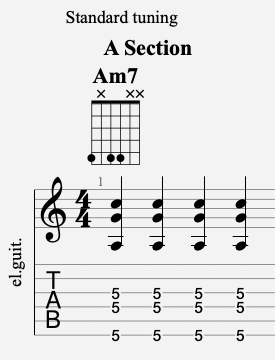
However, Freddie Green (on guitar) with the Count Basie Orchestra would play a straight 4 rhythm against this swing like this:
Conclusion
To wrap it up, “Fly Me To The Moon” is one of the most iconic songs of all time. Still, to this day, it’s just as relevant and timeless-sounding.
Keep practicing, and if you want to learn songs way faster, better understand the fretboard for lead and rhythm, and not waste years spinning your wheels with guitar, grab my free fretboard guide here right now:
Jon MacLennan
Like this blog post? Get Jon’s best guitar lessons straight to your inbox.
Discover the 5 easiest and fastest ways to play the blues scale anywhere on the neck with this FREE PDF GUIDE
