The Beatles – For No One Chords & Guitar Lesson
Here's a song about a man slowly waking up to the realization that his love is dead and his relationship is over.
It’s an underrated Beatles song, but it packs a punch.
Below, I’m going to share with you some insider tips on the guitar style behind it.
So grab your axe, and let’s dive into this “For No One” chords and guitar lesson!
Who Wrote For No One?
“For No One” was written by Paul McCartney. But, like all Beatles songs, it’s credited to the Lennon/McCartney songwriting partnership. The song is about coming to the realization that a relationship has ended. The man’s love has detached, and he’s waking up to it. Perhaps not in its fullest sense and complete truth. But still, the protagonist remains calm and stoic. McCartney wrote this about his relationship with Jane Asher.
“For No One” was included on The Beatles’ 1966 album Revolver, which is often cited as one of the most influential records in history. It was recorded at Abbey Road Studios in London, and features an awesome French horn solo played by session musician Alan Civil.
Plus, with producer George Martin at the helm, he added a beautiful classical twist to the arrangement. First on the original, with the main accompaniment being played on a harpsichord, to subsequent versions featuring orchestral string players.
Although it was never released as a single, the song has been widely praised for its reflection of the depth of McCartney’s songwriting. “For No One” showcases his brilliant melodicism and mature ability to craft a ballad.
Critics have cited it as one of McCartney’s most impressive tunes, and it’s often highlighted as a high point on Revolver.
Check out this incredible acoustic version:
Now, you may be wondering…
What is the tuning for For No One?
The tuning for "For No One” is standard tuning, if you want to play along with the acoustic version above. Standard tuning is spelled: E, A, D, G, B, and E.
Here are the strings:
- E (6th string, lowest pitch)
- A (5th string)
- D (4th string)
- G (3rd string)
- B (2nd string)
- E (1st string, highest pitch)
However, if you want to play along with the Revolver album recording, then the tuning is Eb standard. Eb standard tuning is spelled: Eb, Ab, Db, Gb, Bb, and Eb.
Here are the strings:
- Eb (6th string, lowest pitch)
- Ab (5th string)
- Db (4th string)
- Gb (3rd string)
- Bb (2nd string)
- Eb (1st string, highest pitch)
All right!
Now that you know the tuning for “For No One,” let’s next talk about…
For No One Chords
To play “For No One”, you only need to know 10 main chords they are C, C/B, Am, Am/G, F, Bb, Dm, A7, Gsus4, and G. These chords can be played primarily as open position chords. However, there are a few bar chords.
If bar chords are giving you all kinds of aches and pains, and you haven’t yet discovered how to play them effortlessly, go here: https://www.jonmaclennan.com/7mistakes
Let’s take a look at a few ways these shapes might appear on the fretboard.
C can be played in a standard (campfire) position, from the 5th string down, like this:

C/B simply walks the bass note down the progression like this:

Am is played from the 5th string down like so:

Am/G again continues the walking bass idea:

F is played as a bar chord in 1st position, using all 6 strings like so:

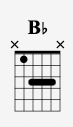
Bb is another bar chord, but this time with a root on the 5th string like this:
Dm is played in open position from the 4th string down like so:

A7 is a great bluesy-sounding chord played from the 5th string down like this:

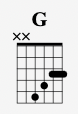
Then finally, we have a little cadence where the tune actually slows down as you change from Gsus4 to G like this:

If you’ve struggled to understand the fretboard for RHYTHM and LEAD guitar, and want to discover the easiest and fastest way. Then get your hands on my free Fretboard Guide PDF right here now:
Is For No One hard to play on guitar?
I would say playing “For No One” on guitar is going to require an intermediate skill level. The trickiest parts are the fingerstyle, the descending bass line progressions, and bar chords. These are all devices, though, used in countless Beatles songs, so take your time with this one.
What key is For No One in?
“For No One”, as recorded by The Beatles, is in the key of B major.
However, the live acoustic version is played in the key of C major.
If you want to play along with the recording on guitar, then simply tune down ½ step as described above. But for our purposes here, I simply think the guitar key, C major. This makes the primary scale for the song the C major scale, which is built using the notes C, D, E, F, G, A, and B.
Let’s take a closer look at how all these chords relate in the key of C major. Starting with…
C
Notes: C, E, G
Function: This is the I chord, the tonic in C major. It’s the “home” chord and establishes the key center.
C/B
Notes: C, E, G with B in the bass
Function: This chord is made by putting a B note in the bass. This creates a smooth descending bass line toward the next chord, Am.
Am
Notes: A, C, E
Function: This is the vi chord, the relative minor of C major. It shares notes with the tonic and creates a more melancholic sound.
Am/G
Notes: A, C, E with G in the bass
Function: This is a first inversion of the vi chord. The G in the bass creates a descending bass motion toward F.
F
Notes: F, A, C
Function: This is the IV chord, the subdominant. It gives you movement away from the tonic and often sets up a return to C or to the dominant G chord.
Bb
Notes: B♭, D, F
Function: This chord is not diatonic to C major. It functions as a borrowed chord from the parallel minor (C minor). It’s a subtonic and adds a rock or even bluesy feeling to the progression.
Dm
Notes: D, F, A
Function: This is the ii chord, a minor chord built on the second scale degree. It often leads naturally to the dominant (V) chord, creating a ii–V–I progression. We hear this at the end of the B Section.
A7
Notes: A, C♯, E, G
Function: This is a secondary dominant, the V7 of vi (V7/vi). In the key of C major, it strongly leads to D minor or can be used to add tension before moving elsewhere.
Gsus4
Notes: G, C, D
Function: This is a suspended V chord. It uses the fourth (C) to create tension that resolves naturally to the G major chord.
G
Notes: G, B, D
Function: This is the V chord, the dominant in C major. This one then creates tension to resolve back to the I chord or tonic C major.
All right!
That’s my theory breakdown.
Next, let’s look at…
What is the strumming pattern for For No One?
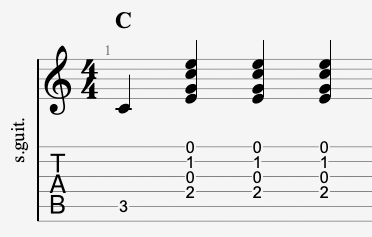
The main underlying feel for “For No One” is a swift quarter note groove – almost classical. In 4/4 time, there are 4 quarter notes per bar. You can count them out loud like this:
one - two - three - four
one - two - three - four
one - two - three - four
one - two - three - four
This gives the song a brisk skip.
For strumming, try hitting the bass note on the down beat (one) and then downstrumming on the remaining beats in the measure (two - three - four).
Here’s an example of a strumming pattern in the style of “For No One”:
Conclusion
Bottom line, “For No One” is an often overlooked yet brilliant Beatles song. It showcases Paul McCartney’s masterful ability to craft a song and is a lot of fun to play.
Keep practicing, and if you want to learn songs way faster, better understand the fretboard for lead and rhythm, and not waste years spinning your wheels with guitar, grab my free fretboard guide here right now:
Jon MacLennan
Like this blog post? Get Jon’s best guitar lessons straight to your inbox.
Discover the 5 easiest and fastest ways to play the blues scale anywhere on the neck with this FREE PDF GUIDE
