The ULTIMATE Girl From The North Country Chords & Guitar Lesson
Here’s an incredible tune that walks the line of deep personal reflection and folklore.
Dylan, in interviews, has remained a mystery about this tune’s origins. But nonetheless, the song and vibe have struck a chord with listeners around the world.
Below, I’m going to break down the guitar style behind it.
So grab your axe, and let’s dive into this “Girl From The North Country” chords and guitar lesson!
Who Wrote Girl From The North Country?
"Girl from the North Country" was written by legendary American singer-songwriter Bob Dylan. It’s a haunting song that originally appeared on his second album, The Freewheelin’ Bob Dylan, released in 1963.
It’s a bit of a poetic mystery. There has been much speculation about who the "girl" is in the song. Two common thoughts are:
1) Echo Helstrom – Dylan’s high school sweetheart from Hibbing, Minnesota. Or, 2) Suze Rotolo – Dylan's girlfriend in New York in the early 1960s. (Suze is the one who appears walking with Dylan on the front cover of Freewheelin’).
Dylan (in rockstar fashion) has remained vague about it, saying in interviews: “That’s kind of a mysterious song. I’m not even sure who the girl was.”
At its heart, the song is about lost love. The narrator asks the listener – perhaps another traveler – to look in on the girl he once knew if they ever go north. The lyrics sing:
“If you’re travelin’ in the north country fair,
Where the winds hit heavy on the borderline…”
The first version was built around a simple fingerpicked style guitar part recorded at Columbia Studios in New York City in 1963.
Later, in 1969, Johnny Cash recorded a duet with Dylan at Columbia Studio A in Nashville. This 2nd version brought a country influence to the arrangement with both singers trading verses.
While ‘Girl From The North Country” was never a charting single, it is one of Dylan’s most covered and respected ballads. The Johnny Cash duet helped push Dylan’s crossover into country music and expanded his audience significantly.
Now, you may be wondering…
What is the tuning for Girl From The North Country?
The tuning for "Girl From The North Country", as recorded by Bob Dylan and Johnny Cash, is standard tuning. Dylan kept things simple. Standard tuning is spelled: E, A, D, G, B, and E.
Here are the strings:
- E (6th string, lowest pitch)
- A (5th string)
- D (4th string)
- G (3rd string)
- B (2nd string)
- E (1st string, highest pitch)
All right!
Now that you know the tuning for “Girl From The North Country”, let’s next talk about…
Girl From The North Country Chords
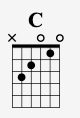
To play “Girl From The North Country”, as recorded by Bob Dylan and Johnny Cash, you’ll only need to know 3 main chords they are G, Bm/F#, and C. The majority of these chords can be played in open position. Let’s take a look at a few ways they can be played on the fretboard.
G is played in a folk style fretting 3 notes and using all 6 strings like this:

Bm/F# is a bar chord played in 2nd position and uses all 6 strings as well like this:

Finally, I play C as a typical (campfire) chord in open position like this:
If you’ve struggled to understand the fretboard for RHYTHM and LEAD guitar. and want to discover the easiest and fastest way. Then get your hands on my free Fretboard Guide PDF right here now:
Is Girl From The North Country hard to play on guitar?
I would say playing “Girl From The North Country” on guitar requires a late beginner to early intermediate skill level. There are only 3 chords, and one main repeating progression. However, the tricky part is the Bm bar chord. That’s (most likely) going to be the hardest chord for beginner players. So, take your time with this one. Once that chord feels comfortable, it shouldn’t be too bad.
What key is Girl From The North Country in?
“Girl From The North Country,” as recorded by Bob Dylan and Johnny Cash, is in the key of G major. All of the chords fit within the diatonic scale of G major, which contains the notes G, A, B, C, D, E, and F#.
Here’s a quick look at how the chords relate in the key of G major:
G major
Notes: G, B, D
Function: This is the I chord in the key of G major.
It’s the tonic, or “home” chord. It feels stable and resolved. Most chord progressions in G major will either start or end here.
Bm/F#
Notes: B, D, F# (with F# in the bass)
Function: This is the iii chord in the key of G major, with the fifth (F#) in the bass.
It’s a minor chord built on the third scale degree. The slash bass (F#) creates a descending bass motion from G to F#, adding a smooth, connected feel. It’s often used as a passing chord that leads into Em or C, and it shares almost the exact same notes as the G major (I) chord.
C major
Notes: C, E, G
Function: This is the IV chord in the key of G major.
It’s the subdominant. The IV chord creates movement away from the tonic and helps drive the progression forward. It introduces just enough tension to set up a return back to G.
So that’s the theory. Next, let’s look at…
What is the strumming pattern for Girl From The North Country?
The main underlying subdivision I use for “Girl From The North Country” is an even 16th-note feel. In 4/4 time, 16th notes mean each beat is divided evenly into four parts. No swing, just tight, crisp precision.
Here’s how you can count 16ths:
1 e & a, 2 e & a, 3 e & a, 4 e & a
(“One-ee-and-uh, Two-ee-and-uh…”)
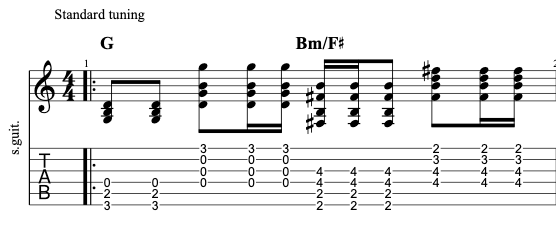
However, in context, I would not strum all 16th notes. Instead, I would use a combination of 8ths and 16th notes. Here’s an example of a strumming pattern in the style of “Girl From The North Country”:
Conclusion
Bottom line, whether you are jamming along with the fingerstyle version or the iconic Johnny Cash duet “Girl From The North Country” is one of Dylan’s most mysterious tunes.
Keep practicing, and if you want to learn songs way faster, better understand the fretboard for lead and rhythm, and not waste years spinning your wheels with guitar, grab my free fretboard guide here right now:
Jon MacLennan
Like this blog post? Get Jon’s best guitar lessons straight to your inbox.
Discover the 5 easiest and fastest ways to play the blues scale anywhere on the neck with this FREE PDF GUIDE
