George Harrison – Give Me Love (Give Me Peace on Earth) Guitar Lesson
If you’re a fan of 12-string guitars and George Harrison… then I think you might enjoy this post.
Below, I’m going to share some insider tips on one of his most iconic songs.
And no, you don’t need a 12-string for it to sound good. This lesson works for any guitar.
So grab your axe, and let’s dive into this “Give Me Love” chords and guitar lesson!
Who Wrote Give Me Love?
“Give Me Love (Give Me Peace on Earth)” was originally written by George Harrison. Harrison’s songwriting truly flourished after the Beatles broke up, and this tune was a part of his acclaimed album Living in the Material World.
During this time, Harrison was deeply entrenched in eastern philosophy and spirituality. The song is almost a mantra, similar to “My Sweet Lord” in that it repeats themes and ideas over and over. This made the song resonate with listeners on many levels. It’s a unique hybrid of a spiritual search and pop sensibility.
The song was recorded at Apple Studios and later at the Record Plant in Los Angeles with George Harrison producing, alongside a select team of mighty session musicians.
Upon its release in 1973, “Give Me Love” became a hit. It reached number one on the Billboard Hot 100 in the United States, becoming Harrison’s second number-one solo hit after “My Sweet Lord.” These tunes cemented Harrison’s career as a major solo artist following the breakup of The Beatles.
Critics praised the song for its melodic beauty, message, and spiritual depth.
Paul McCartney described the song as having purity of intention, and Harrison himself often introduced it in concerts as a song about peace and love.
Now, you may be wondering…
What is the tuning for Give Me Love?
The tuning for "Give Me Love,” as recorded by George Harrison, is standard tuning. Standard tuning is spelled: E, A, D, G, B, and E.
Here are the strings:
- E (6th string, lowest pitch)
- A (5th string)
- D (4th string)
- G (3rd string)
- B (2nd string)
- E (1st string, highest pitch)
However, the main guitar part is capo’d on the 3rd fret, which changes the tuning to this:
- G (6th string, lowest pitch)
- C (5th string)
- F (4th string)
- Bb (3rd string)
- D (2nd string)
- G (1st string, highest pitch)
All right!
Now that you know the tuning for “Give Me Love,” let’s next talk about…
Give Me Love Chords
To play “Give Me Love”, you’ll need to know 10 main chords they are Dsus2, D, Dmaj7, Em, A, Gm, C, G, D7, and E. Most of these chord shapes are played in open position. However, some require the bar technique.
If bar chords are giving you all kinds of aches and pains, and you haven’t yet discovered how to play them effortlessly, go here: https://www.jonmaclennan.com/7mistakes
Let’s take a look at a few ways these shapes can be played on the fretboard:
Dsus2 is the first chord in the song, and this one is played like a typical D chord from the 4th string down. However, we are going to open up the first string like this:

Then place it back for the D chord like so:

Dmaj7 can be played as a bar or with a finger on each fret. Here are the notes:

Em is a beautiful sounding chord using all 6 strings like this:

A is played from the 5th string down like so:

Gm is a bar chord played using all 6 strings in 3rd position, like this:

C is played from the 5th string down like this:

G is played using all 6 strings like this:

D7 comes in during the interlude and is a great bluesy-sounding chord. I play it from the 4th string down like so:

Finally, E is played using all 6 strings like this:

If you’ve struggled to understand the fretboard for RHYTHM and LEAD guitar, and want to discover the easiest and fastest way. Then get your hands on my free Fretboard Guide PDF right here now:
Is Give Me Love hard to play on guitar?
I would say playing “Give Me Love” on guitar is going to require an intermediate skill level. The most difficult parts are the strumming pattern, bar chords, and the fact that it’s played on a 12-string. A 12-string requires more effort because of the doubled strings. So, take your time with this one.
What key is Give Me Love in?
“Give Me Love”, as recorded by George Harrison, is in the key of F major concert pitch. The primary scale for the song is the F major scale, which is built using the notes F, G, A, Bb, C, D, and E.
However, the guitar part is played in the key of D major but uses a capo on the 3rd fret.
D major capo’d 3 = F major concert pitch
Not all the chords fit into the diatonic scale. Let’s take a quick look at how these chords relate in the key of D major (the capo key). Starting with…
Dsus2
Notes: D, E, A
Function: This is a variation of the I chord (tonic) in D major. The second (E) replaces the third (F♯), giving it an open, suspended sound. This chord feels like an airy tonic chord.
D
Notes: D, F♯, A
Function: This is the I chord, the “home” in the key of D major.
Dmaj7
Notes: D, F♯, A, C♯
Function: This is a variation of the tonic (I chord) with the major seventh (C♯) added. It adds a jazzy, dreamy quality while still functioning as the home chord.
D7
Notes: D, F♯, A, C
Function: This is again another variation on the tonic chord. While it functions like the I chord, the added minor seventh (C) introduces tension which resolves to the IV chord (G). This dominant seventh chord creates a bluesy sound.
Em
Notes: E, G, B
Function: This is the ii chord (supertonic) in D major. It acts as a pre-dominant, often leading naturally to the V chord (A) or creating smooth motion from the tonic to other chords.
A
Notes: A, C♯, E
Function: This is the V chord (dominant) in D major. It creates tension that wants to resolve back to the tonic (D), creating forward motion in progressions.
Gm
Notes: G, B♭, D
Function: This chord is not diatonic to D major. It acts as a borrowed chord from the parallel minor (D minor), giving a darker or bluesy contrast. The Beatles used this chord all the time.
C
Notes: C, E, G
Function: This chord is not diatonic to D major. It is a ♭VII chord, or subtonic, often borrowed from the Mixolydian mode. Again, this is another bluesy or rock influence. It creates tension and often moves back to D.
G
Notes: G, B, D
Function: This is the IV chord (subdominant) in D major. The IV chord creates movement away from the tonic and often sets up a return to the D (I) chord or toward the dominant (A).
E
Notes: E, G♯, B
Function: This is a major II chord. It’s not diatonic, but it creates an unexpected lift or modulation effect. This is sometimes called a secondary dominant and leads to A or other chords.
All right!
That’s my theory breakdown.
Next, let’s look at…
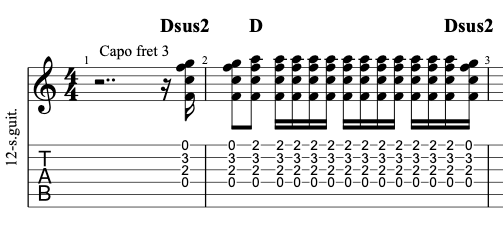
What is the strumming pattern for Give Me Love?
The main underlying feel for “Give Me Love” is a slow 16th note rock feel. In 4/4 time, 16th notes divide each beat into four equal parts, creating a quicker, more flowing rhythm. I count 16th notes in a measure, like this:
1 e & a 2 e & a 3 e & a 4 e & a
The numbers (1, 2, 3, 4) represent the main beats in the measure. The "e," "&," and "a" divide each beat into four evenly spaced subdivisions.
When counted out loud, it sounds like:
"One-ee-and-a, Two-ee-and-a, Three-ee-and-a, Four-ee-and-a."
Here’s an example of a common strumming pattern in the style of “Give Me Love”:
Conclusion
Bottom line, “Give Me Love” is a beautiful song that cemented George Harrison’s legacy as a solo artist post-Beatles. And of course, it’s a lot of fun to play, so…
Keep practicing, and if you want to learn songs way faster, better understand the fretboard for lead and rhythm, and not waste years spinning your wheels with guitar, grab my free fretboard guide here right now:
Jon MacLennan
Like this blog post? Get Jon’s best guitar lessons straight to your inbox.
Discover the 5 easiest and fastest ways to play the blues scale anywhere on the neck with this FREE PDF GUIDE
