The ULTIMATE Gloria Chords & Guitar Lesson
At 18 years old, Van Morrison sang:
===
And here name is...
G…
L…
O…
R…
I…
GLORIA.
===
You only need 3 chords to play this epic garage rock anthem.
And it's a perfect song for newer players, and advanced ones too.
Below, I’m going to share some insider tips on the guitar style behind it.
So grab your axe, and let’s dive into this “Gloria” chords and guitar lesson!
Who Wrote Gloria?
“Gloria” was written by Northern Irish singer-songwriter and musician Van Morrison at just 18 years old. It was first recorded in 1964 by his Belfast band Them, during a session at Decca Three Studios in West Hampstead, London.
Though the track was originally the B-side to “Baby, Please Don’t Go,” it quickly took on a life of its own through a massive amount of airplay and live gigs.
At its core, “Gloria” thrives on a primal rock 'n' roll energy and teenage lust.
There’s not much more that needs to be said in the lyrics. It’s just raw expression and a chorus that spells out her name – G‑L‑O‑R‑I‑A .
Apparently, Van Morrison came up with the idea for “Gloria” while gigging in Germany in the summer of 1963. Them honed it during their live sets in Belfast before taking it into the studio in April 1964.
They recorded seven other tracks in the studio, the day they cut “Gloria.” The tracks were produced by Dick Rowe, and he even brought in some session musicians as well. There’s a rumor that Jimmy Page might have added the second (lead) guitar, though that’s still debated. Either way, check out the video above to see the lead part broken down.
“Gloria” was inducted into the Grammy Hall of Fame in 1999, and it’s featured as one of the 500 Songs That Shaped Rock and Roll.
Though the original release peaked only at #93 on the US Billboard chart, its influence exploded especially after a version by the Shadows of Knight hit #10 in 1966.
There have also been many other great covers, including: The Doors, Patti Smith, U2, AC/DC, Jimi Hendrix, David Bowie, and more… The song’s simplicity and raw power speaks for itself.
Now, you may be wondering…
What is the tuning for Gloria?
The tuning for "Gloria" as recorded by Van Morrison is standard tuning. Standard tuning is spelled: E, A, D, G, B, and E.
Here are the strings:
- E (6th string, lowest pitch)
- A (5th string)
- D (4th string)
- G (3rd string)
- B (2nd string)
- E (1st string, highest pitch)
All right!
Now that you know the tuning for “Gloria”, let’s next talk about…
Gloria Chords
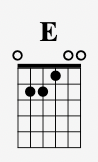
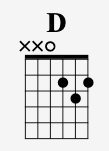
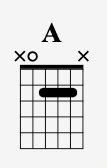
To play “Gloria”, as recorded by Van Morrison, you only need to know three main chords they are E, D, and A. Let’s take a look at a few ways these shapes can be played on the fretboard.
E is a great open chord played using all 6 strings like this:
D is played from the 4th string down like this:
Finally, A is played with 1 finger (in the fretting hand) and in open position like so:
If you’ve struggled to understand the fretboard for RHYTHM and LEAD guitar, and want to discover the easiest and fastest way. Then get your hands on my free Fretboard Guide PDF right here now:
Is Gloria hard to play on guitar?
I would say playing “Gloria” on guitar is going to require a late beginner to intermediate skill level. There are only 3 chords. However, to get it right, the strum hand has to stay consistent with an alternating pattern, and the chord changes need to be on point. So, take your time with this one.
What key is Gloria in?
“Gloria,” as recorded by Van Morrison, is in the key of E major. The primary scale is the E major scale, which is built using the notes E, F#, G#, A, B, C#, and D#. However, with the use of the D chord instead of the D# note, which is diatonic, the scale becomes E mixolydian. But, I would still call it the key of E.
Here’s a quick look at how the chords relate in the key:
E
Notes: E, G♯, B
Function: This is the I chord (tonic) in the key of E major — the “home base.” It gives a strong sense of resolution and stability. Most progressions in E major will feel complete when they land here.
D
Notes: D, F♯, A
Function: This chord is not diatonic to the key of E major. It belongs to E Mixolydian mode (which uses a flat 7th). In that context, D functions as a ♭VII chord or sub-tonic, which gives a bluesy, rock feel. It’s often used in classic rock and blues progressions like E–D–A or E–D–E.
A
Notes: A, C♯, E
Function: This is the IV chord (subdominant) in the key of E major. It creates contrast and a sense of forward motion, often used to prepare for the dominant chord (B or B7), or resolve back to the tonic (E). The I–IV–V movement is foundational in blues, rock, and pop.
Summary:
E = I (tonic)
A = IV (subdominant)
D = ♭VII (borrowed from E Mixolydian)
The inclusion of D major gives the progression a slightly rebellious, blues/rock flavor. This move was used famously by artists like Jimi Hendrix, CCR, and the Rolling Stones all the time.
What is the strumming pattern for Gloria?
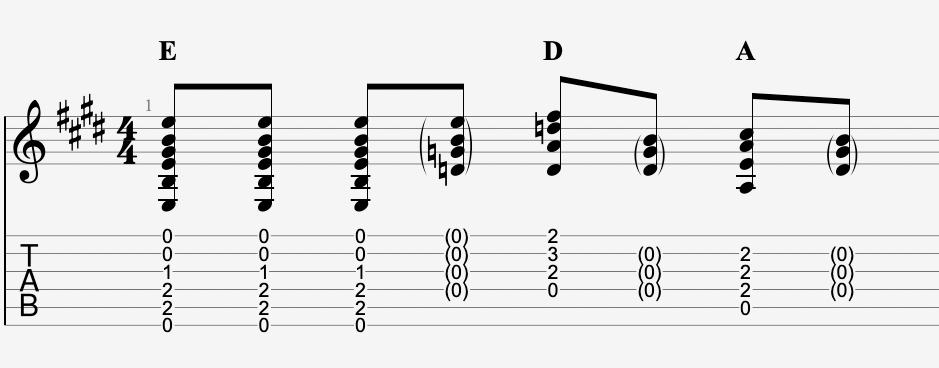
The main underlying groove for “Gloria” is a driving 8th-note rock feel. In 4/4 time, 8th notes divide each beat into two equal parts, creating a steady rhythm like this:
1 & 2 & 3 & 4 &
The numbers (1, 2, 3, 4) represent the main beats in the measure, while the "&" represents the offbeats that add energy and momentum.
When counted out loud, it sounds like:
"One-and, Two-and, Three-and, Four-and."
This gives a strong and consistent forward motion to the tune. Here’s an example of a “Gloria” strumming pattern:
Conclusion
Bottom line, whether you are a beginner or an advanced player, “Gloria” is a blast to play on guitar.
Keep practicing, and if you want to learn songs way faster, better understand the fretboard for lead and rhythm, and not waste years spinning your wheels with guitar, grab my free fretboard guide here right now:
Jon MacLennan
Like this blog post? Get Jon’s best guitar lessons straight to your inbox.
Discover the 5 easiest and fastest ways to play the blues scale anywhere on the neck with this FREE PDF GUIDE
