Top 10 Guitar Chords For Beginners
How are your calluses?
Guitar can be tough as nails.
There’s so much information and so little organization on the internet for a consistent thread of study. But in this post, I want to share with you 7 essential guitar chords for beginners. Plus some easy diagrams and tips so you can build a strong foundation for playing your favorite songs on guitar.
Starting with the good ole’...
1) D Major
In my humble (but accurate opinion) this is a great first chord to try. It’s not too difficult like a full C chord because your fingers can remain relatively close. It sounds really good, and you can use this in millions of songs.

To play a D major chord on guitar in open position, follow these steps:
- Index Finger (1st fret hand finger) – Place it on the 2nd fret of the G (3rd) string.
- Middle Finger (2nd finger) – Place it on the 2nd fret of the high E (1st) string.
- Ring Finger (3rd finger) – Place it on the 3rd fret of the B (2nd) string.
- Strum from the D (4th) string down. The A (5th) and low E (6th) strings should not be played (marked "X" in the diagram).
Also, one other point I want to make about these chord shapes in this lesson is that they are used at all levels of guitar. If you get them down, they will serve you for many years.
Up next is…
2) G Major
G major is a great chord to transition to from D and you can keep one finger down (middle finger). There are many ways to play G major, however, this one using all 6 strings is great for many pop and rock styles.
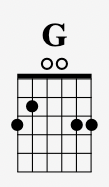
To play a G major chord on guitar in open position, follow these steps:
- Middle Finger (2nd finger) – Place it on the 3rd fret of the low E (6th) string.
- Index Finger (1st finger) – Place it on the 2nd fret of the A (5th) string.
- Ring Finger (3rd finger) – Place it on the 3rd fret of the B (2nd) string.
- Use your pinky (4th finger) on the 3rd fret of the high E (1st) string.
- Strum all 6 strings
Next, try…
3) A Major
A major is a perfect compliment to the last two chords. It’s played from the 5th string down like this:
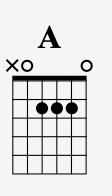
- Middle Finger (2nd finger) – Place it on the 2nd fret of the D (4th) string.
- Index Finger (1st finger) – Place it on the 2nd fret of the G (3rd) string.
- Ring Finger (3rd finger) – Place it on the 2nd fret of the B (2nd) string.
- The high E (1st) and A (5th) strings are open.
- Do not play the low E (6th) string (marked “X” in the diagram).
From there, we’ve got…
4) E Major
In my opinion, E major is one of the greatest guitar chords ever. It’s optimizing the range of guitar, using all 6 strings, and is not too difficult to play.
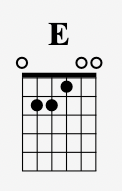
To play an E major chord in open position, follow these steps:
- Index Finger (1st finger) – Place it on the 1st fret of the G (3rd) string.
- Middle Finger (2nd finger) – Place it on the 2nd fret of the A (5th) string.
- Ring Finger (3rd finger) – Place it on the 2nd fret of the D (4th) string.
- All other strings (low E, B, and high E) are played open.
Next, let’s check out the…
5) E Minor
To play E minor, simply take E major and lift up your index finger. This one simple change converts E major to E minor. It’s again, another very full and beautiful sounding chord. It’s slightly more melancholic and can be used in tons of songs.
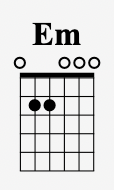
To play an E minor chord in open position, follow these steps:
- Middle Finger (2nd finger) – Place it on the 2nd fret of the A (5th) string.
- Ring Finger (3rd finger) – Place it on the 2nd fret of the D (4th) string.
- All other strings (E, G, B, high E) are played open.
Alternatively, you can also finger the chord this way:
- Index Finger (1st finger) – Place it on the 2nd fret of the A (5th) string.
- Middle Finger (2nd finger) – Place it on the 2nd fret of the D (4th) string.
- All other strings (E, G, B, high E) are played open.
Another similar chord is…
6) A Minor
A minor is just like E major but the whole thing is shifted down (toward the ground) one string. This is an interesting phenomenon of guitar playing. Many shapes on the fretboard can be moved around and produce different results. It’s important to note that you can have another chord with almost the same shape. But the quality of the chord has changed. Before this shape resulted in a major chord now it’s minor.
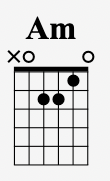
To play an A minor in open position, follow these steps:
- Index Finger (1st finger) – Place it on the 1st fret of the B (2nd) string.
- Middle Finger (2nd finger) – Place it on the 2nd fret of the D (4th) string.
- Ring Finger (3rd finger) – Place it on the 2nd fret of the G (3rd) string.
- A (5th) string is played open.
- High E (1st) string is played open.
- Do not play the low E (6th) string.
Finally, we have…
7) C Major
This is often one of the first chords players learn. However, I think it’s the hardest one on this list. Obviously, everybody's hands are different. Some may get it quick, while others take longer but here it is:
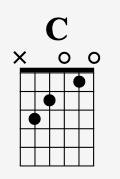
To play C major in open position, follow these steps:
- Index Finger (1st finger) – Place it on the 1st fret of the B (2nd) string.
- Middle Finger (2nd finger) – Place it on the 2nd fret of the D (4th) string.
- Ring Finger (3rd finger) – Place it on the 3rd fret of the A (5th) string.
- High E (1st) and G (3rd) strings are played open.
- Do not play the low E (6th) string.
Now, if getting that 3rd finger is too much of a stretch. You can alternatively try a 2-finger C chord like this:
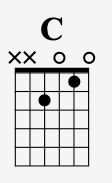
This process of paring down chords can also be done to make them even easier. However, it does present other complications because you’ll have to be better at muting which is another guitar skill you want to develop.
But start with these 10 guitar chords for beginners and then go from there…
If you’ve struggled to understand the fretboard for RHYTHM and LEAD guitar and want to discover the simplest way to map scales and chords anywhere on the neck. (Including seeing many of these chords in a PDF format.) Then get your hands on my free fretboard guide PDF right here now:
Jon MacLennan
Like this blog post? Get Jon’s best guitar lessons straight to your inbox.
Discover the 5 easiest and fastest ways to play the blues scale anywhere on the neck with this FREE PDF GUIDE
