How To Play The Harmonic Minor Scale On Guitar
Let’s talk about how to play the harmonic minor scale on guitar. This scale is a great scale to know whether you are a beginner or an advanced player.
In this post, I’ll share two different ways to play the A harmonic minor scale on guitar. How to practice the A harmonic minor scale. And finally, a few examples of songs that use the harmonic minor scale, so you can hear the sounds in context.
So make sure you’re tuned up. And let’s get started!
What is the A harmonic minor scale on guitar?
The A harmonic minor scale on guitar is just a series of 7 notes in a row. It is a way of grouping together a specific set of notes similar to the A natural minor scale but with one change. The A harmonic minor scale has a very specific sound to it, and the notes form the foundation for putting together chords in a minor key.
What notes are in the A harmonic scale?
The notes in the A harmonic minor scale are:
A - B - C - D - E - F - G# - A
This scale is based on the A natural minor scale (A - B - C - D - E - F - G - A) but with a raised 7th note (G#). This one change creates a leading tone, which has a stronger pull or resolution back to A.
The A harmonic minor scale follows a specific pattern of whole steps (W) and half steps (H):
W – H – W – W – H – Augmented Second (W+H) – H
If you played this scale on piano, you would start on A and play the white keys except for G, which is raised to G#.
On the guitar, you can play the A harmonic minor scale in various positions across the fretboard.
Here is the first example I would start with:
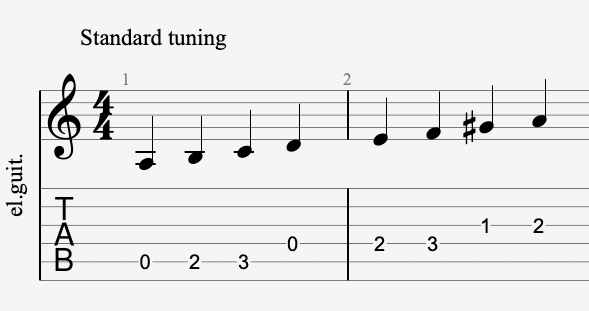
This scale pattern starts on the open 5th string (A). It ascends up the scale to the octave on the 2nd fret 3rd string. The easiest way to start is to play each one of these notes with downstrums in the strum hand.
Make sure you are getting each note clean and playing close to the frets. Now, you may be wondering…
What fingers do you use for A harmonic minor scale?
For the fretting hand what you want to do is match the frets to the fingers. For example, if you play the 3rd fret then use your 3rd finger in the fretting hand. The 2nd fret is going to be with the 2nd finger, and so on and so forth.
Basically, they match up.
This is called playing "in position". It refers to using a simple system within a specific fret range on the neck of the guitar, typically spanning four frets.
When playing in position, you generally keep your hand and fingers within a fixed span on the neck, allowing you to play notes and patterns without excessive hand movement up and down the neck. This technique can help you navigate the fretboard more efficiently and develop a better understanding of scale patterns and note relationships.
What is the formula for the A harmonic minor scale?
As mentioned above, the notes in the A harmonic minor scale are:
A - B - C - D - E - F - G# - A
The formula for the A harmonic minor scale is:
Whole Step (W)
Half Step (H)
Whole Step (W)
Whole Step (W)
Half Step (H)
Augmented Second (W+H)
Half Step (H)
If you’ve struggled to understand the fretboard for RHYTHM and LEAD guitar and want to discover the simplest way to map scales and chords anywhere on the neck. Then get your hands on my free fretboard guide PDF right here now:
In terms of frets, the pattern is:
2 - 1 - 2 - 2 - 1 - 3 - 1
This specific sequence of whole steps (W) and half steps (H) will create any harmonic minor scale. Whatever note you start on plug in the formula and you’ve got a harmonic minor scale.
It’s like magic!
The formula guarantees that the A harmonic minor scale maintains a specific set of intervals between each note.
On the guitar, you can play the C major scale in a ton of different ways.
Next, let’s expand on our one-octave scale above and learn the entire position.

This now gives us all the notes in this area of the fretboard. Notice now though that we are not starting on the root note. Instead, we are starting on the open 6th string. This note is E.
But still, we have that first octave pattern inside this larger scale pattern.
How to Practice the A Harmonic Minor Scale on Guitar
Practicing the A harmonic minor scale with a metronome is a great way to improve your timing, accuracy, and consistency. Since this scale has an augmented second (W+H) between the 6th and 7th notes, focusing on smooth transitions is key.
Here’s a step-by-step guide on how to practice the A harmonic minor scale with a metronome:
- Set Your Metronome – Start at a slow, comfortable tempo, then gradually increase the speed as you gain control.
- Learn the Scale Fingering – Familiarize yourself with the A harmonic minor scale across different positions on the guitar. Make sure you know the correct sequence of notes and fingerings.
- Start on One String – Play the scale ascending (going up) on a single string (e.g., the low E string) to get a feel for the pattern.
- Play to a Metronome – Match each note to the beat, and keep a steady rhythm. Begin with quarter notes (one note per click).
- Focus on Technique – Listen to make sure each note rings out clearly. Be mindful of the larger interval (G# to A) and avoid rushing it.
- Increase Difficulty – Once comfortable, you can:
- Increase the tempo gradually.
- Experiment with different rhythms, like eighth notes or triplets.
- Practice in multiple positions on the neck.
- Stay Consistent – Focus on accuracy first, then speed. A clean, and controlled scale is better than a rushed, sloppy one.
By following this method, you'll develop fluency and control over the A harmonic minor scale, making it easier to apply in solos and improvisation.
What songs use the harmonic minor scale?
There are a lot of great songs that use the harmonic minor scale. Here are 3 examples to check out that will help you hear the harmonic minor scale in context.
1. Paint It Black Guitar Lesson (The Rolling Stones)
In 1966 the Rolling Stones were at a pivotal period in their musical evolution. They were starting to break away from their earlier rhythm and blues roots. And were venturing off with experimental sounds. Brian Jones, a founding member of the band, had come up with this awesome riff, after picking up a sitar and being inspired by the sounds of the harmonic minor scale.
2. Smooth Guitar Lesson (Carlos Santana)
The opening solo to “Smooth” played by Carlos Santana is a great example of the A harmonic minor scale in context.
3. Girl Guitar Lesson (The Beatles)
“Girl” as recorded by The Beatles is a great example of the C harmonic minor scale in context. Take a listen…
Conclusion:
Learning the harmonic minor scale on guitar is both exciting and super important for all guitar players. It gives you a toolbox to help certain exotic melodies and how music works.
If you’ve struggled to understand the fretboard for RHYTHM and LEAD guitar and want to discover the simplest way to map scales and chords anywhere on the neck. Then get your hands on my free fretboard guide PDF right here now:
Like this blog post? Get Jon’s best guitar lessons straight to your inbox.
Discover the 5 easiest and fastest ways to play the blues scale anywhere on the neck with this FREE PDF GUIDE
