The ULTIMATE – "Holly Jolly Christmas” Chords & Guitar Lesson
Whether you know this song from the famous television show “Rudolph the Red-Nosed Reindeer” or from some other cover, here’s one of the most famous Christmas songs of all time.
You only need a handful of chords to play it.
Below, I’m going to share with you some insider tips on the guitar style behind it.
So grab your axe, and let’s dive into this “Holly Jolly Christmas” chords and guitar lesson!
Who Wrote Holly Jolly Christmas?
“Holly Jolly Christmas” was originally written by Johnny Marks. Marks was an American songwriter who specialized in writing Christmas songs. He wrote many standards, like “Rudolph the Red-Nosed Reindeer,” “Rockin’ Around the Christmas Tree,” and “A Marshmallow World.”
He wrote “Holly Jolly Christmas” in the early 1960s, and the first popularized version of it was recorded by Burl Ives.
Burl’s unique voice, coupled with the song’s cheerful spirit, created a classic.
The song’s narrative is about the simple pleasures of the Christmas season, like friendly conversations, community laughter, and good cheer.
The story behind the song is closely tied to television history. “A Holly Jolly Christmas” got its original fame through the 1964 Rankin/Bass animated television special “Rudolph the Red-Nosed Reindeer.” Burl Ives was the narrator of the special, playing Sam the Snowman, and his performance of the song helped cement it as a Christmas standard.
The arrangement is brilliant with orchestra, bells, and background singers. Couple this with Ives’ baritone sound, and you can see why it’s so widely loved and covered.
While it didn’t debut as a massive chart hit in the 1960s, it has achieved platinum certification in the digital era. The long-term cultural impact far outweighs any initial chart performance.
The song is timeless, and Johnny Marks’ career helped shape what many people think of as “classic Christmas music”.
Now, you may be wondering…
What is the tuning for Holly Jolly Christmas?
The tuning for "Holly Jolly Christmas” is standard tuning. Standard tuning is spelled: E, A, D, G, B, and E.
Here are the strings:
- E (6th string, lowest pitch)
- A (5th string)
- D (4th string)
- G (3rd string)
- B (2nd string)
- E (1st string, highest pitch)
All right!
Now that you know the tuning for “Holly Jolly Christmas,” let’s next talk about…
Holly Jolly Christmas Chords
To play “Holly Jolly Christmas”, as recorded by Burl Ives, you’ll need to know 8 main chords they are C, C#dim, G7, F, Em, Dm, Am, and D7. These chords are a mix of open and bar chords. If bar chords are giving you all kinds of aches and pains, and you haven’t yet discovered how to play them effortlessly, go here: https://www.jonmaclennan.com/barchords
Let’s take a look at a few ways these shapes might show up on the fretboard.
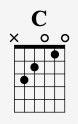
C is played in a standard (campfire) style from the 5th string down like so:
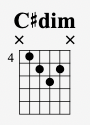
C#dim is a passing chord played on the middle strings like this:
G7 uses all 6 strings like so:

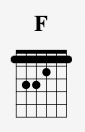
F is a bar chord played in 1st position and uses all 6 strings like so:
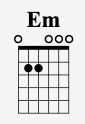
Em is a beautiful sounding open chord, and also uses all 6 strings like this:
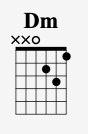
Dm is played in a standard (campfire) style from the 4th string down like this:
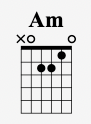
Am is played from the 5th string down like this:
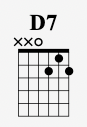
Finally, D7 is a bluesy style chord played from the 4th string down like this:
If you’ve struggled to understand the fretboard for RHYTHM and LEAD guitar, and want to discover the easiest and fastest way. Then get your hands on my free Fretboard Guide PDF right here now:
Is Holly Jolly Christmas hard to play on guitar?
I would say playing “Holly Jolly Christmas” on guitar is going to require an intermediate skill level. The song only has two sections. So there are not a lot of parts to memorize. However, a few of the chords are more complicated shapes, like C#dim and the bar chords, which push it beyond a beginner level. So, take your time with this one.
What key is Holly Jolly Christmas in?
“Holly Jolly Christmas”, as recorded by Burl Ives, is in the key of C major. The primary scale would be the C major scale, which is built using the notes C, D, E, F, G, A, and B.
Let’s take a closer look at how all these chords relate in the key of C major. Starting with…
C
Notes: C, E, G
Function: This is the I chord, the tonic in the key of C major. It’s the home base where everything feels resolved and stable. Most progressions want to return here to feel complete.
C#dim
Notes: C#, E, G
Function: This is a chromatic passing diminished chord. It does not belong diatonically to C major, but it’s commonly used to create smooth voice leading between C and Dm. Or, in the case of “Holly Jolly Christmas” C#dim goes to G7.
G7
Notes: G, B, D, F
Function: This is the V7 chord, the dominant seventh in C major. It dominates the key, creating a strong tension that wants to resolve back to C. The tritone interval between B and F is what gives this chord its powerful pull toward the tonic.
F
Notes: F, A, C
Function: This is the IV chord, the subdominant. It gives the listener a nice reprieve from the tonic while still staying in the key. F often sets up a move to G7 or in some way returns back to C.
Em
Notes: E, G, B
Function: This is the iii chord in C major. It shares two notes with the tonic (E and G), so it feels closely related to C. Em is often used as a transitional chord. In “Holly Jolly Christmas,” it’s used in a walk-down progression through the scale F → Em → Dm.
Dm
Notes: D, F, A
Function: This is the ii chord, the supertonic in C major. It plays a crucial role in functional harmony. This chord often leads to G7 in “Holly Jolly Christmas,” creating a standard ii → V → I progression.
Am
Notes: A, C, E
Function: This is the vi chord, a.k.a the relative minor of C major. Am shares two notes with the tonic (C and E), which makes it sound closely connected while shifting the mood slightly darker.
And finally…
D7
Notes: D, F#, A, C
Function: This chord is not diatonic to the key of C major; it’s a secondary dominant, specifically the V7 of V in the key of C major. D7 temporarily borrows the note F# from outside the key to strongly pull toward G7. From there, G7 resolves naturally back to C.
Together, these chords make up some of the most common sets of chords in popular music.
Millions of songs use them…
All right!
That’s my theory breakdown.
Next, let’s look at…
What is the strumming pattern for Holly Jolly Christmas?
The main underlying groove for “Holly Jolly Christmas” is an 8th note swing. In 4/4 time with a swing feel, 8th notes are played unevenly, where the first 8th note of the beat is longer and the second 8th note is shorter. This creates the swing. The counting for swung 8th notes in a measure still uses the standard notation, but the performance is based on a triplet subdivision:
1 (trip-let) 2 (trip-let) 3 (trip-let) 4 (trip-let)
The actual duration of the notes divides the beat into a triplet figure, with the first 8th note taking up two-thirds of the beat and the second 8th note taking up the final one-third.
When counted out loud to express the rhythm, it sounds like:
"One-and-uh, Two-and-uh, Three-and-uh, Four-and-uh"
"One-trip-let, Two-trip-let, Three-trip-let, Four-trip-let."
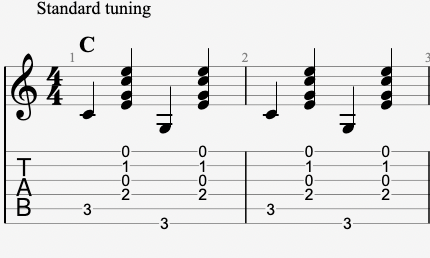
Now, that’s the overall feel. But for the strumming pattern on guitar, I would play quarter notes with an alternating bass pattern like this:
Conclusion
There ya have it!
Another perennial Christmas classic you can add to your repertoire this year.
Keep practicing, and if you want to learn songs way faster, better understand the fretboard for lead and rhythm, and not waste years spinning your wheels with guitar, grab my free fretboard guide here right now:
Jon MacLennan
Like this blog post? Get Jon’s best guitar lessons straight to your inbox.
Discover the 5 easiest and fastest ways to play the blues scale anywhere on the neck with this FREE PDF GUIDE
