The ULTIMATE Hound Dog Chords & Guitar Lesson
If you trace back the roots of rock and roll… you’ll wind up at the blues.
Below, I want to share with you a perfect example of this. Here’s a tune that became a huge hit for 2 different artists.
So grab your axe, and let’s dive into this “Hound Dog” chords and guitar lesson!
Who Wrote Hound Dog?
“Hound Dog” was written by Jerry Leiber and Mike Stoller – a legendary songwriting duo from New York. They were known for writing dozens of rock and R&B hits during the 1950s and 1960s.
They wrote “Hound Dog” in 1952 when they were still teenagers. At its core, it’s really a blues tune. The first person to record “Hound Dog” was Big Mama Thornton in August 1952. Her version is raw and more down-home.
Then, later in 1956, Elvis recorded it at RCA Studios in New York City.
Elvis’s version hit #1 on the Billboard pop chart, R&B chart, and country chart all at once. It stayed there for 11 weeks, which was a record at the time.
When Elvis’s version came out, Jerry Leiber reportedly called it “a joke.” He later softened, realizing it was just a different interpretation for a different audience, but still felt Big Mama’s was the definitive version.
On the Milton Berle Show, Elvis sang “Hound Dog” without his guitar and added slow, exaggerated hip movements.
The media lost their minds.
Critics called it “vulgar” and “appalling.” But teens? They ate it up. That performance helped launch Elvis-mania.
Now, you may be wondering…
What is the tuning for Hound Dog?
The tuning for "Hound Dog", as recorded by Elvis Presley, is standard tuning. Standard tuning is spelled: E, A, D, G, B, and E.
Here are the strings:
- E (6th string, lowest pitch)
- A (5th string)
- D (4th string)
- G (3rd string)
- B (2nd string)
- E (1st string, highest pitch)
However, if you want to play along with the Big Mama Thornton version, the guitar is tuned down ½ step.
Here are the strings:
- Eb (6th string, lowest pitch)
- Ab (5th string)
- Db (4th string)
- Gb (3rd string)
- Bb (2nd string)
- Eb (1st string, highest pitch)
All right!
Now that you know the tuning for “Hound Dog”, let’s next talk about…
Hound Dog Chords
To play “Hound Dog”, as recorded by Elvis Presley, you’ll only need to know 3 main chords they are C7, F7, and G7. They are all dominant seven chords – a characteristic of the blues. Let’s take a look at a few ways these chords can be played on the fretboard:
C7 is played like a typical C “cowboy” chord, but with the added pinky on the 3rd fret of the 3rd string, and no open strings like this:

F7 is a bar chord played in 1st position using all 6 strings like so:

Finally, G7, is played like F7 just shifted up 2 frets, to the 3rd position like this:

If you’ve struggled to understand the fretboard for RHYTHM and LEAD guitar. and want to discover the easiest and fastest way. Then get your hands on my free Fretboard Guide PDF right here now:
Is Hound Dog hard to play on guitar?
I would say playing “Hound Dog” on guitar requires a late beginner to intermediate guitar skill level. There are only 3 chords. However, the tricky part is getting the swing feel right and being able to play bar chords where needed. So, take your time with this one.
What key is Hound Dog in?
“Hound Dog,” as recorded by Elvis Presley, is in the key of C major concert pitch. However, it is a blues. This means it doesn’t necessarily fit into the standard box of Western music theory.
You see, the C major scale uses the notes C, D, E, F, G, A, and B. But only one chord in the song comes from this scale.
Here’s a quick look at how all the chords relate in the key of C major:
C7
Notes: C, E, G, B♭
Function: This is the I7 chord in C blues.
In a strict major key, the I chord would usually be just C major (C–E–G). But in blues, we make the tonic a dominant 7th.
That B♭ is not part of the C major scale (which uses B natural), but it adds that bluesy bite. This chord has tension even though it's the "home" chord, and that’s a signature sound in blues.
F7
Notes: F, A, C, E♭
Function: This is the IV7 chord in C blues.
F7 is the subdominant chord in this key.
The E♭ (♭7 of F) is also outside the C major scale (which instead contains an E natural), but again, this is typical in blues.
The IV7 adds a sweet, soulful tension and often leads right back to the I7 (C7) or up to the V7 (G7).
G7
Notes: G, B, D, F
Function: This is the V7 chord in C blues.
This is the dominant chord in both blues and traditional harmony.
It includes the leading tone (B), which wants to resolve to the root (C), and the F natural gives it that dominant 7th color.
G7 is often used to “turnaround” the progression back to C7, especially in bars 11–12 of a 12-bar blues.
To recap, the entire song is built on just 3 chords: the I7, IV7, and V7.
So that’s the theory. Next, let’s look at…
What is the strumming pattern for Hound Dog?
The main underlying groove for “Hound Dog” is an 8th-note shuffle feel. In 4/4 time, a shuffle feel gives the 8th notes a long-short swing, instead of dividing each beat evenly.
Instead of straight 8ths like:
1 & 2 & 3 & 4 &
(“One-and, Two-and, Three-and, Four-and” — evenly spaced)
A shuffle sounds more like:
1 (a) 2 (a) 3 (a) 4 (a)
("One-a, Two-a, Three-a, Four-a")
Or you can feel it like:
DAH - duh, DAH - duh, DAH - duh, DAH - duh
The first 8th note is held longer, and the second is short and snappy, like a triplet feel with the middle note missing.
So instead of playing or counting evenly, you swing the rhythm. This creates the signature bluesy, rolling groove that’s essential in blues, rock & roll, and boogie-woogie.
Here’s an example of a shuffle groove in the style of “Hound Dog”:
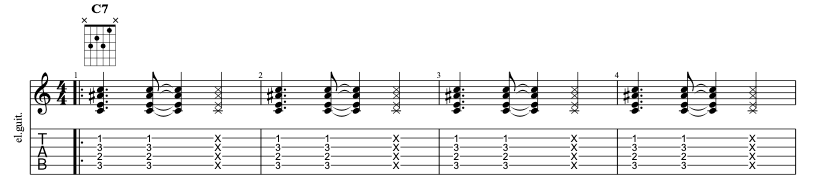
Hound Dog Guitar Lesson (Big Mama Thornton Version)
Conclusion
To wrap it up, “Hound Dog” started as this down-home, bluesy tune and skyrocketed into a huge pop hit for Elvis. It’s a perfect example of how, if you trace back the roots of rock and roll, you’ll wind up at the blues.
Keep practicing, and if you want to learn songs way faster, better understand the fretboard, and not waste years spinning your wheels with guitar, grab my free fretboard guide here right now:
Jon MacLennan
Like this blog post? Get Jon’s best guitar lessons straight to your inbox.
Discover the 5 easiest and fastest ways to play the blues scale anywhere on the neck with this FREE PDF GUIDE
