I've Just Seen A Face Chords & Guitar Lesson (MOST ACCURATE)
Here’s an exciting tune Paul McCartney said was one of his favorite early Beatles songs.
It starts off with a wicked riff, and then catapults into fast strumming.
Below, I’m going to share some insider tips on the guitar style behind it.
So grab your axe, and let’s dive into this “I've Just Seen A Face” chords and guitar lesson!
Who Wrote I've Just Seen A Face?
“I've Just Seen A Face” was written primarily by Paul McCartney, but like many Beatles tunes, it is credited to the McCartney/Lennon songwriting partnership. It’s an upbeat, folk-leaning Beatles tune that marked a stylistic change from their earlier pop-rock sound.
McCartney said that the song came to him quite suddenly. He said it was one of the fastest songs he ever wrote. This is a common theme with many hit songs from all kinds of different artists. It’s almost as if the songs fall out of the ether.
The lyrics sing about someone falling in love at first sight with lines like:
“I’ve just seen a face I can’t forget / The time or place where we just met…”
“I've Just Seen A Face” was recorded at Abbey Road Studios in London on June 14th, 1965. Of course, George Martin was producing, and Norman Smith was the engineer.
The Beatles recorded it in two takes. McCartney was on lead vocal and acoustic guitar, George Harrison on lead acoustic, John Lennon on rhythm acoustic, and Ringo Starr on brushed snare and maracas. It’s one of the few Beatles tracks that does not feature bass guitar. The fast tempo, acoustic instrumentation, and rhythmic drive make it one of the most Americana/bluegrass-inspired Beatles recordings.
In my opinion, it sounds like the introduction was recorded as one part, played fingerstyle, and then the rest of the tune was done as a separate take.
In the U.S., Capitol Records placed “I’ve Just Seen a Face” as the opening track for their monumental album Rubber Soul in 1965. However, the song wasn't even on the original UK Rubber Soul at all. This always puzzled me.
But some other cool notes are, the song has no electric instruments, which gives it a raw acoustic feel. McCartney later called it one of his favorite early Beatles songs, saying it showed his love for “wordy, fast songs.”
Now, you may be wondering…
What is the tuning for I've Just Seen A Face?
The tuning for "I've Just Seen A Face" as recorded by The Beatles is standard tuning. Standard tuning is spelled: E, A, D, G, B, and E.
Here are the strings:
- E (6th string, lowest pitch)
- A (5th string)
- D (4th string)
- G (3rd string)
- B (2nd string)
- E (1st string, highest pitch)
However, they use a capo on the 2nd fret, which changes the notes to read:
- F# (6th string, lowest pitch)
- B (5th string)
- E (4th string)
- A (3rd string)
- C# (2nd string)
- F# (1st string, highest pitch)
So, depending upon whether you are using a capo or not, you may have to make these adjustments.
All right!
Now that you know the tuning for “I've Just Seen A Face”, let’s next talk about…
I've Just Seen A Face Chords
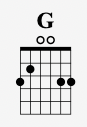
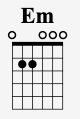
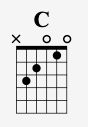
To play “I've Just Seen A Face”, as recorded by The Beatles, you only need to know 6 main chords they are G, Em, C, C/B, D/A, and D. Now, it’s important to keep in mind, these are the capo chords. Let’s take a look at a few ways these shapes can be played on the fretboard.
G is played using all 6 strings like this:
Em is a beautiful, open-sounding chord, again using all 6 strings like this:
C is played from the 5th string down like so:
There are also a few moments in “I’ve Just Seen A Face” where you play a standard open-position chord but then shift the bass note. C/B is an example of this:

D/A is another, this one is played from the 5th string down like so:

Finally, D is played from the 4th string down like this:

If you’ve struggled to understand the fretboard for RHYTHM and LEAD guitar, and want to discover the easiest and fastest way. Then get your hands on my free Fretboard Guide PDF right here now:
I Below is a quick look at how the chords relate in the key. (Note: I’ve simplified the chords to just their root function.)
G
Notes: G, B, D
Function: This is the I chord (tonic) in the key of G major – the “home base.” It gives a strong sense of resolution and stability. Most songs in G will feel complete when they land here.
Em
Notes: E, G, B
Function: This is the vi chord (the relative minor) in G major. It shares two notes with the tonic (G and B), so it blends nicely and gives a more melancholic contrast to the major chords.
C
Notes: C, E, G
Function: This is the IV chord (subdominant) in G major. C gives a contrast and movement away from the tonic. Often used to set up motion to the V chord (D) or back to the I (G).
D
Notes: D, F#, A
Function: This is the V chord (dominant) in G major. It creates tension that wants to resolve back to the tonic (G). The F# acts as a leading tone, giving the D chord a strong pull back to home base.
Summary:
- G = I (tonic)
- Em = vi (relative minor)
- C = IV (subdominant)
- D = V (dominant)
What is the strumming pattern for I've Just Seen A Face?
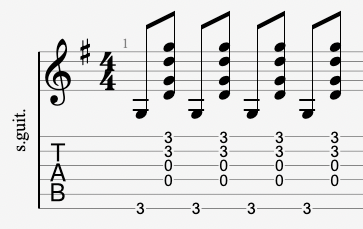
The main underlying feel for “I've Just Seen A Face” is a fast 8th note folk feel. In 4/4 time, 8th notes divide each beat into two equal parts, creating a steady rhythm like this:
1 & 2 & 3 & 4 &
The numbers (1, 2, 3, 4) represent the main beats in the measure, while the "&" represents the offbeats that add energy and momentum.
When counted out loud, it sounds like:
"One-and, Two-and, Three-and, Four-and."
I like to break up the strings and use a simple bass-note strum like this:
Conclusion
To wrap it up, this is one of Paul McCartney’s favorite early Beatles songs. It’s got an awesome intro riff and is an exciting tune you can add to your setlist.
Keep practicing, and if you want to learn songs way faster, better understand the fretboard for lead and rhythm, and not waste years spinning your wheels with guitar, grab my free fretboard guide here right now:
Jon MacLennan
Like this blog post? Get Jon’s best guitar lessons straight to your inbox.
Discover the 5 easiest and fastest ways to play the blues scale anywhere on the neck with this FREE PDF GUIDE
