The Beatles – “I Saw Her Standing There” Chords & Guitar Lesson
1
2
3
4!..
McCartney yelled as the band launched into this iconic rock n roll groove.
Below, I want to share with you some insider tips on the guitar style behind it.
So grab your axe, and let’s dive into this “I Saw Her Standing There” chords and guitar lesson!
Who wrote I Saw Her Standing There?
“I Saw Her Standing There” was originally written by Paul McCartney and credited to the Lennon/McCartney songwriting partnership. The song is a straight-ahead rock and roll story song about instant attraction.
McCartney sees a girl from across the room and gets captivated. The song embodies the feelings of new love and excitement.
“I Saw Her Standing There” was recorded at Abbey Road Studios (then known as EMI Studios) on February 11, 1963, during the marathon session that produced most of Please Please Me in a single day!
Producer George Martin was at the helm and helped shape the arrangement. He also captured the band’s sound of playing together in a room with minimal overdubs.
The whole song kicks off with McCartney counting it in, “1 2 3 4!”. Then the band joins in with a driving beat that anchors the song.
“I Saw Her Standing There” became one of the Beatles’ early concert staples and was often used to open up the show because of its high energy and immediate impact.
While the song itself did not win formal awards at the time, it has since been recognized as one of the defining early rock and roll tracks of the 1960s.
Ultimately, “I Saw Her Standing There” endures because it captures something universal and timeless: the instant spark of attraction and the excitement of youth.
Now, you may be wondering…
What is the tuning for I Saw Her Standing There?
The tuning for "I Saw Her Standing There” as recorded by The Beatles is standard tuning. The lads from Liverpool kept things simple. Standard tuning is spelled: E, A, D, G, B, and E.
Here are the strings:
- E (6th string, lowest pitch)
- A (5th string)
- D (4th string)
- G (3rd string)
- B (2nd string)
- E (1st string, highest pitch)
All right!
Now that you know the tuning for “I Saw Her Standing There,” let’s next talk about…
I Saw Her Standing There Chords
To play “I Saw Her Standing There”, as recorded by The Beatles, you’ll need to know 6 main chords they are E7, A7, B7, E/G#, C6, and E9. These chords are a mix of open and bar chord shapes.
If bar chords are giving you all kinds of aches and pains, and you haven’t yet discovered how to play them effortlessly, go here: https://www.jonmaclennan.com/barchords
Let’s take a look at a few ways these shapes might show up on the fretboard.
E7 is a beautiful bluesy-sounding chord. It uses all 6 strings like this:
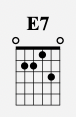
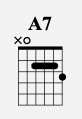
A7 is another great blues chord. On this one, I play it from the 5th string down like so:
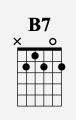
B7 is a trickier chord shape. This one is played from the 5th string down as well like this:
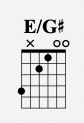
E/G# can be a bit stretchy in the fretting hand. Here we’ll use all the strings, except for the 5th:
C6 is a bar chord played in the 3rd position like this:
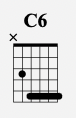
Finally, E9 is just a slight variation from the E7 chord. I play this for the ending like so:
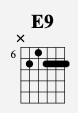
If you want to get better at this bluesy style and master the fretboard for rhythm and lead, then grab my FREE blues scale PDF guide here right now:
Is I Saw Her Standing There hard to play on guitar?
I would say playing “I Saw Her Standing There” on guitar, as recorded by The Beatles, is going to require an intermediate skill level. The song itself only uses 6 chords. But getting the feel right, and the cool blues licks that appear throughout, aren’t that easy. So, take your time with this one.
What key is I Saw Her Standing There in?
“I Saw Her Standing There”, as recorded by The Beatles, is in the key of E major. The primary scale for the song would be the E major scale, which is built using the notes E, F#, G#, A, B, C#, and D#.
Let’s take a look at how the main chords all function in the key of E major. Starting with…
E7
Notes: E, G#, B, D
Function: This chord is built on the tonic of E major, but the added minor seventh (D) makes it a dominant seventh chord rather than a plain major tonic. In traditional harmony, the I chord in E major would normally be E major, not E7, so this creates a bluesy version of the “home” chord.
A7
Notes: A, C#, E, G
Function: A7 is the IV7 chord in the key of E major. In strict diatonic harmony, the IV chord would normally be A major, but again adding the minor seventh (G) creates dominant tension. This is typical in blues and rock styles.
B7
Notes: B, D#, F#, A
Function: This is the V7 chord, the dominant seventh in E major. It creates strong tension that wants to resolve back to E or E7. The D# functions as the leading tone, pulling upward toward E. This is one of the most important tension-and-release chords in the key.
E/G#
Notes: G#, B, E
Function: This is an E major chord in first inversion, with the third (G#) in the bass. Harmonically it still functions as the tonic chord, but the altered bass note creates smoother bass movement and a more flowing sound between chords in the progression of the tune.
C6
Notes: C, E, G, A
Function: C6 is not diatonic to E major because it contains both C natural and G natural, which are outside the key. This chord acts as a borrowed chord. It’s borrowed from the parallel minor E minor.
E9
Notes: E, G#, B, D, F#
Function: E9 is an extended tonic dominant chord. It is essentially an E7 chord with the added ninth (F#). The ninth gives the chord a richer and more sophisticated sound while still maintaining a bluesy character.
Taken together, these chords create a rich palette to choose from in the key of E major.
All right!
That’s my theory breakdown.
Next, let’s look at…
What is the strumming pattern for I Saw Her Standing There?
The main underlying groove for “I Saw Her Standing There” is a driving 8th-note rock feel. In 4/4 time, 8th notes divide each beat into two equal parts, creating a steady rock rhythm like this:
1 & 2 & 3 & 4 &
The numbers (1, 2, 3, 4) represent the main beats in the measure, while the "&" represents the offbeats that add energy and momentum.
When counted out loud, it sounds like:
"One-and, Two-and, Three-and, Four-and."
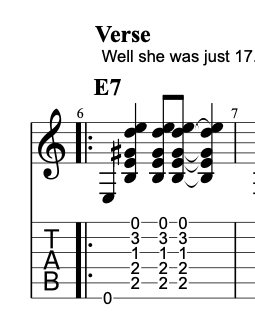
As for the strumming pattern, I would actually use two different ones. Here’s an example of a strumming pattern I might play for the Verse:
And here’s an example of a strumming pattern I might play for the Chorus:
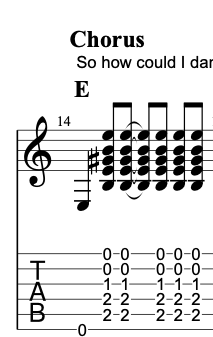
These patterns still keep the 8th note rock feel, but change just slightly depending upon where you are in the song.
Conclusion
To wrap it up, “I Saw Her Standing There” is classic early-Beatles repertoire. It’s a perfect example of their simple rhythm section sound that was quite the craze during Beatlemania.
So keep practicing, and if you want to get better at this bluesy style and master the fretboard for rhythm and lead, then grab my FREE blues scale PDF guide here right now:
Jon MacLennan
Like this blog post? Get Jon’s best guitar lessons straight to your inbox.
Discover the 5 easiest and fastest ways to play the blues scale anywhere on the neck with this FREE PDF GUIDE
