The ULTIMATE I Want You To Want Me Chords & Guitar Lesson
Here’s an epic classic rock song I used to cover in my first band.
The crowd always went wild when I kicked into the opening lick.
Below, I’m going to share some insider tips on the guitar style behind it.
So grab your axe, and let’s dive into this “I Want You To Want Me” chords and guitar lesson!
Who Wrote I Want You To Want Me?
“I Want You To Want Me” was written by Rick Nielsen, the lead guitarist and primary songwriter of the American rock band Cheap Trick. The first version was released in 1977 on their studio album called In Color. This original version was recorded at Kendun Recorders in Burbank, California. The original version became very successful. But there is also another great live version as well from their album Cheap Trick at Budokan.
The energy and feel of the live version really capture the essence of the song, and this version climbed the charts, reaching number seven on the Billboard Hot 100 in 1979.
“I Want You To Want Me” has gone on to become one of Cheap Trick’s most signature tunes and a staple of classic rock radio.
Now, you may be wondering…
What is the tuning for I Want You To Want Me?
The tuning for "I Want You To Want Me," as recorded by Cheap Trick, is standard tuning. The band kept things simple. Standard tuning is spelled: E, A, D, G, B, and E.
Here are the strings:
- E (6th string, lowest pitch)
- A (5th string)
- D (4th string)
- G (3rd string)
- B (2nd string)
- E (1st string, highest pitch)
All right!
Now that you know the tuning for “I Want You To Want Me”, let’s next talk about…
I Want You To Want Me Chords
To play “I Want You To Want Me”, as recorded by Cheap Trick, you’ll need to know 7 main chords they are A, A/G#, F#m, D, A5/C#, B7, and G5. It’s important to note that in the video above, I play the majority of these chords as power chords. This keeps the rhythm chunky, and can be done by only playing a select portion of these full chords below.
Let’s take a look at a few ways these shapes can be played on the fretboard.
A is played in open position using just the index finger like this:

A/G# simply changes the bass note on the A chord like this:

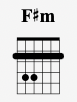
F#m is a bar chord played in 2nd position and using all 6 strings like so:
If bar chords are giving you all kinds of aches and pains, and you haven’t yet discovered how to play them effortlessly, go here: https://www.jonmaclennan.com/7mistakes
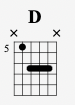
D is played as a bar chord as well in 5th position, like this:
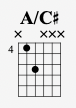
A5/C# is played using just 3 notes like this:
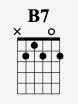
B7 is a great blues chord played from the 5th string down like this:
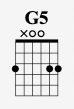
Finally, we have G5. I play this chord as an open power chord using 5 strings like this:
If you’ve struggled to understand the fretboard for RHYTHM and LEAD guitar, and want to discover the easiest and fastest way. Then get your hands on my free Fretboard Guide PDF right here now:
Is I Want You To Want Me hard to play on guitar?
I would say playing “I Want You To Want Me” on guitar is going to require an intermediate skill level. There are many different chord changes and sections to get down. Plus, the lead parts require fast picking and a strong fretting hand to be able to bend the strings correctly. So, take your time with this one.
What key is I Want You To Want Me in?
“I Want You To Want Me,” as recorded by Cheap Trick, is in the key of A major. The primary scale used in the song is the A major scale, which is built with the notes A, B, C#, D, E, F#, and G#.
Let’s take a look at how all these chords relate in the key of A major:
A (A major)
Notes: A, C♯, E
Function: This is the I chord in A major. It’s the tonic and tonal center of the key, providing the strongest sense of resolution and “home.”
A/G♯ (A major over G♯)
Notes: G♯, A, C♯, E
Function: This is a slash chord. It’s the I chord with the major seventh (G♯) in the bass. This creates a smooth stepwise bass motion, leading down to F♯m. This type of descending bass line movement happens throughout the entire song.
F♯m (F♯ minor)
Notes: F♯, A, C♯
Function: This is the vi chord in A major. It’s the relative minor of A major and shares two notes (A and C♯) with the tonic, making it a great transition chord.
D (D major)
Notes: D, F♯, A
Function: This is the IV chord (subdominant) in A major. It creates movement away from the tonic and is often used to set up a return to A or lead into the dominant (E or B7).
A/C♯ (A major over C♯)
Notes: C♯, A, E
Function: This is the first inversion of the I chord (I⁶), with the third (C♯) in the bass. It again provides a smooth bass movement connecting chords.
B7 (B dominant 7)
Notes: B, D♯, F♯, A
Function: This is the V7/V (secondary dominant) in A major, meaning it’s the dominant of the dominant (it resolves strongly to E major, which is V in A major). It adds tension and brightness to the progression.
G5 (G power chord)
Notes: G, D (no third)
Function: G is not diatonic to A major. In this context, G functions as a ♭VII chord, a borrowed chord from the Mixolydian mode. This chord is a total classic rock guitar move and is used in millions of songs.
So to recap, all of the chords are diatonic to the key except B7 and G5.
So that’s the theory. Next, let’s look at…
What is the strumming pattern for I Want You To Want Me?
The main underlying groove for “I Want You To Want Me” is an uptempo 8th note rock feel with a light swing. In 4/4 time, 8th note swing divides each beat into two uneven parts, creating a laid-back, swinging rhythm like this:
1 & 2 & 3 & 4 &
The numbers (1, 2, 3, 4) represent the main beats in the measure. The "&" represents the offbeat, which is delayed slightly to create the swing feel, making the first note of each pair longer and the second note shorter.
When counted out loud, it sounds like:
"One...ah, Two...ah, Three...ah, Four...ah."
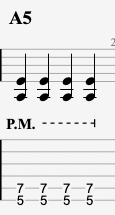
However, I wouldn’t strum all 8th notes. Instead, I primarily play quarter notes with a palm-mute feel. Here’s an example of a strumming pattern in the style of “I Want You To Want Me”:
Conclusion
To wrap it up, the chords are the same whether you are playing along with the original or the live version. So pick your favorite, and have a ball.
Keep practicing, and if you want to learn songs way faster, better understand the fretboard for lead and rhythm, and not waste years spinning your wheels with guitar, grab my free fretboard guide here right now:
Jon MacLennan
Like this blog post? Get Jon’s best guitar lessons straight to your inbox.
Discover the 5 easiest and fastest ways to play the blues scale anywhere on the neck with this FREE PDF GUIDE
