The ULTIMATE Ironic Chords & Guitar Lesson
Let’s go back in time to the ‘90s…
Here’s a song from a landmark album from Alanis Morissette.
You only need a handful of chords to play it.
Below, I’m going to share some insider tips on the guitar style behind it.
So grab your axe, and let’s dive into this “Ironic” chords and guitar lesson!
Who Wrote Ironic?
“Ironic” was originally written by Canadian singer-songwriter Alanis Morissette and guitarist-producer Glen Ballard. The song has a catchy, pop-rock sound to it, and was released in 1996 as the third single off the album Jagged Little Pill.
“Ironic” was recorded primarily at Westlake Recording Studios in Los Angeles. Morissette and Ballard worked closely on the arrangement, crafting a radio-friendly structure that highlighted her quirky, yet expressive vocals. It starts off with a simple acoustic guitar played without a pick. And then kicks into a full rock band sound.
Upon release, “Ironic” soared up to number four on the Billboard Hot 100 and became one of Morissette’s biggest hits. The relatable female storytelling and irony of daily life resonated with a lot of people, and the song became a defining track of the ‘90s.
The music video, directed by Stéphane Sednaoui, features a young Morissette performing in a car and goofing around:
Now, you may be wondering…
What is the tuning for Ironic?
The tuning for "Ironic” is standard tuning. Standard tuning is spelled: E, A, D, G, B, and E.
Here are the strings:
- E (6th string, lowest pitch)
- A (5th string)
- D (4th string)
- G (3rd string)
- B (2nd string)
- E (1st string, highest pitch)
However, the main guitar uses a capo on the 4th fret, so that would change the notes to:
- G# (6th string, lowest pitch)
- C# (5th string)
- F# (4th string)
- B (3rd string)
- D# (2nd string)
- G# (1st string, highest pitch)
All right!
Now that you know the tuning for “Ironic,” let’s next talk about…
Ironic Chords
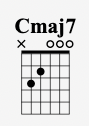
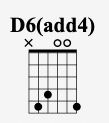
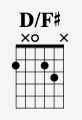
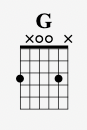
To play “Ironic”, you only need to know 8 main chord shapes they are Cmaj7, D6(add4), D/F#, G, Em, F, C, and D. Keep in mind these are the capo chords, and most of them can be played in open position. That is one of the beautiful things about using a capo.
Let’s take a look at a few ways these shapes can be played on the fretboard:
Cmaj7 is the first chord you hear, and it’s played like a standard open position C chord. However, I lift off the index finger and make the 2nd string open like this:
D6(add4) looks similar to a C chord, but it’s shifted up two frets like this:
I play D/F# using my fretting hand thumb. If that feels uncomfortable for you, you can also play it without the fretting hand thumb as well. Here are the notes:
G I play using just 2 fingers in the fretting hand and keep things simple. However, most forms of G will work.
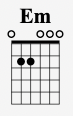
Em is a beautiful chord using all 6 strings like so:
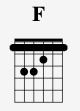
F is played in the 1st position as a bar chord like this:
If bar chords are giving you all kinds of aches and pains, and you haven’t yet discovered how to play them effortlessly, go here: https://www.jonmaclennan.com/7mistakes
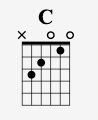
C is played in a standard open position like this:
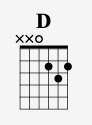
Finally, D is played from the 4th string down like this:
If you’ve struggled to understand the fretboard for RHYTHM and LEAD guitar, and want to discover the easiest and fastest way. Then get your hands on my free Fretboard Guide PDF right here now:
Is Ironic hard to play on guitar?
I would say playing “Ironic” on guitar is going to require an intermediate skill level. The trickiest parts are the syncopated rhythms, finger-picking, and transitioning from one section to the next. So, take your time with this one.
What key is Ironic in?
“Ironic”, as recorded by Alanis Morissette, is in the key of B major concert pitch. However, the guitar with a capo on the 4th fret plays it in the key of G major. This means the primary scale for the song is the G major scale, which is built using the notes G, A, B, C, D, E, and F#.
Let’s break down the main chords and how they function in the key of G major.
C
Notes: C, E, G
Function: This is the IV chord, the subdominant. It is built on the fourth degree of the G major scale. It provides a stable, yet slightly expectant feeling, often used to move away from the tonic and lead toward the dominant (V) chord.
D
Notes: D, F♯, A
Function: This is the V chord, the dominant. It is built on the fifth degree of the G major scale. This one gives a strong sense of tension and a powerful, almost mandatory pull, back to the tonic (I) chord.
G
Notes: G, B, D
Function: This is the I chord, the tonic. It is the "home" chord in the key of G major.
Em
Notes: E, G, B
Function: This is the vi chord, the submediant. It is the relative minor of G major, built on the sixth degree. It provides a slightly melancholic or introspective sound, often used as a substitute for the tonic chord to vary the progression while maintaining a sense of home.
F
Notes: F, A, C
Function: This is the ♭VII chord, the subtonic major. This is a non-diatonic or "borrowed" chord in the key of G major because it uses the F natural (a note not in the G major scale). It’s a borrowed chord from the G Mixolydian mode or the G minor key. This gives it a bluesy sound.
All right!
So that’s the theory. Next, let’s look at…
What is the strumming pattern for Ironic?
The main underlying feel for “Ironic” is an 8th note pop-rock feel. In 4/4 time, 8th notes divide each beat into two equal parts, creating a steady, walking rhythm. The counting for 8th notes in a measure looks like this:
1 & 2 & 3 & 4 &
The numbers (1, 2, 3, 4) represent the main beats in the measure. The "&" divides each beat into two evenly spaced subdivisions.
When counted out loud, it sounds like:
"One-and, Two-and, Three-and, Four-and."
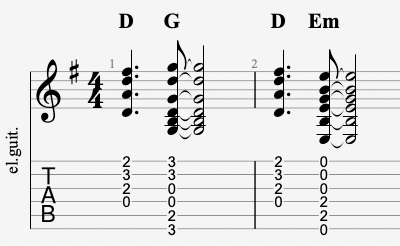
Here’s an example of a strumming pattern in the style of “Ironic”:
Conclusion
To wrap it up, “Ironic” was a breakthrough tune for Alanis Morissette. It’s an anthem of the ‘90s and is still getting played today.
Keep practicing, and if you want to learn songs way faster, better understand the fretboard for lead and rhythm, and not waste years spinning your wheels with guitar, grab my free fretboard guide here right now:
Jon MacLennan
Like this blog post? Get Jon’s best guitar lessons straight to your inbox.
Discover the 5 easiest and fastest ways to play the blues scale anywhere on the neck with this FREE PDF GUIDE
