“It's All Over Now Baby Blue” Chords & Guitar Lesson (MOST ACCURATE)
Here’s a haunting song about the end of a relationship.
It wasn’t released as a single, but over the years it’s become a Bob Dylan fan favorite.
Below, I’m going to share some insider tips on the guitar style behind it.
So grab your axe, and let’s dive into this “It's All Over Now Baby Blue” chords and guitar lesson!
Who Wrote It's All Over Now Baby Blue?
“It’s All Over Now, Baby Blue” was written by American singer-songwriter Bob Dylan. It was released as the final track on his 1965 album Bringing It All Back Home.
The recording was tracked on January 15, 1965, at Columbia’s 7th Avenue Studio in New York City. Tom Wilson was at the helm as producer, and the arrangement was sparse. It features Dylan on acoustic guitar and harmonica, and bassist William E. Lee.
The song’s lyrics – like most Dylan tunes – are rich in surreal imagery. He paints pictures in your mind with his masterful songwriting. This one in particular captures a raw “farewell energy” of the end of a relationship.
Although the identity of “Baby Blue” has long been debated. It’s possible it could have been folk singer Joan Baez. However, others interpret the song as a farewell to the folk movement. You see, Dylan closed his acoustic set with the song at the 1965 Newport Folk Festival after controversy over going electric.
“It's All Over Now Baby Blue” wasn’t released as a single. However, the song gained acclaim through multiple Dylan compilations—including Greatest Hits Vol. II, The Essential Bob Dylan, and has appeared on live recordings, such as The 1974 Live Recordings.
Not only that, the song has inspired some great covers as well, like the one from the Belfast band Them in 1966.
Rolling Stone Australia called it “Dylan writing like a short‑story writer.”
Now, you may be wondering…
What is the tuning for It's All Over Now Baby Blue?
The tuning for "It's All Over Now Baby Blue" as recorded by Bob Dylan, is standard tuning. Standard tuning is spelled: E, A, D, G, B, and E.
Here are the strings:
- E (6th string, lowest pitch)
- A (5th string)
- D (4th string)
- G (3rd string)
- B (2nd string)
- E (1st string, highest pitch)
However, for this lesson, I’ll be using a capo on the 4th fret, which makes the tuning:
- G# (6th string, lowest pitch)
- C# (5th string)
- F# (4th string)
- B (3rd string)
- D# (2nd string)
- G# (1st string, highest pitch)
All right!
Now that you know the tuning for “It's All Over Now Baby Blue”, let’s next talk about…
It's All Over Now Baby Blue Chords
To play “It's All Over Now Baby Blue”, as recorded by Bob Dylan, you’ll need to know six main chords they are C, G, F, Dm, E, and G7. Let’s take a look at a few ways these chords can be played on the fretboard.
C is played in a standard (campfire) position like this:

G, I play using a folk style fingering and muting the 5th string like this:

F is played as a bar chord in 1st position like so:
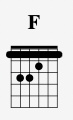
Dm is played from the 4th string down like this:

E is a beautiful chord. This one is played using all 6 strings like so:
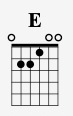
G7 is played similarly to the G above; however, this one brings in the 5th string and also plays an F note on the 1st string 1st fret like this:
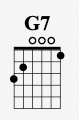
If you’ve struggled to understand the fretboard for RHYTHM and LEAD guitar, and want to discover the easiest and fastest way. Then get your hands on my free Fretboard Guide PDF right here now:
Is It's All Over Now Baby Blue hard to play on guitar?
I would say playing “It's All Over Now Baby Blue” on guitar is going to require a late beginner to intermediate skill level. It would be a decent beginner song. However, there is one chord that pushes it out of beginner territory, and that is the F major bar chord. So, take your time with this one. If bar chords are giving you all kinds of aches and pains, and you’ve haven’t yet discovered how to play them effortlessly yet, go here: https://www.jonmaclennan.com/7mistakes
What key is It's All Over Now Baby Blue in?
“It's All Over Now Baby Blue,” as recorded by Bob Dylan, is in the key of E major concert pitch. However, for this guitar lesson, I am using a capo on the 4th fret and playing it in the key of C major.
C moved up 4 frets = E.
However, to keep things simple, let’s take a look at how the chords relate in the key of C major:
C
Notes: C, E, G
Function: This is the I chord (tonic) in the key of C major. It's the “home” chord that provides resolution, rest, and stability. Most chord progressions in C major will feel settled when they return here.
G
Notes: G, B, D
Function: This is the V chord (dominant) in C major. It builds strong harmonic tension and leads naturally back to the tonic (C). The V–I progression is one of the most common in Western music. G7 is also used to add a little more tension throughout the song.
F
Notes: F, A, C
Function: This is the IV chord (subdominant) in C major. It creates a smooth move away from the tonic and often sets up the transition to the dominant (V) or back to the tonic (I). It has an open quality to it.
Dm
Notes: D, F, A
Function: This is the ii chord (supertonic minor) in C major. It typically functions as a pre-dominant chord, meaning it sets up the IV or V chords. In “It’s All Over Now Baby Blue” the progression moves ii–IV–V–I, another very common progression.
E
Notes: E, G♯, B
Function: This chord does not belong to the key of C major — it contains a G♯, which is outside the key. In this context, E major is a secondary dominant (written V/vi), meaning it temporarily acts as the dominant to A minor, which is the vi chord in C major. It creates a sense of tension that resolves nicely to Am, or F in the case of “It's All Over Now Baby Blue”.
So that’s the theory. Next, let’s look at…
What is the strumming pattern for It's All Over Now Baby Blue?
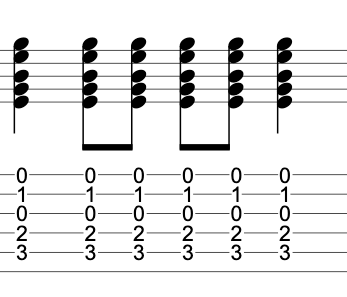
The main underlying groove for “It's All Over Now Baby Blue” is a steady 8th-note feel.
This drives the tune. Dylan keeps his strum hand moving back and forth. In 4/4 time, 8th notes divide each beat into two equal parts, creating a steady rhythm like this:
1 & 2 & 3 & 4 &
The numbers (1, 2, 3, 4) represent the main beats in the measure, while the "&" represents the offbeats that add energy and momentum.
When counted out loud, it sounds like:
"One-and, Two-and, Three-and, Four-and."
This is the main rhythm and can be played throughout. However, I often don’t play all the 8th notes. Instead, I would use a combination of 1/4 notes and 8th-notes like this:
Conclusion
There ya have it!
The final farewell tune on Dylan’s 1965 album Bringing It All Back Home.
Keep practicing, and if you want to learn songs way faster, better understand the fretboard for lead and rhythm, and not waste years spinning your wheels with guitar, grab my free fretboard guide here right now:
Jon MacLennan
Like this blog post? Get Jon’s best guitar lessons straight to your inbox.
Discover the 5 easiest and fastest ways to play the blues scale anywhere on the neck with this FREE PDF GUIDE
