John Mellencamp – “Jack And Diane” Chords & Guitar Lesson
If you’re interested in learning cool chords up and down the neck for rhythm and lead guitar playing… then I think you’re going to enjoy this video.
It’s on one of the most iconic songs of the ‘80s, and the guitars blend both acoustic and electric. But I’m going to share with you a way to combine the parts into one main guitar part.
This will give you a super solid way to play it on one guitar.
So grab your axe, and let’s dive into this “Jack And Diane” chords and guitar lesson!
Who Wrote Jack And Diane?
“Jack and Diane” was originally written by John Mellencamp and released in 1982 on his breakthrough album American Fool. Before the release of this song, his career hadn’t fully clicked with a mass audience. The song has an American small-town youth kind of vibe to it, which became a hallmark of his career.
The song starts out really innocent with two teenagers, Jack and Diane, hanging out behind the Tastee-Freez, dreaming about the future. But then takes a twist as that childhood freedom collides with adulthood. Lyrics like, “Oh yeah, life goes on… long after the thrill of living is gone” capture this essence.
The story behind the song was originally longer, but producer Don Gehman pushed Mellencamp to strip it down and cut the extra verses. This is a big reason why the song works so well.
“Jack and Diane” was recorded at Belmont Mall Studio in Bloomington, Indiana. One of the most prominent elements in the track is the handclap. Gehman added it late in the process to give the track a more sing-along feel.
Upon its release, “Jack and Diane” became a massive hit. It reached number one on the Billboard Hot 100 and stayed there for four weeks, making it Mellencamp’s biggest chart success.
It also played a major role in the record American Fool reaching number one on the Billboard 200 as well. The album went on to win a Grammy Award for Best Male Rock Vocal Performance, solidifying Mellencamp as a major American songwriter.
Now, you may be wondering…
What is the tuning for Jack And Diane?
The tuning for "Jack And Diane” is standard tuning. Standard tuning is spelled: E, A, D, G, B, and E.
Here are the strings:
- E (6th string, lowest pitch)
- A (5th string)
- D (4th string)
- G (3rd string)
- B (2nd string)
- E (1st string, highest pitch)
All right!
Now that you know the tuning for “Jack And Diane,” let’s next talk about…
Jack And Diane Chords
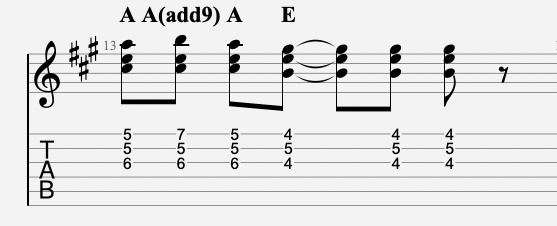
To play “Jack And Diane”, as recorded by John Mellencamp, you only need to know 3 main chords they are A, E, and D. All of these chords can be played in open position.
Let’s take a look at a few ways these shapes might show up on the fretboard.
A is played from the 5th string down like so:

D is played in a simple (campfire) style from the 4th string down like this:

Finally, we have E. This chord is a beautiful-sounding chord that uses all 6 strings like so:

If you’ve struggled to understand the fretboard for RHYTHM and LEAD guitar, and want to discover the easiest and fastest way. Then get your hands on my free Fretboard Guide PDF right here now:
Is Jack And Diane hard to play on guitar?
I would say playing “Jack And Diane” on guitar is going to require a solid intermediate guitar skill level. The trickiest parts are the syncopated rhythms, sliding chords, and then switching from single notes to chords. Putting all the variations together and getting a clean sound with a tight rhythm is going to require many skills. So, take your time with this one.
What key is Jack And Diane in?
“Jack And Diane”, as recorded by John Mellencamp, is in the key of A major. The primary scale for the song would be the A major scale, which is built using the notes A, B, C#, D, E, F#, and G#.
Let’s take a closer look at how these chords relate in the key of A. Starting with…
A
Notes: A, C#, E
Function: This is the I chord, the tonic of A major. It’s “home”. All movement in the key is ultimately heard in relation to this chord, and returning to A gives the listener a sense of resolution.
E
Notes: E, G#, B
Function: This is the V chord, the dominant of A major. Its role is to create tension that generally resolves back to the tonic. The G# is the leading tone of the key and pulls strongly toward A, which gives progressions energy and forward momentum. Moving from E back to A is one of the most fundamental chord progressions in Western music.
D
Notes: D, F#, A
Function: This is the IV chord in A major. It creates movement away from the tonic while still feeling stable and supportive. D often acts as a setup chord, either preparing a return to A or leading into E.
Together, these three chords form the classic I–IV–V framework in the key of A major. This progression is the backbone of countless folk, blues, rock, and country songs, because… they just work.
All right!
That’s my theory breakdown.
Next, let’s look at…
What is the strumming pattern for Jack And Diane?
The main underlying groove for “Jack And Diane” is a folk-rock feel. It’s primarily 8th note driven; however, some 16th notes do slip in. Remember – in 4/4 time, 8th notes divide each beat into two equal parts, creating a steady, driving rhythm. The counting for 8th notes in a measure looks like this:
1 & 2 & 3 & 4 &
The numbers (1, 2, 3, 4) represent the main beats in the measure. The "&" divides each beat into two evenly spaced subdivisions.
When counted out loud, it sounds like:
"One-and, Two-and, Three-and, Four-and."
This gives the tune a strong and consistent forward motion
Conclusion
To wrap it up, “Jack And Diane” is a legendary tune. The guitar part is catchy all by itself and is a great way to better understand chords up and down the fretboard.
Keep practicing, and if you want to learn songs way faster, better understand the fretboard for lead and rhythm, and not waste years spinning your wheels with guitar, grab my free fretboard guide here right now:
Jon MacLennan
Like this blog post? Get Jon’s best guitar lessons straight to your inbox.
Discover the 5 easiest and fastest ways to play the blues scale anywhere on the neck with this FREE PDF GUIDE
