The ULTIMATE “Jessie's Girl” Chords & Guitar Lesson
Here’s a tune that became a breakthrough song for Australian-American musician Rick Springfield.
He was struggling as an artist and doing acting work on the side to supplement his income.
Then this song took off, and the rest is history.
Below, I’m going to share some insider tips on the guitar style behind it.
So grab your axe, and let’s dive into this “Jessie's Girl” chords and guitar lesson!
Who wrote Jessie's Girl?
“Jessie’s Girl” was originally written by Rick Springfield, and it was released as a single from his album Working Class Dog in 1981.
The song is about a blatant love interest with his best friend’s girlfriend. The narrator is jealous of his friend Jessie and longs to find “a woman like that.” The song captures frustration and not getting what you want.
Springfield has said that the inspiration came from a real-life experience when he became infatuated with a girlfriend of a friend he knew during his time in Los Angeles. The friend’s real name was Gary, but he didn’t think “Gary’s Girl” had the right ring to it for the song. So he ended up changing the name to Jessie. Ironically, there was no real “Jessie.” This later led to countless fans and journalists trying to track down a nonexistent person.
“Jessie’s Girl” was recorded at Sound City Studios in Van Nuys, California with producer Keith Olsen at the helm. This studio is legendary, and it still exists today. It’s known for being the place where many famous rock records have been made. Fleetwood Mac, Nirvana, and Tom Petty have all recorded iconic albums here, just to name a few.
Upon its release, “Jessie’s Girl” reached number one on the Billboard Hot 100 in the United States in August 1981. It became Springfield’s signature song and helped him gain real traction in the U.S. Before this, he was primarily only known in Australia, so “Jessie’s Girl” was a breakthrough tune for his career. It also earned him a Grammy Award for Best Male Rock Vocal Performance at the 1982 Grammy Awards, cementing its status as both a commercial and critical success.
Over the decades, it has consistently appeared on “greatest songs of the ’80s” lists and still to this day remains a staple of classic rock, pop radio, and many cover bands.
Now, you may be wondering…
What is the tuning for Jessie's Girl?
The tuning for "Jessie's Girl” is standard tuning. Rick Springfield kept things simple. Standard tuning is spelled: E, A, D, G, B, and E.
Here are the strings:
- E (6th string, lowest pitch)
- A (5th string)
- D (4th string)
- G (3rd string)
- B (2nd string)
- E (1st string, highest pitch)
All right!
Now that you know the tuning for “Jessie's Girl,” let’s next talk about…
Jessie's Girl Chords
To play “Jessie's Girl”, as recorded by Rick Springfield, you’ll need to know 7 main chords they are D5, A5, B5, G5, A, D/A, and F#5. These chords are primarily played as power chords. However, they can also be played as full bar chords as well.
If bar chords are giving you all kinds of aches and pains, and you haven’t yet discovered how to play them effortlessly, go here: https://www.jonmaclennan.com/barchords
Let’s take a look at a few ways these shapes might show up on the fretboard.
D5 is played in 5th position on the 5th and 4th strings like this:

A5 shifts the D5 power up (toward the sky) one string set like so:

B5 still has a root on the 6th string, it just shifts up 2 frets from A5 like this:

G5 moves lower on the fretboard (to position 3) like this:

Then we have a one-finger A chord. I use my index finger in the fretting hand only like so:
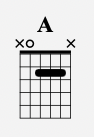
D/A makes a small change from the A like this:

Finally, we have F#5. This one comes in during the interlude section and is played in 2nd position like so:

If you’ve struggled to understand the fretboard for RHYTHM and LEAD guitar, and want to discover the easiest and fastest way. Then get your hands on my free Fretboard Guide PDF right here now:
Is Jessie's Girl hard to play on guitar?
I would say playing “Jessie's Girl” on guitar is going to require an intermediate skill level. The chords themselves are not too difficult. However, there are a number of rhythm syncopations, where the chords change on “off” beats, and also so riffs to learn that make it more difficult. So, take your time with it.
What key is Jessie's Girl in?
“Jessie's Girl”, as recorded by Rick Springfield, is in the key of D major. The primary scale for the song would be the D major scale, which is built using the notes D, E, F#, G, A, B, and C#.
Let’s take a closer look at how these chords relate in the key of D major. Starting with…
D5
Notes: D, A
Function: D5 is a power chord built on the tonic of D major. This is the “home” chord. Although it is a power chord, meaning it’s neither major nor minor by itself…in the context of D major, it clearly functions as the I chord.
A5
Notes: A, E
Function: A5 is the power chord built on the fifth scale degree. In the key of D major, A is the V chord. Even without the C#, it still carries dominant energy, and you could use the full A major, which comes in during the chorus as well.
B5
Notes: B, F#
Function: B5 is the vi chord. In a full triad, this would be B minor (vi). As a power chord, it removes the minor third (D), making it tonally neutral, but functionally it still behaves like the vi chord. It often adds movement while keeping things inside the key.
G5
Notes: G, D
Function: G5 is the IV chord. This chord moves the harmony away from the tonic without creating strong tension. It provides a nice lift and contrast before returning to D or moving toward A.
D/A
Notes: D, F#, A (with A in the bass)
Function: This is the I chord in second inversion. Harmonically, it is still the tonic, but placing A in the bass gives it a strong sound. It’s almost a suspended feel.
F#5
Notes: F#, C#
Function: F#5 is built on the third scale degree of D major. In a full triad, this would be F# minor (iii). However, in the context of the song it actually becomes an F# major which is a temporary modulation to the key of F#. So it’s a momentary one chord.
Taken together, these chords make up some of the most common progressions in music.
All right!
That’s my theory breakdown.
Next, let’s look at…
What is the strumming pattern for Jessie's Girl?
The main underlying feel for “Jessie's Girl” is a straight-up 8th note rock feel. The primary rhythm you should use to strum would be an 8th note rhythm. In 4/4 time, 8th notes divide each beat into two equal parts, creating a steady, driving rhythm. The counting for 8th notes in a measure looks like this:
1 & 2 & 3 & 4 &
The numbers (1, 2, 3, 4) represent the main beats in the measure. The "&" divides each beat into two evenly spaced subdivisions.
When counted out loud, it sounds like:
"One-and, Two-and, Three-and, Four-and."
This gives the tune a consistent forward motion
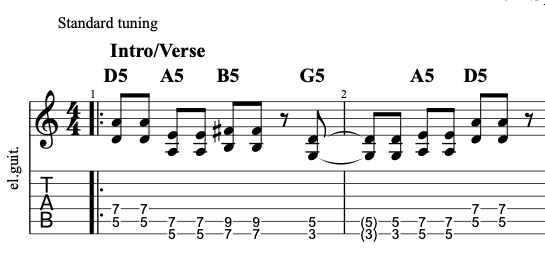
However, instead of playing all 8th notes. I might combine them with some 8th note rests and even some ties. Here’s an example of a strumming pattern in the style of “Jessie's Girl”:
Conclusion
To wrap it up, “Jessie's Girl” is an epic rock anthem. It’s a perfect song to add to your party setlist, or to jam along with the recording.
Keep practicing, and if you want to learn songs way faster, better understand the fretboard for lead and rhythm, and not waste years spinning your wheels with guitar, grab my free fretboard guide here right now:
Jon MacLennan
Like this blog post? Get Jon’s best guitar lessons straight to your inbox.
Discover the 5 easiest and fastest ways to play the blues scale anywhere on the neck with this FREE PDF GUIDE
