The ULTIMATE "Jingle Bell Rock” Chords & Guitar Lesson
Here’s one of the first songs ever to blend Christmas and rock and roll.
It’s one of the most famous holiday tunes of all time.
But keep in mind, it's not for beginners. There are many advanced chords to know.
Below, I’m going to share with you some insider tips for how to play it.
So grab your axe, and let’s dive into this “Jingle Bell Rock” chords and guitar lesson!
Who Wrote Jingle Bell Rock?
“Jingle Bell Rock” was originally written by two American songwriters, Joseph Carleton Beal and James Ross Boothe, in 1957.
It was one of the first Christmas songs ever written in a rock and roll style, which was exploding in popularity during this time. Because of the theme of Christmas and the influence of rock and roll, the song was considered quite controversial. In fact, many radio stations would not play it. These two had not yet mixed together in society.
But the recording for “Jingle Bell Rock” was done in Nashville, and the arrangement blends country twang, early rock rhythm, and a subtle jazz swing feel.
The result became this iconic Christmas song that comes back into popularity year after year.
“Jingle Bell Rock” has been covered by countless legendary artists over the past 60 years, making it a standard. It’s also been featured in many commercials, advertisements, and films. For example, its inclusion in the film “Mean Girls” introduced the song to a whole new generation:
Now, you may be wondering…
What is the tuning for Jingle Bell Rock?
The tuning for "Jingle Bell Rock” is standard tuning. Standard tuning is spelled: E, A, D, G, B, and E.
Here are the strings:
- E (6th string, lowest pitch)
- A (5th string)
- D (4th string)
- G (3rd string)
- B (2nd string)
- E (1st string, highest pitch)
All right!
Now that you know the tuning for “Jingle Bell Rock,” let’s next talk about…
Jingle Bell Rock Chords
To play “Jingle Bell Rock”, as recorded by Bobby Helms, you’ll need to know 14 main chords they are D6, Dmaj7, Ebdim7, Em7, A7, G6, Abdim7, C#, D, D#, E, B7, Gm6, and E7. These chords are all played as closed position chords. This is common in a jazz style, and many of these chords require the bar technique.
If bar chords are giving you all kinds of aches and pains, and you haven’t yet discovered how to play them effortlessly, go here: https://www.jonmaclennan.com/barchords
Let’s take a look at a few ways these shapes might show up on the fretboard.
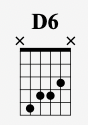
D6 is a beautiful chord played on the middle strings like this:
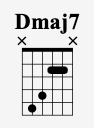
Dmaj7 makes a subtle pivot and bars in 2nd position like so:
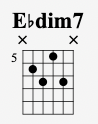
Ebdim7 is a common jazz chord played on the middle strings like this:
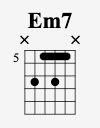
Em7 continues this idea of playing on the middle strings like this:
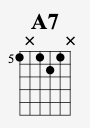
A7 I play as a thumb-chord like this:
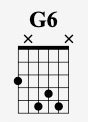
G6 comes in during the B section and uses 4 strings like this:
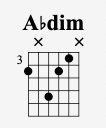
Abdim7 is another diminished shape like Ebdim7, but this one has a root on the 6th string, like so:
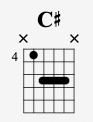
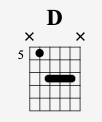
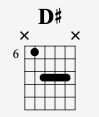
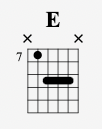
C#, D, D#, and E are all the same bar chord grip, just in different places on the fretboard:
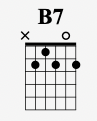
B7 is a very common blues chord played from the 5th string down like this:
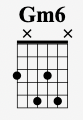
Gm6 is the minor version of the G6 chord above. Again, I use my fretting hand thumb to play the 6th string like this:
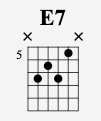
Finally, E7 is another bluesy style chord played on the middle strings like this:
If you’ve struggled to understand the fretboard for RHYTHM and LEAD guitar, and want to discover the easiest and fastest way. Then get your hands on my free Fretboard Guide PDF right here now:
Is Jingle Bell Rock hard to play on guitar?
I would say playing “Jingle Bell Rock” on guitar is going to require an advanced skill level. The song only has two sections. But there are many advanced chord shapes that come from jazz harmony, also getting the rockabilly intro lick and swing feel right is something beginners will struggle with. So, take your time with this one.
What key is Jingle Bell Rock in?
“Jingle Bell Rock”, as recorded by Bobby Helms, is in the key of D major. The primary scale would be the D major scale, which is built using the notes D, E, F#, G, A, B, and C#.
Let’s take a closer look at how all these chords relate in the key of D major. Starting with…
D6
Notes: D, F#, A, B
Function: This is the I chord in D major with an added 6th. The B adds color and warmth without creating tension. D6 still feels like “home,” but with a slightly jazzy or pop flavor.
Dmaj7
Notes: D, F#, A, C#
Function: This is also the I chord, but this time with a major 7th. The C# adds a peaceful, jazzy sound.
Ebdim7
Notes: Eb, A, C, Gb
Function: This is a chromatic passing diminished chord. It does not belong diatonically to D major, but it functions as a leading chord between D and Em. Diminished chords are often used to create tension and smooth voice-leading between chords. That’s what’s happening here.
Em7
Notes: E, G, B, D
Function: This is the ii7 chord in D major. It has a predominant function and naturally wants to move to A or A7. Em7 softens the harmony while setting up forward motion.
A7
Notes: A, C#, E, G
Function: This is the V7 chord in D major. It creates strong tension that resolves back to D. The minor 7th (G) gives it extra pull and makes the resolution feel satisfying.
G6
Notes: G, B, D, E
Function: This is the IV chord with an added 6th. The E adds brightness and an old-school sound. G6 functions as a subdominant, giving you a sense of moving away from the tonic while keeping the harmony stable and relaxed.
Abdim7
Notes: Ab, F, B, D
Function: This is another chromatic diminished chord. It commonly functions as a passing chord or as a leading chord. It increases tension and adds a jazzy or dramatic transition.
C#
Notes: C#, F, G#
Function: This is a non-diatonic major chord in D major. It’s used chromatically to dip down ½ step and then up in the progression.
D
Notes: D, F#, A
Function: This is the I chord, the tonic of D major.
D#
Notes: D#, G, A#
Function: This is another chromatic chord outside the key.
E
Notes: E, G#, B
Function: E is not in the key of D major. It’s functioning as a secondary dominant leading toward A, or a V/V.
B7
Notes: B, D#, F#, A
Function: This is another secondary dominant chord. In D major, B7 functions as V/ii, meaning it leads to Em or Em7.
Gm6
Notes: G, Bb, D, E
Function: This is a borrowed chord from the parallel minor (D minor). It’s a common chord giving the progression a very distinct bluesy flavor.
E7
Notes: E, G#, B, D
Function: This is another secondary dominant. In D major, E7 functions as V/V, leading directly to A or A7.
Together, these chords make up some of the most common sets of chords in popular music.
Millions of songs use them…
All right!
That’s my theory breakdown.
Next, let’s look at…
What is the strumming pattern for Jingle Bell Rock?
The main underlying groove for “Jingle Bell Rock” is an 8th note swing. In 4/4 time with a swing feel, 8th notes are played unevenly, where the first 8th note of the beat is longer and the second 8th note is shorter. This creates the swing. The counting for swung 8th notes in a measure still uses the standard notation, but the performance is based on a triplet subdivision:
1 (trip-let) 2 (trip-let) 3 (trip-let) 4 (trip-let)
The actual duration of the notes divides the beat into a triplet figure, with the first 8th note taking up two-thirds of the beat and the second 8th note taking up the final one-third.
When counted out loud to express the rhythm, it sounds like:
"One-and-uh, Two-and-uh, Three-and-uh, Four-and-uh"
"One-trip-let, Two-trip-let, Three-trip-let, Four-trip-let."
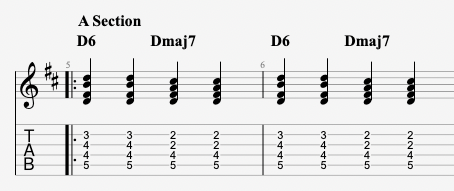
So that’s the overall feel. But for the strumming pattern on guitar, I would play a straight quarter note rhythm in a Freddie Green style like this:
Conclusion
To wrap it up, “Jingle Bell Rock” is a classic and was one of the first songs ever written to blend Christmas and rock and roll.
Keep practicing, and if you want to learn songs way faster, better understand the fretboard for lead and rhythm, and not waste years spinning your wheels with guitar, grab my free fretboard guide here right now:
Jon MacLennan
Like this blog post? Get Jon’s best guitar lessons straight to your inbox.
Discover the 5 easiest and fastest ways to play the blues scale anywhere on the neck with this FREE PDF GUIDE
