Dolly Parton – “Jolene” Chords & Guitar Lesson
This week, the music business lost a bright light.
Dolly Parton has gone on to join the choir invisible.
And with all the stories and clips of her flying around, I was reminded of my favorite riff of hers.
It’s like French toast on Sunday morning.
(mmmm...)
I’ve played it for years with various bands.
But upon looking up the song online, I noticed most guitar instructors don’t teach it accurately to the recording.
They show you how to play the chords and a campfire strummy version.
Which is fine, but the real guitar parts (played by top Nashville session musicians) are much more powerful.
At the root of this riff is a mighty technique called Travis picking.
In this lesson, you’ll learn:
* Why Travis picking is the key to sounding like the original recording.
* How a song with 195 million plays on YouTube Music is built around just 3 chords.
* The instantly recognizable riff broken down step-by-step in more detail than any other lesson on Al Gore's internet.
* What specific techniques I use to get that explosively percussive sound.
And a whole lot more!
So grab your axe, and let’s dive into this “Jolene” chords and guitar lesson!
Who wrote Jolene?
“Jolene” was originally written by Dolly Parton and is one of the most famous songs in country music history.
She recorded it in Nashville in 1973, and it was released as a single later that year ahead of her 1974 album of the same name. The song is very simple in terms of arrangement, instrumentation, and parts. But it’s fiercely hypnotic.
Lyrically, Dolly takes an interesting position. It’s not a typical love song. It’s one where she’s incredibly vulnerable and begs another woman not to take her man.
She doesn't attack the other woman, call her names, or even blame her. Instead, she admits that Jolene is extraordinarily beautiful and essentially says, “I can't compete with you.”
“Jolene” was recorded on May 22, 1973, at the legendary RCA Studio B in Nashville, Tennessee, with Bob Ferguson at the helm producing.
This room has been used by a whole slew of famous artists, including Elvis Presley, the Everly Brothers, Roy Orbison, Jim Reeves, and many, many others. So “Jolene” wasn't made in some little obscure studio; it came straight out of one of the most historically important recording studios in American popular music.
On top of that, the session musicians who played on this were Nashville elite. Chip Young and Wayne Moss on guitar, with Young being responsible for the thumb-picked rhythm figure. This is the engine of the song.
Upon its release, “Jolene” became a major country hit and reached No. 1 on Billboard's country chart, giving Dolly another chart-topper at a crucial stage in her emergence as a star.
The awards history is interesting because the original recording became legendary without actually winning Dolly a Grammy at the time. It was nominated for Best Country Vocal Performance, Female, and a later live version generated another nomination. Decades later, however, the recording received one of the Recording Academy's great retrospective honors when “Jolene” was inducted into the Grammy Hall of Fame in 2014.
Another interesting plot in the song is that we never find out what happens. Dolly simply freezes the story at the moment of maximum emotional uncertainty.
In my opinion, this song is up there with tunes like “Layla,” “Roxanne,” and “Billie Jean” as some comparable examples.
Now, you may be wondering…
What is the tuning for Jolene?
The tuning for "Jolene” as recorded by Dolly Parton is standard tuning. Standard tuning is spelled: E, A, D, G, B, and E.
Here are the strings:
- E (6th string, lowest pitch)
- A (5th string)
- D (4th string)
- G (3rd string)
- B (2nd string)
- E (1st string, highest pitch)
However, the main guitar part uses a capo on the 4th fret. This then changes the open strings to:
- G# (6th string, lowest pitch)
- C# (5th string)
- F# (4th string)
- B (3rd string)
- D# (2nd string)
- G# (1st string, highest pitch)
All right!
Now that you know the tuning for “Jolene,” let’s next talk about…
Jolene Chords
To play “Jolene”, as recorded by Dolly Parton, you only need to know 3 main chords/ Yes this song (as of this writing has 195 million plays on YouTube music, yet only uses 3 chords) they are Am, C, and G. Now, keep in mind, these are the capo chords and played all in open position.
If you want to play these chords without a capo, then you most likely need to use a bar technique.
If bar chords are giving you all kinds of aches and pains, and you haven’t yet discovered how to play them effortlessly, go here: https://www.jonmaclennan.com/barchords
Let’s take a look at a few ways these shapes might show up on the fretboard.
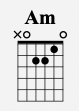
Am is played in open position from the 5th string down like so:
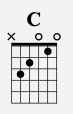
C is played by just moving one finger from the Am shape like this:
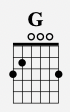
Finally, we have G, which I play in a folk-style like this:
If you’ve struggled to understand the fretboard for RHYTHM and LEAD guitar. and want to discover the easiest and fastest way. Then get your hands on my free Fretboard Guide PDF right here now:
Is Jolene hard to play on guitar?
I would say playing “Jolene” as recorded by Dolly Parton is going to require an advanced skill level. The chord progression is simple. But the fingerpicking is advanced. Between the hammer-ons, and pull-offs, to the percussive nature of it, and of course the SPEED, all of these things make it quite difficult to copy note-for-note. So, take your time with this one.
What key is Jolene in?
“Jolene”, as recorded by Dolly Parton, is in the key of C# minor. The primary scale for the song is the C# minor scale, which is built using the notes C#, D#, E, F#, G#, A, and B.
However, the guitar plays this with a capo on fret 4 and in the key of A minor. This makes the guitar scale A, B, C, E, F, and G.
Let’s next take a look at how these chords function in the key of A minor, starting with…
Am
Notes: A, C, E
Function: This is the i chord, the tonic of A minor. It’s the “home” chord and establishes the tonal center. The other chords create movement away from Am and eventually lead back to it.
C
Notes: C, E, G
Function: This is the III chord in A minor. It is also the relative major of A minor and shares two notes with the tonic Am chord (C and E). Because of this, moving between Am and C sounds very smooth while providing a brighter contrast to the minor tonic. We hear this throughout “Jolene”.
G
Notes: G, B, D
Function: This is the VII chord in A natural minor. It sits one whole step below the tonic and creates a strong sense of movement without the more powerful dominant pull of E or E7. G commonly moves to C (III) or directly back to Am (i), and its lowered seventh-degree sound is a major part of rock and folk progressions in minor keys.
Together, Am (i), C (III), and G (VII) all come directly from the A natural minor scale:
A – B – C – D – E – F – G
It’s a completely diatonic progression.
All right!
That’s my theory breakdown.
Next, let’s look at…
What is the fingerpicking/strumming pattern for Jolene?
The main feel for “Jolene” as recorded by Dolly Parton, is a sixteenth-note groove. In 4/4 time, a 16th-note groove divides each beat into four equal parts, creating a more active and detailed rhythmic feel than 8th notes.
The basic subdivision looks like this:
1 e & a 2 e & a 3 e & a 4 e & a
The numbers 1, 2, 3, and 4 represent the four main beats in the measure, while the “e,” “&,” and “a” divide the space between each beat into equal parts.
When counted out loud, it sounds like:
“One-ee-and-uh, Two-ee-and-uh, Three-ee-and-uh, Four-ee-and-uh.”
That gives you four 16th notes per beat and sixteen 16th notes in one measure of 4/4.
The fingerpicking pattern uses this rhythm.
Now if you want to strum it, a great way to feel this is to keep your strum hand moving continuously down and up:
1 e & a 2 e & a 3 e & a 4 e & a
D U D U D U D U D U D U D U D U
You don't necessarily have to strike the strings on every subdivision. In fact, I wouldn’t when playing the song. But this is where the actual groove comes from.
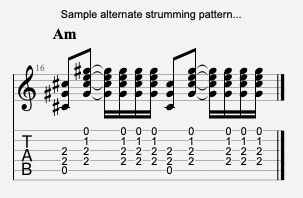
Here’s an example of a strumming pattern in the style of “Jolene”:
Conclusion
Bottom line, “Jolene” is one of the most famous songs in country music history. It’s also a ton of fun to play!
Keep practicing, and if you want to improve your fingerstyle guitar faster and not waste years spinning your wheels with guitar, grab my free fingerstyle cheat sheet PDF guide right here now:
Jon MacLennan
Like this blog post? Get Jon’s best guitar lessons straight to your inbox.
Discover the 5 easiest and fastest ways to play the blues scale anywhere on the neck with this FREE PDF GUIDE
