The ULTIMATE Knockin' On Heaven's Door Chords & Guitar Lesson
Behold…
A powerful Dylan song originally from the 1973 film “Pat Garrett and Billy the Kid”.
Below, I’m going to share some insider tips on the guitar style behind it. As well as some great covers of this tune…
…And a fingerpicking version to boot.
So grab your axe, and let’s dive into this “Knockin' On Heaven's Door” chords and guitar lesson!
Who Wrote Knockin' On Heaven's Door?
"Knockin' on Heaven's Door" was written by the great American singer-songwriter Bob Dylan. He wrote it for the soundtrack of the 1973 film “Pat Garrett and Billy the Kid”. Dylan also appeared in this movie.
The song is a simple but powerful folk ballad. Dylan wrote it for a pivotal scene in the film where Sheriff’s Deputy Slim Pickens is slowly dying from a gunshot wound. His wife is there and crying, as the lyrics sing…
"Mama, take this badge off of me
I can't use it anymore…"
It’s a great scene.
The song wrestles with the issues of mortality and death. This made it resonate with millions of people and is one of the main reasons it’s been such a big success.
The original version of “Knockin' On Heaven's Door” was recorded in 1973 in Mexico City. Upon its release as a single, it quickly became a worldwide hit, climbing up to number 12 on the Billboard Hot 100 chart.
“Knockin' On Heaven's Door” has also inspired many legendary cover versions by artists like Eric Clapton and Guns N’ Roses. Guns N’ Roses took a harder rock take on the song and brought it to a whole new generation of fans. They first performed it at a tribute concert for Freddie Mercury in 1992, and it’s become one of their most well-known tracks.
Now, you may be wondering…
What is the tuning for Knockin' On Heaven's Door?
The tuning for "Knockin' On Heaven's Door” is standard tuning. Standard tuning is spelled: E, A, D, G, B, and E.
Here are the strings:
- E (6th string, lowest pitch)
- A (5th string)
- D (4th string)
- G (3rd string)
- B (2nd string)
- E (1st string, highest pitch)
All right!
Now that you know the tuning for “Knockin' On Heaven's Door”, let’s next talk about…
Knockin' On Heaven's Door Chords
To play “Knockin' On Heaven's Door”, you only need to know 4 main chords they are G, D, Am, and C. Some people think there are 3, but there are actually 4.
Let’s take a look at a few ways these shapes can be played on the fretboard:
G is played using all 6 strings like this:
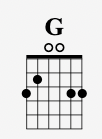
D is played from the 4th string down like this:

C is played in a standard (campfire) position from the 5th string down, like so:

Finally, Am uses 3 fingers in the fretting hand like this:

If you’ve struggled to understand the fretboard for RHYTHM and LEAD guitar, and want to discover the easiest and fastest way. Then get your hands on my free Fretboard Guide PDF right here now:
Is Knockin' On Heaven's Door hard to play on guitar?
I would say playing “Knockin' On Heaven's Door” on guitar is going to require a beginner skill level. The song only has 4 chords. It has one main progression that repeats, and the strumming pattern is relatively simple. So, if you’re a beginner looking for songs, give this one a go.
What key is Knockin' On Heaven's Door in?
“Knockin' On Heaven's Door”, as recorded by Bob Dylan, is in the key of G major. The primary scale for the song is the G major scale, which is built using the notes G, A, B, C, D, E, and F#.
Let’s break down the chords and how they function in the key of G major:
G
Notes: G, B, D
Function: This is the I chord, the tonic. It is the “home” chord in the key of G major.
D
Notes: D, F#, A
Function: This is the V chord, the dominant. It is built on the fifth degree of the G major scale. It creates a strong sense of tension and a powerful pull, wanting to resolve back to the tonic (I) chord.
Am
Notes: A, C, E
Function: This is the ii7 chord, the supertonic in the key of G major. This chord comes in bar 2 and is a part of an alternating pattern. (See video above for more on this)
C
Notes: C, E, G
Function: This is the IV chord, the subdominant. It’s built on the fourth degree of the G major scale. It used to move away from the tonic and often toward the dominant chord, or back home to G.
All right!
So that’s the theory. Next, let’s look at…
What is the strumming pattern for Knockin' On Heaven's Door?
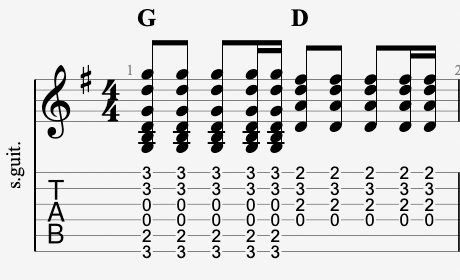
The main underlying feel for “Knockin' On Heaven's Door” is a slow ballad divided into 16th notes. In 4/4 time, 16th notes split each beat into four equal parts, creating a quicker, more flowing rhythm. The counting for 16th notes in a measure looks like this:
1 e & a 2 e & a 3 e & a 4 e & a
The numbers (1, 2, 3, 4) represent the main beats in the measure. The "e," "&," and "a" divide each beat into four evenly spaced subdivisions.
When counted out loud, it sounds like:
"One-ee-and-a, Two-ee-and-a, Three-ee-and-a, Four-ee-and-a."
Here’s an example of a simple 2-beat strumming pattern in the style of “Knockin' On Heaven's Door”:
Knockin' On Heaven's Door (Fingerpicking Guitar Lesson)
Here's a great way to take the song and instead of strumming it, try fingerpicking through the progression.
Fingerpicking is great for taking any chord progression and spicing it up.
Eric Clapton – Knockin' On Heaven's Door Guitar Lesson
Conclusion
There ya have it!
“Knockin' On Heaven's Door” is a fun song to learn quickly and start playing today. It’s also a great demonstration of Dylan’s masterful songwriting.
Keep practicing, and if you want to learn songs way faster, better understand the fretboard for lead and rhythm, and not waste years spinning your wheels with guitar, grab my free fretboard guide here right now:
Jon MacLennan
Like this blog post? Get Jon’s best guitar lessons straight to your inbox.
Discover the 5 easiest and fastest ways to play the blues scale anywhere on the neck with this FREE PDF GUIDE
