The Beatles – Lady Madonna Chords & Guitar Lesson
If you look closely at many iconic Beatles songs, you'll find they have roots in rhythm & blues.
The guitar in this legendary song rips a boogie-woogie bass line. right along with the piano part.
Below, I’m going to share some insider tips on the guitar style behind it.
So grab your axe, and let’s dive into this “Lady Madonna” chords and guitar lesson!
Who Wrote Lady Madonna?
“Lady Madonna” was written by the great Paul McCartney. However, it’s credited to the typical Lennon/McCartney partnership in The Beatles. The inspiration came from McCartney seeing a photo in National Geographic of a mother with her children. That was when the idea hit him.
It’s a tribute to everyday women juggling the toils of trying to be a mother while also a provider.
“Lady Madonna” was recorded at Abbey Road Studios on February 3rd and 6th, 1968. The sessions were done with George Martin producing. McCartney played piano and sang lead vocals, Lennon and Harrison played guitars and sang backing vocals, and Ringo Starr played drums. He began laying down some brushes and then overdubbed a snare. The piano style McCartney played is a boogie-woogie style similar to Fats Domino. And he got the riff idea from Humphrey Lyttelton’s 1956 jazz hit “Bad Penny Blues.”
I love this jazz-influenced, vintage sound.
Later in the recording process, McCartney thought it needed horns. So EMI’s Laurie Gold quickly assembled four saxophonists, including jazz great Ronnie Scott, to add to the final version.
The song was released on March 15, 1968, with George Harrison’s “The Inner Light” as the B-side. It topped the UK charts for two weeks and reached number four in the US. “Lady Madonna” was The Beatles’ final single on Parlophone before they launched Apple Records.
Now, you may be wondering…
What is the tuning for Lady Madonna?
The tuning for "Lady Madonna," as recorded by The Beatles, is standard tuning. The band kept things simple. Standard tuning is spelled: E, A, D, G, B, and E.
Here are the strings:
- E (6th string, lowest pitch)
- A (5th string)
- D (4th string)
- G (3rd string)
- B (2nd string)
- E (1st string, highest pitch)
All right!
Now that you know the tuning for “Lady Madonna”, let’s next talk about…
Lady Madonna Chords
To play “Lady Madonna”, as recorded by The Beatles, you’ll need to know 10 main chords they are A, D, F, G, Dm, C, Am7, Bm7, Esus4, and E7. Many of these full chords are covered by the piano while the guitar plays riffs around them.
Let’s take a look at a few ways these shapes can be played on the fretboard.
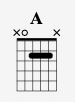
A is played in open position using just the index finger like this:
D is played from the 4th string down like so:

F is a bar chord played in 1st position and using all 6 strings like so:

If bar chords are giving you all kinds of aches and pains, and you haven’t yet discovered how to play them effortlessly, go here: https://www.jonmaclennan.com/7mistakes
G I play the same way as F, just shifted up 2 frets like this:

Dm comes in the B section and is played from the 4th string down like this:

C is played as a standard (campfire) chord in open position like so:

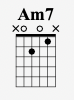
Am7 just changes one note from the previous C chord, like this:
Bm7 is a bar chord played in 2nd position and from the 5th string down, like this:

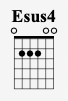
Esus4 is a beautiful chord and uses all 6 strings like this:
Finally, we have E7. I play this chord using all 6 strings as well like so:

If you’ve struggled to understand the fretboard for RHYTHM and LEAD guitar, and want to discover the easiest and fastest way. Then get your hands on my free Fretboard Guide PDF right here now:
Is Lady Madonna hard to play on guitar?
I would say playing “Lady Madonna” on guitar is going to require an intermediate skill level. The song has a number of bar chords and also some faster picking. So, between those two things, I would definitely rank it in the intermediate level. So, take your time with this one.
What key is Lady Madonna in?
“Lady Madonna,” as recorded by The Beatles, is in the key of A major. The primary scale used in the song is the A major scale, which is built with the notes A, B, C#, D, E, F#, and G#.
Let’s take a look at how all these chords relate in the key of A major:
A (A major)
Notes: A, C♯, E
Function: This is the I chord in A major. It’s the tonic and tonal center of the key, providing the strongest sense of resolution and “home.”
D (D major)
Notes: D, F♯, A
Function: This is the IV chord (subdominant) in A major. It creates movement away from the tonic and often sets up a return to A or a move toward the dominant E.
F (F major)
Notes: F, A, C
Function: F is not diatonic to A major. It functions as a ♭VI chord, typically borrowed from A minor or the parallel A Mixolydian mode. It adds a strong, colorful contrast and is often used for dramatic shifts. In “Lady Madonna” this chord is part of a climb F → G → A.
G (G major)
Notes: G, B, D
Function: G is not diatonic to A major. It acts as a ♭VII chord, also commonly borrowed from A Mixolydian. It has a classic rock flavor and often moves strongly to the I chord (A).
Dm (D minor)
Notes: D, F, A
Function: Dm is the iv chord in A minor and is borrowed from the parallel minor. It changes the color of the IV chord from bright to moody, adding a bittersweet sound.
C (C major)
Notes: C, E, G
Function: C is not diatonic to A major. It functions as a ♭III chord, another borrowed chord from A minor or A Mixolydian, adding a folk/rock flavor and modal character.
Am7 (A minor 7)
Notes: A, C, E, G
Function: This is the i7 chord in A minor, borrowed from the parallel minor key. It brings a more subdued, jazzy minor sound when contrasted against A major.
Bm7 (B minor 7)
Notes: B, D, F♯, A
Function: This is the ii7 chord (supertonic) in A major. It often functions as a pre-dominant chord, leading to E7 or Esus4 in ii–V–I progressions.
Esus4 (E suspended 4th)
Notes: E, A, B
Function: This is a suspended version of the V chord (E major) in A major. The third (G♯) is replaced by the fourth (A), creating tension that typically resolves to E major or E7 before resolving to A.
E7 (E dominant 7th)
Notes: E, G♯, B, D
Function: This is the V7 chord (dominant) in A major. It contains a strong tritone between G♯ and D, creating maximum tension and pull back to the tonic A major.
So that’s the theory. Next, let’s look at…
What is the strumming pattern for Lady Madonna?
The main underlying groove for “Lady Madonna” is an uptempo 8th note rock feel. In 4/4 time, 8th notes divide each beat into two equal parts, creating a driving, steady rhythm like this:
1 & 2 & 3 & 4 &
The numbers (1, 2, 3, 4) represent the main beats in the measure, while the "&" represents the offbeats that add energy and momentum.
When counted out loud, it sounds like:
"One-and, Two-and, Three-and, Four-and."
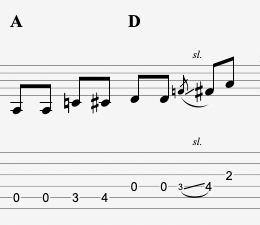
However, instead of strumming all 8th notes, on guitar, I’ll often use an 8th note riff like this:
Conclusion
Bottom line, “Lady Madonna” is a classic tune that marked a shift from a more psychedelic Beatles period back to their rhythm and blues roots.
Keep practicing, and if you want to learn songs way faster, better understand the fretboard for lead and rhythm, and not waste years spinning your wheels with guitar, grab my free fretboard guide here right now:
Jon MacLennan
Like this blog post? Get Jon’s best guitar lessons straight to your inbox.
Discover the 5 easiest and fastest ways to play the blues scale anywhere on the neck with this FREE PDF GUIDE
