Bill Withers Lean On Me Chords & Guitar Lesson
Mr. William Withers sang:
===
Sometimes in our lives, we all have pain
We all have sorrow
But if we are wise
We know that there's always tomorrow
===
Those are the opening lyrics to a powerful song first released in 1972.
It’s gone on to become one of the most beloved songs in American music history. Below, I’m going to share with you some insider tips for playing in this style on guitar.
So grab your axe, and let’s dive into this “Lean On Me” chords and guitar lesson!
Who Wrote Lean On Me?
“Lean On Me” was written by legendary soul singer Bill Withers. It’s one of his most popular songs, and it’s become an iconic piece of American music history.
“Lean On Me” was included on his second album Still Bill, but was first released as a single in April of 1972. The song quickly shot up to No. 1 on both the Billboard Hot 100 and R&B charts.
Withers drew inspiration for “Lean On Me” from his upbringing in the coal mining town of Slab Fork, West Virginia. After moving to Los Angeles, he found himself missing the strong sense of community he had known in his hometown.
Personally, I can relate to this myself, being in Los Angeles as well. It’s a big place, and many people move here to extract what they can from others and the city. This longing led him to write a song about support, community, and friendship. He came up with the idea on a Wurlitzer piano he purchased with earnings from his first album. It makes sense since it’s in the key of C (a very common piano key). Withers emphasized simplicity in the lyrics to convey a universal message of solidarity .
The recording session for “Lean on Me” featured members of the Watts 103rd Street Rhythm Band, including guitarist Benorce Blackmon, bassist Melvin Dunlap, drummer James Gadson, and Raymond Jackson on Wurlitzer electric piano and string arrangements. Withers provided vocals and piano, creating a soulful blend of gospel and R&B that underscored the song’s heartfelt message.
“Lean on Me” has received many accolades over the years. It was inducted into the Grammy Hall of Fame in 2007 and ranked number 208 on Rolling Stone's list of "The 500 Greatest Songs of All Time" in 2010.
The song has been covered by various artists, including Club Nouveau, whose 1987 rendition also reached No. 1 on the Billboard Hot 100 and earned a Grammy Award for Best R&B Song for Withers as the songwriter.
Now, you may be wondering…
What is the tuning for Lean On Me?
The tuning for "Lean On Me," as recorded by Bill Withers is standard tuning. Standard tuning is spelled: E, A, D, G, B, and E.
Here are the strings:
- E (6th string, lowest pitch)
- A (5th string)
- D (4th string)
- G (3rd string)
- B (2nd string)
- E (1st string, highest pitch)
All right!
Now that you know the “Lean On Me” tuning, let’s next talk about the…
Lean On Me Chords
To play “Lean On Me” you only need to know 5 main chords they are C, F, G6, G, and Dm. Let’s take a look at a few ways these chords can be played on the fretboard.
C can be played from the 5th string down in open position like this:
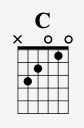
I play F as a little bar chord in 1st position like this:

G6 is played using all 6 strings like so:
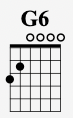
G makes just a slight change from G6 like this:

Finally, we have Dm, which can be played from the 4th string down like this:

If you’ve struggled to understand the fretboard for RHYTHM and LEAD guitar and want to discover the easiest and fastest way. Then get your hands on my free Fretboard Guide PDF right here now:
Is Lean On Me hard to play on guitar?
“Lean On Me” is a great song for newer players because there are just a couple of sections and a handful of chords. You also get to practice tiny bar chords (good for building calluses) and walking bass lines.
What key is Lean On Me in?
“Lean On Me” as recorded Bill Withers is in the key of C major. The C major scale uses all natural notes: C – D – E – F – G – A – B.
All of the chords fit into the diatonic scale of C major. Here’s a quick look at how they all relate:
1. C Major
Notes: C – E – G
This is the I chord in the key of C major — the tonal center.
It feels resolved, stable, and is often used to start or end a progression.
2. F Major
Notes: F – A – C
This is the IV chord — the subdominant.
It moves away from the tonic and often sets up a return via the dominant chord.
Common in progressions like C → F → G → C.
3. G6
Notes: G – B – D – E
This is a variation of the V chord (G), with an added 6th (E).
It still functions as a dominant chord, but the added 6th softens the tension a bit.
You’ll hear this a lot in pop, soul, and jazz-influenced styles.
4. G Major
Notes: G – B – D
This is the V chord — the dominant.
It creates strong tension and wants to resolve back to C (the tonic). This is used throughout the tune. Plus, it’s a classic move in countless songs: G → C.
5. D Minor
Notes: D – F – A
This is the ii chord — the supertonic.
It sets up the dominant chord (G or G6) and is part of the classic ii–V–I progression:
Dm → G → C.
This progression is very common in both jazz and pop/rock songwriting.
So that’s the theory. Next, let’s look at…
What is the strumming pattern for Lean On Me?
The main underlying feel for “Lean On Me” is a sixteenth note funky feel. In 4/4 time, sixteenth notes divide each beat into four equal parts, creating a fast, energetic rhythm like this:
1 e & a 2 e & a 3 e & a 4 e & a
The numbers (1, 2, 3, 4) represent the main beats in the measure.
The “e,” “&,” and “a” divide each beat further, adding drive and detail to the rhythm.
When counted out loud, it sounds like:
"One-e-and-a, Two-e-and-a, Three-e-and-a, Four-e-and-a."
This is the underlying feel. However, I wouldn’t strum all sixteenth notes. Instead, I would mix half notes, eighth notes, and even some walking bass lines like this:

Conclusion
To wrap it up, “Lean On Me” is a beautiful song about kindness and community. When life gets hard, we’ve got to lean on each other.
So, keep practicing, and if you want to learn songs way faster, better understand the fretboard, and not waste years spinning your wheels with guitar, grab my free fretboard guide here right now:
Jon MacLennan
Like this blog post? Get Jon’s best guitar lessons straight to your inbox.
Discover the 5 easiest and fastest ways to play the blues scale anywhere on the neck with this FREE PDF GUIDE
