The ULTIMATE Like A Rolling Stone Chords & Guitar Lesson
Here’s a tune that was almost shelved by Columbia Records.
They weren’t going to release it because 1) it clocked in at over 6 minutes long, which defied the rules of modern radio during the time. And 2) the executives thought it was too long, too loud, and too weird.
Add to this the fact that guitarist Al Kooper wasn’t even supposed to be on the session. You see, he snuck in, jumped on the organ, and improvised these little off-the-beat melodies. Bob Dylan loved the sound he added, and the rest is history.
Below, I’m going to break down the guitar style behind it.
So grab your axe, and let’s dive into this “Like A Rolling Stone” chords and guitar lesson!
Who Wrote Like A Rolling Stone?
“Like a Rolling Stone” was written by American singer-songwriter Bob Dylan. He wrote it during a period of personal and artistic transformation in 1965. The track marked a significant change in his music.
He was pivoting from folk to electric rock, and this move gained a lot of controversy – especially at the 1965 Newport Folk Festival where he performed with an electric band.
This track was long, and a raw expression came through in the song's final lyrics.
“Like a Rolling Stone” was recorded over two days, June 15–16, 1965, at Columbia Records' Studio A in New York City, with producer Tom Wilson. The initial session featured a waltz-like arrangement with Dylan on piano, but it didn’t hit the mark.
The breakthrough came on the second day when Al Kooper, a young musician present at the session, improvised the now-famous organ riff, despite not even being an organist. He was a guitarist. But Dylan loved Kooper's contribution and told Wilson, the producer, to turn up his track in the mix. The final take which also featured Mike Bloomfield on guitar, became the definitive version of the song.
Upon its release, “Like a Rolling Stone” reached No. 2 on the Billboard Hot 100 chart. Its six-minute length was unprecedented for a single at the time. This challenged the radio norms and paved the way for more expansive songwriting in popular music.
The song's innovative structure and poetic lyrics influenced countless artists and signaled a new era in music where songs could be both commercially successful and artistically profound. It has been covered by numerous artists, including Jimi Hendrix and the Rolling Stones, and remains a staple in Dylan's live performances.
Now, you may be wondering…
What is the tuning for Like A Rolling Stone?
The tuning for "Like A Rolling Stone", as recorded by Bob Dylan, is standard tuning. Dylan kept things simple. Standard tuning is spelled: E, A, D, G, B, and E.
Here are the strings:
- E (6th string, lowest pitch)
- A (5th string)
- D (4th string)
- G (3rd string)
- B (2nd string)
- E (1st string, highest pitch)
All right!
Now that you know the tuning for “Like A Rolling Stone”, let’s next talk about…
Like A Rolling Stone Chords
To play “Like A Rolling Stone”, as recorded by Bob Dylan, you’ll only need to know 5 main chords they are C, F, Dm, Em, and G. The majority of these chords can be played in open position. Let’s take a look at a few ways they can be played on the fretboard:
I play C as a typical (campfire) chord in open position like this:

F is the only bar chord in the tune, and this one can be played in 1st position like so:

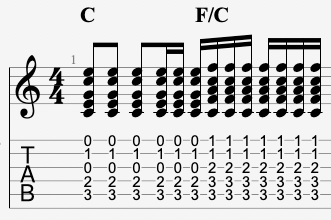
(Note: in the intro section, I only play from the 5th string down, which makes this chord an F/C.)
Dm is played from the 4th string down like this:

Em is played with all 6 strings like this:

Finally, we have G, this is played in a folk-style like this:

If you’ve struggled to understand the fretboard for RHYTHM and LEAD guitar. and want to discover the easiest and fastest way. Then get your hands on my free Fretboard Guide PDF right here now:
Is Like A Rolling Stone hard to play on guitar?
I would say playing “Like A Rolling Stone” on guitar requires a solid intermediate skill level. There are only a handful of chords, but strumming the 16th note rhythms and syncopating the chords can be tricky. So, take your time with this one.
What key is Like A Rolling Stone in?
“Like A Rolling Stone,” as recorded by Bob Dylan, is in the key of C major. All of the chords fit within the diatonic scale of C major, which contains the notes C, D, E, F, G, A, and B.
Here’s a quick look at how the chords relate:
C major
Notes: C, E, G
Function: This is the I chord in the key of C major.
It’s the tonic, or “home” chord. It feels stable and resolved. Most chord progressions in C major will either start or end here.
F major
Notes: F, A, C
Function: This is the IV chord in the key of C major.
It’s the subdominant. The IV chord creates movement away from the tonic and often leads to the V chord. The F chord introduces a bit of tension that helps set up a return to home base (C).
Dm
Notes: D, F, A
Function: This is the ii chord in the key of C major.
It’s a minor chord, built on the second scale degree. It often sets up a ii–V–I progression (Dm–G–C), one of the most important progressions in jazz and pop. It has a slightly moody feel to it.
Em
Notes: E, G, B
Function: This is the iii chord in the key of C major.
The iii chord is a minor chord built on the third degree. It shares two notes with C major (E and G), so it blends easily.
G major
Notes: G, B, D
Function: This is the V chord in the key of C major.
G is the dominant, and it creates tension that wants to resolve to the I chord (C). You hear this in the big build-up right before Dylan sings, “How does it feel?”.
So that’s the theory. Next, let’s look at…
What is the strumming pattern for Like A Rolling Stone?
The main underlying groove for “Like A Rolling Stone” is an even 16th-note feel. In 4/4 time 16th notes mean each beat is divided evenly into four parts. No swing, just tight, crisp precision.
Here’s how you can count 16ths:
1 e & a, 2 e & a, 3 e & a, 4 e & a
(“One-ee-and-uh, Two-ee-and-uh…”)
Here’s an example of a strumming pattern in the style of “Like A Rolling Stone”:
Jimi Hendrix "Like A Rolling Stone" Chords & Guitar Lesson
Conclusion
To wrap it up, “Like A Rolling Stone” is one of Dylan’s most iconic tunes. It’s also a pivotal song in American music history.
So keep practicing, and if you want to learn songs way faster, better understand the fretboard for lead and rhythm, and not waste years spinning your wheels with guitar, grab my free fretboard guide here right now:
Jon MacLennan
Like this blog post? Get Jon’s best guitar lessons straight to your inbox.
Discover the 5 easiest and fastest ways to play the blues scale anywhere on the neck with this FREE PDF GUIDE
