Lovefool Chords & Guitar Lesson (MOST ACCURATE)
Here’s a classic tune from the '90s to which a metalhead on YouTube commented:
===
No shame. I'm a metalhead, and this is one of my favorite songs (ever). It grooves on drums and bass, riffs on guitar, and she's got a voice like an angel.
===
He's got a point.
Below, I’m going to share some insider tips on the guitar style behind this masterpiece.
So grab your axe, and let’s dive into this “Lovefool” chords and guitar lesson!
Who Wrote Lovefool?
“Lovefool” was an international breakthrough hit for the Swedish rock band The Cardigans, released in 1996. It was written by Peter Svensson and Nina Persson, the band’s guitarist and lead vocalist.
It’s got a sugary-sweet sound with lyrics that sing of a girl falling deep in love. The girl is pleading with a lover who doesn’t love her back, begging him to lie if necessary – just to keep her feelings alive. Persson said she was fascinated by the idea of someone willfully living a fantasy on the inside just to avoid heartbreak.
The song was recorded for The Cardigans’ third studio album, First Band on the Moon, and became the group’s biggest global hit.
“Lovefool” was recorded in Stockholm, Sweden, at Tambourine Studios, which was The Cardigans’ main creative space at the time. Tore Johansson, a longtime collaborator with the band, was the producer. He played a major role in creating their retro-chic sound. Though it’s often associated with bubblegum pop, the arrangement is more sophisticated than it appears at first. It takes influence from ‘60s pop, lounge music, and even jazz influences.
While “Lovefool” wasn’t an immediate smash in Sweden, it exploded internationally after being featured on the soundtrack to Baz Luhrmann’s 1996 film Romeo + Juliet, starring Leonardo DiCaprio and Claire Danes. Its placement in the film’s promotional material and scenes gave the song massive exposure, especially in the U.S., U.K., and Australia.
In the United States, “Lovefool” hit No. 2 on the Billboard Hot 100 Airplay chart. It also reached the Top 10 in the U.K., No. 1 in New Zealand, and performed strongly across Europe and Asia.
The song received heavy rotation on MTV and helped First Band on the Moon sell over 2.5 million copies worldwide.
But there was an interesting twist...
“Lovefool” almost didn’t make the album. The band was initially unsure about including it on First Band on the Moon. They felt it was too pop-oriented and might not fit with the rest of the record’s slightly darker, more experimental sound.
However, it not only ended up making the cut, but it ultimately helped define the album’s legacy.
Not bad, eh?
Now, you may be wondering…
What is the tuning for Lovefool?
The tuning for "Lovefool," as recorded by The Cardigans, is standard tuning. Standard tuning is spelled: E, A, D, G, B, and E.
Here are the strings:
- E (6th string, lowest pitch)
- A (5th string)
- D (4th string)
- G (3rd string)
- B (2nd string)
- E (1st string, highest pitch)
All right!
Now that you know the tuning for “Lovefool”, let’s next talk about…
Lovefool Chords
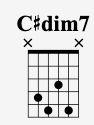
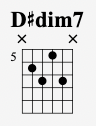
To play “Lovefool”, as recorded by The Cardigans, you need to know 12 main chords they are Am, Dm, G7, Cmaj7, C#dim7, D#dim7, E7, A, Bm7, E, F#m7, and Eaug. Keep in mind that many of these chords come from more of a jazz background. Let’s take a look at a few ways these shapes can be played on the fretboard.
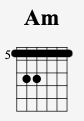
Am is played as a standard bar chord in 5th position like this:
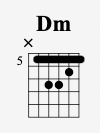
Dm is played from the 5th string down like so:
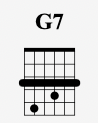
G7 shifts to the 3rd position and uses all 6 strings like this:
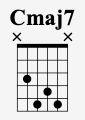
Cmaj7 completes the resolution from G7 and is played like so:
Then we have two diminished seventh chords. These are both played the same way; they are just located in different places on the neck.
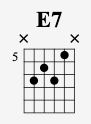
E7 is played on the middle strings and in 5th position like this:
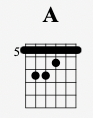
In the chorus, the song shifts to the parallel major key. It goes from A minor to A major. For A, I play a bar chord in 5th position like this:
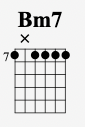
Bm7 I play as a Jimi Hendrix style thumb-chord. (See video above for a demonstration.)
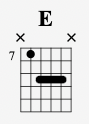
E is another bar chord played on the middle strings:
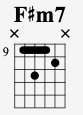
F#m7 moves up to the 9th position like so:
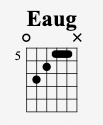
Finally, we have one of the most interesting chords in the entire song, Eaug. I play it like this:
If you’ve struggled to understand the fretboard for RHYTHM and LEAD guitar, and want to discover the easiest and fastest way. Then get your hands on my free Fretboard Guide PDF right here now:
Is Lovefool hard to play on guitar?
I would say playing “Lovefool” on guitar is going to require an advanced skill level. The chords are not beginner chords. They are based in jazz harmony and many require quick changes and solid bar technique. Plus, the rhythms are also advanced. They use 16th note strumming patterns and upbeat syncopations to get it right. So, take your time with this one.
What key is Lovefool in?
“Lovefool,” as recorded by The Cardigans, is in the key of A minor. The primary scale for the song is the A natural minor scale, which is built using the notes A, B, C, D, E, F, and G. However, the song does change keys in the chorus to the parallel major (A major). But since it both starts and ends in the key of A minor, I would call it the key of A minor. Let’s break down how the chords relate to the keys in each section. (Note: I’ve simplified the chords down to just their primary function.)
Here’s a quick look:
Am
Notes: A, C, E
Function: This is the i chord (tonic) in A natural minor – the tonal center and “home base” of the key. It provides a sense of rest and grounding, in the key of A minor.
Dm
Notes: D, F, A
Function: This is the iv chord (subdominant) in A minor. It supports the tonic by reinforcing the minor character, and is often a pre-dominant before chords like E7 or G7.
G7
Notes: G, B, D, F
Function: This chord is the bVII in the key of A minor. It's commonly used in jazz or blues-inflected minor key progressions.
Cmaj7
Notes: C, E, G, B
Function: This is a variation of the III chord in A minor (C major), with the major 7th (B) added. The C major chord brings brightness into the minor context, and the major 7th color adds a jazzy sound.
C#dim7
Notes: C#, E, G, A#
Function: This diminished 7th chord is not diatonic to A natural minor, but it’s often used as a passing chord.
D#dim7
Notes: D#, F#, A, C
Function: This chord is the same as the previous. It’s another chord not diatonic but it’s used as a passing chord.
E7
Notes: E, G#, B, D
Function: This is the V7 chord in A harmonic minor (not natural minor), and it's often borrowed to provide a strong dominant function that resolves powerfully back to Am. The G# is the raised 7th (leading tone) that creates the tension needed to resolve to A.
Then, we get to the chorus where the key changes to the key of A major. So let’s look at the rest of the chords through that lens.
A
Notes: A, C#, E
Function: This is the I chord (tonic) in the key of A major now. It’s the tonal center and home base
Bm7
Notes: B, D, F#, A
Function: This is the ii7 chord in A major, a minor seventh built on the second degree of the scale. This one flows beautifully to…
E
Notes: E, G#, B
Function: This is the V chord (dominant) in A major. It provides a strong pull back to the tonic A, especially in cadences. It contains the leading tone (G#), which creates tension and resolution when it moves up to A. This is one of the most important functional chords in the key.
F#m7
Notes: F#, A, C#, E
Function: This is the vi7 chord in A major—a minor seventh built on the sixth scale degree. It’s sometimes called the relative minor.
So that’s the theory. Next, let’s look at…
What is the strumming pattern for Lovefool?
The main underlying groove for “Lovefool” is a funky 16th note feel. In 4/4 time, 16th notes divide each beat into four equal parts, creating a fast, even rhythm like this:
1 e & a 2 e & a 3 e & a 4 e & a
The numbers (1, 2, 3, 4) represent the main beats in the measure, while "e," "&," and "a" divide each beat into evenly spaced subdivisions.
When counted out loud, it sounds like:
"One-e-and-a, Two-e-and-a, Three-e-and-a, Four-e-and-a."
This rhythm is the underlying feel for “Lovefool”.
Conclusion
To wrap it up, “Lovefool” is a dreamy song that has moved the world. It’s an interesting blend of pop, jazz, and retro, that’s harder than it looks.
So keep practicing, and if you want to learn songs way faster, better understand the fretboard for lead and rhythm, and not waste years spinning your wheels with guitar, grab my free fretboard guide here right now:
Jon MacLennan
Like this blog post? Get Jon’s best guitar lessons straight to your inbox.
Discover the 5 easiest and fastest ways to play the blues scale anywhere on the neck with this FREE PDF GUIDE
