Lovely Day Chords & Guitar Lesson (Most Accurate)
Here’s a song where Bill Withers sustained one of the longest vocal notes ever in a US Top 40 hit.
This note clocked in at an astonishing 18 seconds, and the track features some LA session musician royalty.
Below, I want to share some insider tips on the guitar style behind it.
So grab your axe, and let’s dive into this “Lovely Daaaaaaaaaaaaaaay” chords and guitar lesson!
Who Wrote Lovely Day?
“Lovely Day” was written by American singer-songwriters Bill Withers and Skip Scarborough. It’s a soulful classic that celebrates the power of love to brighten life.
Withers sings:
===
Just one look at you
And I know it’s gonna be
A lovely day…
===
It first appeared on Withers’ sixth studio album, Menagerie, featuring these musicians:
- Keyboards/arrangement: Clarence McDonald
- Guitar: Ray Parker Jr.
- Bass: Jerry Knight
- Drums: Russ Kunkel
- Percussion: Ralph MacDonald
"Lovely Day" was recorded at The Record Plant in Los Angeles, California, in 1977. The Record Plant was one of the premier recording studios in the U.S. at the time. Many major artists like Stevie Wonder, Fleetwood Mac, and Prince all recorded there, The session was co-produced by Withers and Clarence McDonald.
Shortly after the album's release, “Lovely Day” came out as a single in December 1977.
The song reached #402 on Rolling Stone’s “Top 500 Best Songs of All Time”. Withers went on to make 2 more albums and then retired in 1985.
Now, you may be wondering…
What is the tuning for Lovely Day?
The tuning for "Lovely Day" as recorded by Bill Withers is standard tuning. Standard tuning is spelled: E, A, D, G, B, and E.
Here are the strings:
- E (6th string, lowest pitch)
- A (5th string)
- D (4th string)
- G (3rd string)
- B (2nd string)
- E (1st string, highest pitch)
All right!
Now that you know the tuning for “Lovely Day”, let’s next talk about…
Lovely Day Chords
To play “Lovely Day”, as recorded by Bill Withers, you’ll only need to know 8 main chords they are E, C#m7, Amaj7, Cmaj7, Bm7, D11, E11, and Am7. I play all these chords as closed-position chords. This gets a great funky/soulful sound, however, it means they require the bar technique. If you have not discovered how to play effortless bar chords yet, go here: https://www.jonmaclennan.com/7mistakes
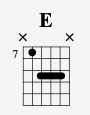
E is played on the middle strings in 7th position like this:
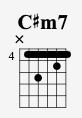
C#m7 is played from the 5th string down like this:
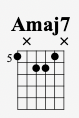
Amaj7 is a wonderful 4-note jazzy shape played in 5th position like this:
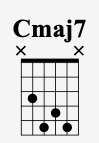
Cmaj7 is played in 3rd position with a root on the 5th string like this:
Bm7 shifts the C#m7 chord above down 2 frets like this:
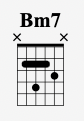
D11 sounds like a complicated chord, but it really just needs one finger like this:
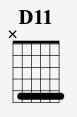
E11 is the same, it’s just shifted up 2 frets like this:
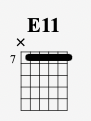
Finally, Am7 is played in the 5th position like this:
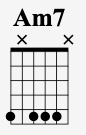
(Pro tip: while some of the chord shapes may seem more difficult, they can be shifted anywhere on the neck. This is one of the many benefits of unlocking effortless bar chords. If you’ve struggled with this, go here: https://www.jonmaclennan.com/7mistakes
Is Lovely Day hard to play on guitar?
I would say playing “Lovely Day” on guitar is going to require a solid intermediate to advanced skill level. It’s got a number of more sophisticated, jazzier style chords. Plus, it uses a funky 16th-note rhythm that drives the entire song. So, take your time with this one.
What key is Lovely Day in?
“Lovely Day,” as recorded by Bill Withers, is in the key of E major. The main scale for the song is the E major scale, which is built using the notes E, F#, G#, A, B, C#, and D#.
The majority of the chords used in the song fit the diatonic scale. However, there are a few twists and turns. Here’s a quick look at how all these chords relate in the key of E major:
E
Notes: E, G♯, B
Function: This is the I chord in the key of E major.
It’s the tonic—the “home” chord that everything resolves to. Strong, bright, and stable.
C#m7
Notes: C♯, E, G♯, B
Function: This is the vi7 chord in E major.
The relative minor of E major. This chord adds a melancholic flavor and is commonly used in pop and soul progressions like I → vi → IV → V.
Amaj7
Notes: A, C♯, E, G♯
Function: This is the IVmaj7 chord in E major.
A peaceful and lush major 7th sound. This chord gives the listener a nice move away from the I chord.
Cmaj7
Notes: C, E, G, B
Function: This is a chromatic chord, not diatonic to E major. However, it is in the key of E minor the parallel minor. It’s a borrowed chord for color. It’s a striking sound.
Bm7
Notes: B, D, F♯, A
Function: This is the v7 chord in E major. The V chord would normally be a dominant seventh in the key of E major. But Bm7 is borrowed from the parallel minor.
D11
Notes: D, F♯, A, C, G (or simplified: D, G, C)
Function: A chromatic dominant, not diatonic to E major. It’s a sub-tonic or flat seventh.
E11
Notes: E, A, D, G♯ (can vary depending on voicing)
Function: This is a I11 chord. It essentially makes the I chord a dominant sound.
It retains the function of the E7 but with more color. Useful in R&B, gospel, and jazz to create tension before resolving to A or returning to E.
Am7
Notes: A, C, E, G
Function: This is a borrowed iv7 chord from again the parallel minor – E minor.
Here’s a quick summary:
- E – I (tonic in E major)
- C#m7 – vi7 (relative minor)
- Amaj7 – IVmaj7 (subdominant, lush major 7th)
- Cmaj7 – ♭VImaj7 (chromatic/modal mixture, jazz color)
- Bm7 – v7 from parallel minor
- D11 – ♭VII11 (blues/funk flavor, chromatic dominant)
- E11 – I11 (extended dominant I chord, resolves back to I)
- Am7 – iv7 (borrowed from E minor, soulful/modal)
So that’s the theory. Next, let’s look at…
What is the strumming pattern for Lovely Day?
The main underlying groove for “Lovely Day” is a funky 16th note feel. In 4/4 time, 16th notes break up each beat into 4 parts. They are counted as:
"1 e & a, 2 e & a, 3 e & a, 4 e & a"
These are evenly spaced and played straight, like a steady stream of quick, equal beats.
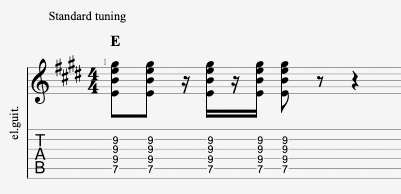
However, I wouldn’t necessarily strum all these 16th notes. In context, I might use a combination of 8ths, 16ths, and even some rests. Here’s an example of a strumming pattern in the style of “Lovely Day”:
Lovely Day Guitar Lesson Melody
Another great way to play this song on guitar is to learn the melody. Here is a lesson on that:
Conclusion
To wrap it up, “Lovely Day” is a classic. It’s been played at countless events, weddings, and jam bands. So it’s a good one to know for jamming with others.
Keep practicing, and if you want to learn songs way faster, better understand the fretboard for lead and rhythm, and not waste years spinning your wheels with guitar, grab my free fretboard guide here right now:
Jon MacLennan
Like this blog post? Get Jon’s best guitar lessons straight to your inbox.
Discover the 5 easiest and fastest ways to play the blues scale anywhere on the neck with this FREE PDF GUIDE
