Emerson, Lake, & Palmer – “Lucky Man” Chords & Guitar Lesson
One thing I love about Greg Lake's guitar playing is his ability to arpeggio-pick.
This is a great guitar technique you hear on many of Emerson, Lake & Palmer's biggest songs.
Below, I want to share with you a perfect example of this.
So grab your axe, and let’s dive into this “Lucky Man” chords and guitar lesson!
Who wrote Lucky Man?
“Lucky Man” was originally written by Greg Lake when he was just 12 years old. It began as a simple acoustic folk-style tune way before Emerson, Lake & Palmer even existed.
In 1970, when ELP was recording their first album, they needed one last song to put on the record. That’s when Lake demoed the song, and they decided to add it to the end of their debut album, Emerson, Lake & Palmer.
It was recorded at Advision Studios in London, England. Lake handled the vocals and guitars, Keith Emerson played keyboards, and Carl Palmer laid down the drums.
The most famous part of the recording is the ending: Keith Emerson’s Moog synthesizer solo. At the time, the Moog was still a relatively new instrument in rock music, and “Lucky Man” became one of the earliest examples of a synthesizer being used as a featured lead instrument in a rock song.
Upon its release as a single in 1970, “Lucky Man” became ELP’s breakthrough radio song. It reached No. 48 on the Billboard Hot 100 in the United States and also charted in Canada and other countries. The album itself was a major success, reaching No. 4 in the UK and No. 18 in the US, helping establish ELP as one of the leading progressive rock bands of the era.
Now, you may be wondering…
What is the tuning for Lucky Man?
The tuning for "Lucky Man” as recorded by Emerson, Lake & Palmer is standard tuning. Greg Lake kept things simple. Standard tuning is spelled: E, A, D, G, B, and E.
Here are the strings:
- E (6th string, lowest pitch)
- A (5th string)
- D (4th string)
- G (3rd string)
- B (2nd string)
- E (1st string, highest pitch)
All right!
Now that you know the tuning for “Lucky Man,” let’s next talk about…
Lucky Man Chords
To play “Lucky Man”, as recorded by Emerson, Lake & Palmer, you only need to know 7 main chords they are G, D/F#, Am, Em, D, Dsus4, and Dsus2.
Let’s take a look at a few ways these shapes might show up on the fretboard.
G is played in a standard open position using all 6 strings like this:

D/F# takes the typical D chord from the 4th string down, but adds the fretting hand thumb on the 2nd fret like this:

Am is played from the 5th string down like so:

Em is a beautiful open-sounding chord. It uses all 6 strings like this:

D is played from the 4th string down like this:

Finally, we have these two variations on the D chord like this:


If you’ve struggled to understand the fretboard for RHYTHM and LEAD guitar. and want to discover the easiest and fastest way. Then get your hands on my free Fretboard Guide PDF right here now:
Is Lucky Man hard to play on guitar?
I would say playing “Lucky Man” as recorded by Emerson, Lake & Palmer is going to require an advanced skill level. Now you can simplify it and just strum the song. But to play the arpeggio picking heard on the recording at tempo is quite difficult. So, take your time with this one.
What key is Lucky Man in?
“Lucky Man”, as recorded by Emerson, Lake & Palmer, is in the key of G major. The primary scale for the song is the G major scale, which is built using the notes G, A, B, C, D, E, and F#.
Let’s take a look at how these chords all function in the key of G major, starting with…
G
Notes: G, B, D
Function: This is the I chord, the tonic of G major. It’s the “home” chord around which everything else hangs.
D/F#
Notes: F#, D, A
Function: This is the V chord in G major (D major) in first inversion, with F# in the bass. The chord’s function is still dominant; it just creates a new bass line with the F# in the bass.
Am
Notes: A, C, E
Function: This is the ii chord in G major (a.k.a. the supertonic). This is the first chord in the chorus section. It functions as a predominant chord, meaning it often prepares the ear for movement toward the dominant (D).
Em
Notes: E, G, B
Function: Em is the vi chord in G major, the relative minor. It shares two notes with G major (G and B), which makes the transition between these chords very smooth.
D
Notes: D, F#, A
Function: This is the V chord in G major, plain and simple. Then we have the few variations…
Dsus4
Notes: D, G, A
Function: This is a suspended version of the V chord. The third of D major (F#) is replaced by G, creating tension because the suspended note wants to resolve down to F#.
And the…
Dsus2
Notes: D, E, A
Function: This is another suspended version of the V chord, replacing the third (F#) with the second (E). It creates a more open and airy vibe.
Taken together, these chords create a beautiful harmonic palette to choose from in the key of G. All the chords are diatonic.
All right!
That’s my theory breakdown.
Next, let’s look at…
What is the strumming pattern for Lucky Man?
“Lucky Man” is in a 6/8 time signature. In 6/8 time, eighth notes are the “default” subdivision. You have six eighth notes in every measure:
1 2 3 4 5 6
Each number represents one eighth note.
But when you divide those eighth notes into sixteenth notes, each eighth note gets split into two parts, so the most natural count is:
1 + 2 + 3 + 4 + 5 + 6 +
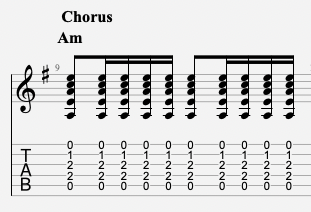
For strumming “Lucky Man”, I would use a mixture of 8th notes and 16th notes.
Here’s an example of a strumming pattern in the style of “Lucky Man”:
Conclusion
Bottom line, “Lucky Man” is an incredible song written by Greg Lake at the early age of 12!
Keep practicing, and if you want to learn songs way faster, better understand the fretboard for lead and rhythm, and not waste years spinning your wheels with guitar, grab my free fretboard guide here right now:
Jon MacLennan
Like this blog post? Get Jon’s best guitar lessons straight to your inbox.
Discover the 5 easiest and fastest ways to play the blues scale anywhere on the neck with this FREE PDF GUIDE
