The Beatles – “Lucy in the Sky with Diamonds” Chords & Guitar Lesson
Let’s go back in time to 1967…
Here’s one of the most iconic pieces of the psychedelic era.
Below, I want to share with you some insider tips on the guitar style behind it.
So grab your axe, and let’s dive into this “Lucy in the Sky with Diamonds” chords and guitar lesson!
Who wrote Lucy in the Sky with Diamonds?
“Lucy in the Sky with Diamonds” was originally written by John Lennon, but it’s credited to the Lennon/McCartney partnership of The Beatles. It appears on their groundbreaking 1967 album Sgt. Pepper's Lonely Hearts Club Band, a record that helped define the psychedelic era of popular music.
Now, many people think this song is about LSD. But its inspiration actually came from John Lennon’s young son Julian. He brought home a school picture of his classmate Lucy O’Donnell “in the sky with diamonds.” Lennon thought the phrase was interesting and transformed it into a musical journey.
“Lucy in the Sky with Diamonds” was recorded at Abbey Road Studios in 1967 during the Sgt. Pepper sessions. George Martin was at the helm producing, and the track has a very surreal sound. From the opening keyboard part, which was played by Paul McCartney on a Lowrey DSO-1 Heritage Deluxe organ. To the key changes and different sound effects. The song is one of the defining pieces of the psychedelic era.
“Lucy in the Sky with Diamonds” was never released as a Beatles single in the UK, but it became famous through album play and later chart success in the United States. The album itself won the Grammy Award for Album of the Year in 1968 and is frequently cited as one of the greatest albums in popular music history.
Now, you may be wondering…
What is the tuning for Lucy in the Sky with Diamonds?
The tuning for "Lucy in the Sky with Diamonds” as recorded by The Beatles is standard tuning. The lads from Liverpool kept things simple. Standard tuning is spelled: E, A, D, G, B, and E.
Here are the strings:
- E (6th string, lowest pitch)
- A (5th string)
- D (4th string)
- G (3rd string)
- B (2nd string)
- E (1st string, highest pitch)
All right!
Now that you know the tuning for “Lucy in the Sky with Diamonds,” let’s next talk about…
Lucy in the Sky with Diamonds Chords
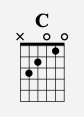
To play “Lucy in the Sky with Diamonds”, as recorded by The Beatles, you’ll need to know 11 main chords they are A, A7, D(add9)/F#, Dm, F, F#m, Dm/C, Bb, C, G5, and D. These chords are a mix of open and bar chord shapes.
If bar chords are giving you all kinds of aches and pains, and you haven’t yet discovered how to play them effortlessly, go here: https://www.jonmaclennan.com/barchords
Let’s take a look at a few ways these shapes might show up on the fretboard. (Note: these first couple of chords are the overall shapes that the keyboard arpeggiates.)
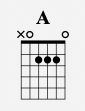
A is played in a standard open position from the 5th string down like so:
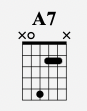
A7 reaches up and grabs the G note on the 4th string 5th fret like this:
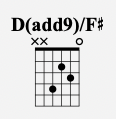
D(add9)/F# is a beautiful sounding chord played from the 4th string down like so:
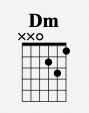
Dm is also played in a simple switch like this:
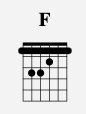
F is played as a bar chord in 1st position. It uses all 6 strings like so:
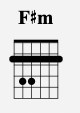
F#m shifts up to the 2nd position. I play it like this:
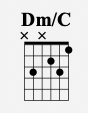
Dm/C is essentially the Dm chord above, but with the C note placed in the bass like so:
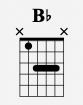
Bb is a bar chord with the root on the 5th string like this:
C is played in a typical (campfire) style like this:
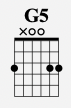
G5 is played using all the strings, except for the 5th, like so:
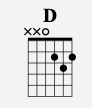
Finally, D is played from the 4th string down like this:
If you’ve struggled to understand the fretboard for RHYTHM and LEAD guitar. and want to discover the easiest and fastest way. Then get your hands on my free Fretboard Guide PDF right here now:
Is Lucy in the Sky with Diamonds hard to play on guitar?
I would say playing “Lucy in the Sky with Diamonds” on guitar, as recorded by The Beatles is going to require an intermediate to advanced skill level. The trickiest parts are all the key changes, and the opening arpegiated keyboard part played on guitar. Often when you take simple keyboard parts and move them over to guitar they can be quite stretchy in the fretting hand. So, take your time with this one.
What key is Lucy in the Sky with Diamonds in?
“Lucy in the Sky with Diamonds”, as recorded by The Beatles, is in the key of A major most of the time. However, it does change keys throughout the song. It starts in A major, then goes to F major, and then G major for the ending.
Let’s take a look at how the main chords all function in each key: Starting with the key of A major…
A
Notes: A, C#, E
Function: This is the I chord in A major, it’s “home”.
A7
Notes: A, C#, E, G
Function: This is a dominant seventh built on the tonic, which makes it non-diatonic in strict A major harmony because of the G natural. However, it’s a very common chord progression The Beatles used quite often. The G note introduces a bluesy tension and wants to shift to the D chord next.
D(add9)/F#
Notes: F#, D, A, E
Function: This is the IV chord (D major) with an added 9th (E), in first inversion with F# in the bass. It’s still a subdominant chord in A major; it creates a nice stable landing point before returning home to the tonic.
Dm
Notes: D, F, A
Function: This is not diatonic to A major because of the F natural. It is a borrowed chord from the parallel minor (A minor). The Beatles used this minor iv chord all the time in countless hit songs.
F#m
Notes: F#, A, C#
Function: This is the vi chord in A major, sometimes called the relative minor. It is one of the most important supporting chords in the key because it shares two notes with the tonic A major (A and C#), making the connection very smooth.
Next, let’s look at the chords in the key of F major…
F
Notes: F, A, C
Function: This is the I chord, the tonic of F major. It’s a temporary new home that begins in the Pre-chorus section of the song.
Bb
Notes: Bb, D, F
Function: This is the IV chord in F major, the subdominant. It’s the same idea as we saw above. Bb moves away from the tonic without creating strong tension.
C
Notes: C, E, G
Function: This is the V chord in F major, the dominant. It creates forward harmonic tension that strongly wants to resolve back to the tonic F.
Then we have the key of G major for the Chorus:
G
Notes: G, B, D
Function: This is the I chord, the tonic of G major.
C
Notes: C, E, G
Function: This is the IV chord in G major, the subdominant.
And finally…
D
Notes: D, F#, A
Function: This is the V chord in G major, the dominant. It creates strong harmonic tension that wants to resolve back to G. The F# acts as the leading tone, pulling upward to G.
Taken together, these chords create an awesome journey that the song goes on.
All right!
That’s my theory breakdown.
Next, let’s look at…
What is the strumming pattern for Lucy in the Sky with Diamonds?
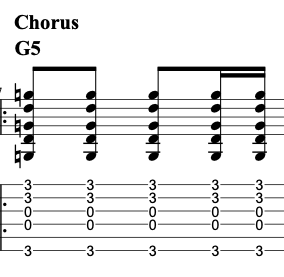
The main underlying groove for “Lucy in the Sky with Diamonds” is an 8th-note rock feel. In 4/4 time, 8th notes divide each beat into two equal parts, creating a steady rock rhythm like this:
1 & 2 & 3 & 4 &
The numbers (1, 2, 3, 4) represent the main beats in the measure, while the "&" represents the offbeats that add energy and momentum.
When counted out loud, it sounds like:
"One-and, Two-and, Three-and, Four-and."
As for the strumming pattern, I would actually use more quarter notes in the Verses and Pre-choruses, and then when I get to the Chorus, play this rhythm:
Conclusion
Bottom line, “Lucy in the Sky with Diamonds” is a legendary Beatles song. Though many think it’s about an LSD trip, its inspiration came from a simple picture drawn by Julian Lennon.
Keep practicing, and if you want to learn songs way faster, better understand the fretboard for lead and rhythm, and not waste years spinning your wheels with guitar, grab my free fretboard guide here right now:
Jon MacLennan
Like this blog post? Get Jon’s best guitar lessons straight to your inbox.
Discover the 5 easiest and fastest ways to play the blues scale anywhere on the neck with this FREE PDF GUIDE
