Michelle Chords & Guitar Lesson (Just Like The Record!)
Here's a song Paul McCartney started writing as a mock French tune to perform at parties.
It's got a soothing, melodic charm to it.
It wasn't until John Lennon told McCartney to develop it into a full song, and as they say, the rest is history…
Below, I want to share some insider tips on the guitar style behind it.
So grab your axe, and let’s dive into this “Michelle” chords and guitar lesson!
Who Wrote Michelle?
“Michelle” was primarily written by Paul McCartney, although it’s credited to the Lennon/McCartney songwriting partnership. It was featured on The Beatles’ monumental album Rubber Soul, released in 1965.
One of the other unique things about “Michelle” is that, as far as I’ve heard, this is the only Beatles song with French lyrics. McCartney sought the help of Jan Vaughan, a French teacher and wife of his friend Ivan Vaughan, to write some authentic French phrases. She contributed the iconic lines “Michelle, ma belle” and “sont des mots qui vont très bien ensemble,” which translate to “these are words that go together well.”
Lennon's input included the “I love you” bridge, inspired by Nina Simone’s rendition of “I Put a Spell on You,” adding a bluesy depth to the composition.
“Michelle” was recorded on November 3, 1965, at EMI Studios (now Abbey Road Studios) in London. The recording featured McCartney on lead vocals, acoustic guitar, and bass; Lennon and George Harrison on backing vocals and guitars; and Ringo Starr on drums.
Although not released as a single in the UK or US, “Michelle” achieved significant success in Europe, topping charts in countries like France, Belgium, and Norway.
In 1967, “Michelle” earned a Grammy Award for Song of the Year. The song has since become one of the most covered Beatles tracks.
“Michelle” showcases McCartney's exploration of fingerstyle guitar techniques.
According to McCartney from Wikipedia:
===
"Michelle" was a tune that I'd written in Chet Atkins' finger-picking style. There is a song he did called "Trambone" with a repetitive top line, and he played a bass line while playing a melody. This was an innovation for us; even though classical guitarists had played it, no rock 'n' roll guitarists had played it. The first person we knew to use finger-picking style was Chet Atkins ... I never learned it. But based on Atkins' "Trambone", I wanted to write something with a melody and a bass line in it, so I did. I just had it as an instrumental.
===
Now, you may be wondering…
What is the tuning for Michelle?
The tuning for "Michelle" as recorded by The Beatles is standard tuning. Standard tuning is spelled: E, A, D, G, B, and E. However, the main acoustic guitar part uses a capo on the 5th fret. This would now make the tuning:
- A (6th string, lowest pitch)
- D (5th string)
- G (4th string)
- C (3rd string)
- E (2nd string)
- A (1st string, highest pitch)
All right!
Now that you know the tuning for “Michelle”, let’s next talk about…
Michelle Chords
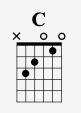
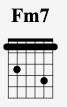
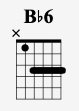
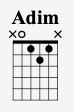
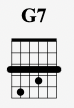
To play “Michelle”, as recorded by The Beatles, you’ll only need to know 9 main chords they are C, Fm7, Bb6, Adim, G, Cm, Eb7, Ab, and G7. It’s important to keep in mind, these are the capo chords.
Let’s take a look at a few ways these shapes can be played on the fretboard.
C is played as a standard (campfire) chord like this:
Fm7 is played as a jazzier bar chord in 1st position like this:
Bb6 is played from the 5th string down like so:
Adim looks similar to an open position D chord just shifted over like this:
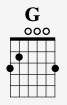
G is played in open position like this:
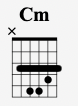
Cm is a bar chord in 3rd position with a root on the 5th string like this:
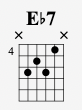
Eb7 is played on the middle strings and slightly higher up the neck like this:
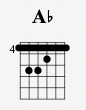
Ab is a bar chord using all 6 strings like this:
Finally, A7 is in 3rd position like this:
If you’ve struggled to understand the fretboard for RHYTHM and LEAD guitar. and want to discover the easiest and fastest way. Then get your hands on my free Fretboard Guide PDF right here now:
Is Michelle hard to play on guitar?
I would say playing “Michelle” on guitar is going to require an intermediate skill. It’s got a number of more sophisticated chords like diminished and 6th chords, a minor walk-down, and it uses a capo higher up the neck. So, take your time with this one.
What key is Michelle in?
“Michelle,” as recorded by The Beatles, is in the key of F major concert pitch. However, since the guitar has a capo on the 5th fret, I just think in the key of C major. Also, it momentarily changes keys to C minor in the bridge.
Here’s a quick look at how the chords relate in the key of C major:
C major
Notes: C, E, G
Function: This is the I chord in the key of C major.
It’s the tonic, or “home” chord. It feels stable and resolved. Most progressions in C major begin or end on this chord.
Fm7
Notes: F, Ab, C, Eb
Function: This is the iv7 chord, borrowed from the parallel minor (C minor).
It adds a soulful, emotional quality. The Beatles used this change all the time.
Bb6
Notes: Bb, D, G
Function: This is the ♭VIII chord, borrowed from the C Mixolydian mode.
It’s not diatonic to C major, but it works well in bluesy or jazz contexts.
Adim
Notes: A, C, Eb
Function: This is a diminished chord functioning as a chromatic passing chord.
Though not diatonic, it’s used as a connecting chord up from G.
G major
Notes: G, B, D
Function: This is the V chord in C major.
It leads strongly to C due to the B natural, which acts as a leading tone to C. It’s common in classical and folk progressions.
Cm
Notes: C, Eb, G
Function: This is the i chord from C minor (the parallel minor of C major).
This chord happens during the momentary key change during the bridge section.
Eb7
Notes: Eb, G, Bb, Db
Function: This is a secondary dominant (V7 of Ab) or borrowed from C minor or Eb major.
It brings a jazzy or bluesy sound and creates tension that resolves to Ab.
Ab major
Notes: Ab, C, Eb
Function: This is a ♭VI chord in the key of C major, borrowed from the parallel minor (C minor).
It adds a lush, dramatic sound and is often followed by G7.
G7
Notes: G, B, D, F
Function: This is the V7 chord in C major.
The dominant seventh adds more tension than a regular G chord and wants to resolve back to the tonic C major.
So that’s the theory. Next, let’s look at…
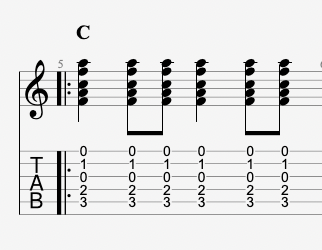
What is the strumming pattern for Michelle?
The main underlying groove for “Michelle” is a light 8th-note swing feel. In 4/4 time, 8th notes are usually counted as evenly spaced: "1 & 2 & 3 & 4 &" – but in a swing feel, they’re played with a long-short rhythm, like a triplet where the first two notes are tied and the third is played.
So instead of sounding even, they feel like:
“Dah - duh, Dah - duh, Dah - duh, Dah - duh”
You still count them as:
1 & 2 & 3 & 4 &
But the feel is more like:
“One...and, Two...and, Three...and, Four...and”
—with the “&” coming late, like it’s leaning forward into the next beat.
Here’s an example of a strumming pattern in the style of “Michelle”:
Conclusion
To wrap it up, “Michelle” started off as a charming party tune and ended up on Rubber Soul and became legendary.
Keep practicing, and if you want to improve your fingerstyle guitar faster and not waste years spinning your wheels with guitar, grab my free fingerstyle cheat sheet PDF guide right here now:
Jon MacLennan
Like this blog post? Get Jon’s best guitar lessons straight to your inbox.
Discover the 5 easiest and fastest ways to play the blues scale anywhere on the neck with this FREE PDF GUIDE
