How To Play The Minor Pentatonic Scale On Guitar
Let’s talk about how to play the minor pentatonic scale on guitar. This scale is one of the most important scales to know, whether you’re a beginner or an advanced player.
In this post, I’ll share two different ways to play the A minor pentatonic scale on guitar. We’ll cover how to practice the scale, songs that use the A minor pentatonic, and even some music theory behind it. Plus, I’ll even dive into how legend Eric Clapton uses the minor pentatonic scale as well!
So make sure you're tuned up, and let’s get started!
What is the minor pentatonic scale on guitar?
The minor pentatonic scale is a series of 5 notes per octave. It’s a simplified scale from a full minor scale that’s extremely versatile for playing solos, riffs, and melodies. The scale serves as a foundation for blues, rock, pop, and many other styles, and it’s often the first scale guitarists learn for improvisation.
It’s a great tool for understanding how melody, phrasing, and rhythm work together over chords in a minor key. For example, the A minor pentatonic scale can be used over a groove in the key of A minor, as well as any chords coming from some kind of A minor key signature. It's very flexible.
What notes are in the A minor pentatonic scale?
The notes in the A minor pentatonic scale are:
A - C - D - E - G - A
These five notes make up the A minor pentatonic scale. Each note has a unique letter name, and they create the characteristic "pentatonic" sound of the scale.
If you played the A minor pentatonic scale on a piano keyboard, you would start on the note A and play only the notes A, C, D, E, and G in sequence, which are all white keys. Then repeat as you move up the keyboard.
On the guitar, you can play the A minor pentatonic scale in various positions and across different frets.
Here is the first example I would start with:
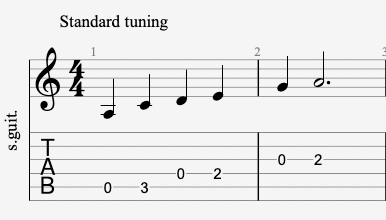
This scale pattern starts on the open A note of the 5th string. It ascends up the scale to the octave on the 2nd fret, 3rd string. The easiest way to start is to play each one of these notes with downstrums in the strum hand. Make sure you are getting each note clean and playing close to the frets.
What fingers do you use for the A minor pentatonic scale?
For the fretting hand, you generally want to match the frets to the fingers. For example, if you play a note on the 1st fret, use your 1st finger; if you play a note on the 4th fret, use your 4th finger. This is called playing “in position.” It means keeping your hand and fingers within a specific fret range of four frets so you can play the scale smoothly without excessive hand movement.
Nothing is worse than having to shift around the fretting hand in a bunch of awkward and clumsy movements.
Playing in position helps you navigate the fretboard more efficiently, develop muscle memory for scale patterns, and understand how the notes relate to each other across the neck.
What is the formula for the A minor pentatonic scale?
The formula for any minor pentatonic scale is:
Root – Minor 3rd – Perfect 4th – Perfect 5th – Minor 7th – Root
In terms of frets (starting from the root note):
3 – 2 – 2 – 3 – 2
Applied to A, the notes would be:
A - C - D - E - G - A
Whatever note you start on, plug in the formula and you’ve got a minor pentatonic scale. It’s like magic!
This pattern guarantees that the A minor pentatonic scale maintains a specific set of intervals between each note. On the guitar, you can play the A minor pentatonic scale in a ton of different ways.
Next, let’s expand on our one-octave scale above and learn the entire position.
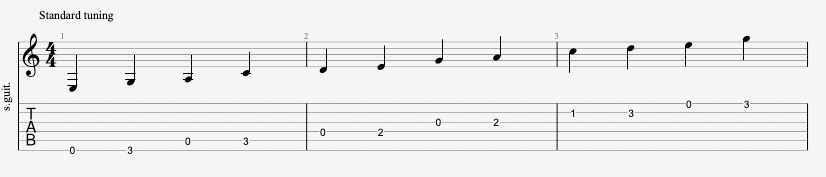
This now gives us all the notes in this specific area of the fretboard. Notice now, though, that we are not starting on the root note. Instead, we are starting on the open 6th string. This note is E.
But still, we have that first octave pattern inside this larger scale pattern.
It all connects!
How to practice the minor pentatonic scale on guitar
Practicing the A minor pentatonic scale with a metronome is a great way to start. This can help improve your timing, accuracy, and consistency.
Here are a few tips on how to practice the A minor pentatonic scale with a metronome:
- Set your metronome to a comfortable tempo. Start with a slower tempo and gradually increase it as you become more comfortable.
- Become familiar with the A minor pentatonic scale fingering and position on the guitar. Make sure you practice this in the correct sequence.
- Start by playing the A minor pentatonic scale ascending (going up) on one string. For example, you can begin on the low E string (6th string) in the full pattern above.
- Begin the metronome and make sure you're comfortable with the beat. Focus on keeping a steady rhythm.
- Play the A minor pentatonic scale slowly and accurately, matching each note with the metronome beat. Right on the money! Start with quarter notes (one note per click).
- Pay attention to your picking or plucking technique. Make sure each note is clear and articulated.
- Once you're comfortable playing the A minor pentatonic scale in this position as quarter notes you can either gradually increase the tempo. You can also experiment with different rhythms like eighth notes, sixteenth notes, etc.
- Remember to focus on accuracy, timing, and maintaining a consistent tempo throughout your practice session. It's important to start slowly and gradually increase the speed as you become more comfortable and proficient with the scale.
What songs use the minor pentatonic scale?
There are billions of songs that use the minor pentatonic scale. But below, I want to share 5 Eric Clapton tunes that use it in some of their most iconic riffs. Starting with...
1. Crossroads
Although originally written by legendary bluesman Robert Johnson, Clapton's version with Cream is phenomenal. The opening riff uses notes directly taken from the above pentatonic scale.
2. I Shot The Sheriff
This one shifts to the key of Gm. But the main riff still uses notes straight from the scale.
3. Layla
This one shifts to the key of Dm, and again, the main riff is pure D minor pentatonic gloriousness.
4. Sunshine Of Your Love
While the main riff on this one could be seen more accurately as the blues scale. Here you'll find another great example of the D minor pentatonic scale in action.
5. While My Guitar Gently Weeps
This one is a Beatles song, but Clapton's solo on it is iconic. Here are 3 sneaky ways Eric Clapton uses the minor pentatonic scale.
Conclusion:
Learning the A minor pentatonic scale on guitar is super important for both beginners and more advanced players. It's like a musical toolbox that helps you understand how music works and lets you create cool melodies and chords.
The more familiar you become with it, the more you will be able to spot it in your favorite songs.
There are many different ways to play the minor pentatonic scale across the neck, and learning each position opens up more creative freedom. If you want to learn the top patterns I recommend, then pick up my FREE Fretboard Guide PDF right here:
Happy playing!
Jon MacLennan
Like this blog post? Get Jon’s best guitar lessons straight to your inbox.
Discover the 5 easiest and fastest ways to play the blues scale anywhere on the neck with this FREE PDF GUIDE
